
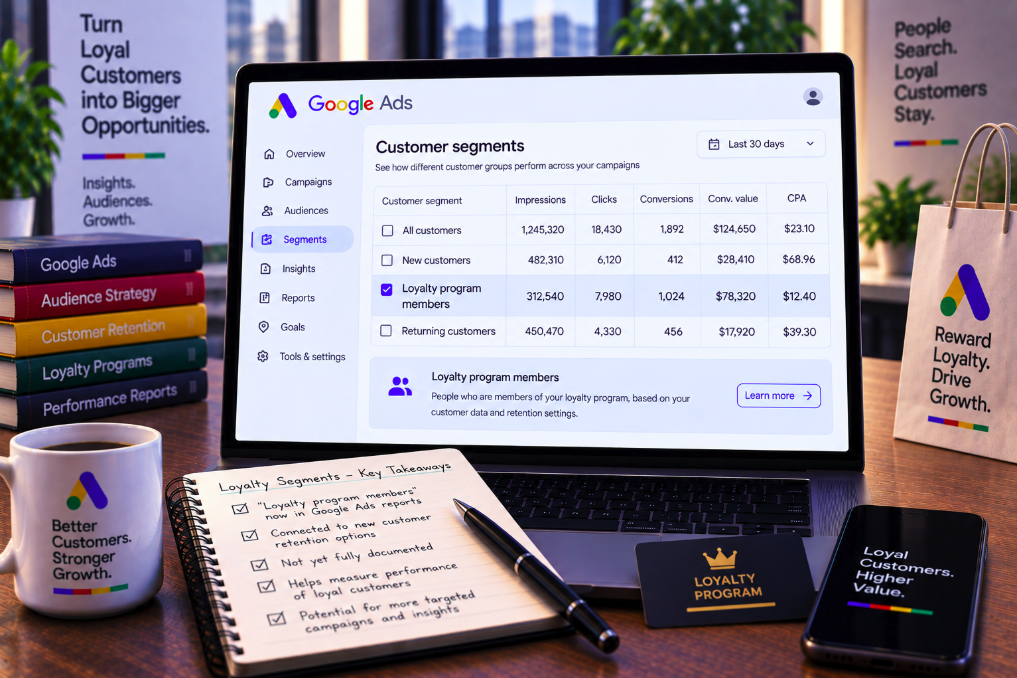
Google Ads is making loyalty customers easier to isolate inside campaign reporting, giving ecommerce advertisers a clearer view of how their existing membership base performs compared with other shoppers.
A new “Loyalty program members” option has appeared in the Segment dropdown in Google Ads campaign reports, according to a screenshot shared by Arpan Banerjee and reported by Search Engine Roundtable on September 11. The interface addition is closely connected to Google's expanding customer-retention tools for loyalty programs.
The precise timing of the UI rollout is not completely documented. Search Engine Roundtable notes that the reporting option may have arrived alongside the recent loyalty-member retention features rather than being a separate launch. Google's current help documentation, however, now explicitly describes the segment and explains what advertisers can measure with it.
That makes the feature more than a screenshot experiment. Google Ads officially instructs advertisers to open the Campaigns table, select Segment and choose “Loyalty program members” to break campaign performance down by loyalty cohorts.
The report separates members, known non-members and unknown customers
Google's official documentation for customer retention among loyalty-program members says the reporting view can divide metrics across loyalty tiers, known non-members and “Unknown” customers.
This is useful because an aggregate campaign result can hide very different customer economics. A campaign might produce an acceptable ROAS overall while performing exceptionally well among loyalty members and poorly among non-members, or vice versa.
Segmenting the report makes those differences visible without forcing the advertiser to infer them from a separate CRM report. The Google Ads table can show whether campaigns are actually reaching and driving results from the loyalty audiences the business has defined.
For retailers with tiered programs, the analysis can become more granular still. Google supports up to seven loyalty tiers, allowing advertisers to distinguish different levels of membership rather than treating every enrolled customer as one homogeneous audience.
The reporting feature is part of Google's customer-retention goal
The loyalty segment makes more sense when viewed within Google's broader customer lifecycle strategy. Google Ads now includes “Loyalty Program Members” as a customer-retention setting for Performance Max and Shopping campaigns.
Google's customer lifecycle documentation describes the setting as a way to retain valuable existing customers by optimizing campaigns to reach and re-engage members of a merchant's loyalty program.
This extends lifecycle optimization beyond the familiar new-versus-existing-customer distinction. Google can now work with several commercially meaningful states: new customers, existing customers, lapsed customers, high-value customers and loyalty-program members.
The reporting segment gives advertisers a measurement layer for one of those states rather than leaving the loyalty setting as a bidding-only control.
Customer Match provides the membership signal
To use customer retention for loyalty-program members, Google requires advertisers to provide loyalty member lists through Customer Match. These are first-party customer lists that allow Google to identify signed-in users who match the advertiser's customer data.
Merchants can create separate lists for different loyalty levels and label those levels consistently with their Merchant Center loyalty-program configuration. Google says up to seven distinct tiers can be supplied.
This is a crucial technical point because Google is not simply guessing who counts as a loyal customer based on ad behavior. The advertiser defines the loyalty membership through its own first-party data and sends the relevant lists to Google.
The quality and freshness of those lists therefore influence the usefulness of both optimization and reporting. Google recommends refreshing Customer Match lists frequently.
Loyalty reporting can show performance by tier
A single “loyalty member” category would already be useful, but tiered reporting can answer more commercially interesting questions. A retailer may have a free entry-level membership, a mid-tier program and a premium tier with higher spending requirements or benefits.
Those groups can have dramatically different purchase frequency, basket size and sensitivity to offers. If Google Ads reports them separately, the advertiser can compare conversions, conversion value and return on ad spend across membership levels.
This can expose a pattern hidden by blended averages. A premium tier may generate fewer clicks but substantially greater conversion value, while an entry tier may deliver volume at lower value.
The purpose is not merely descriptive reporting. Those insights can influence how the business values and targets different customer groups.
Google can also bid differently for loyalty members
The loyalty-member feature is not limited to measurement. Google says Smart Bidding can use the Customer Match lists to apply bid adjustments designed to reach these high-value shoppers more competitively.
That means the same first-party data can influence both campaign optimization and post-campaign analysis. The advertiser tells Google which users belong to the loyalty program, Smart Bidding can prioritize them according to the configured goal, and reporting can then show how those audiences performed.
Google currently documents the loyalty-member retention setting for Performance Max campaigns linked to a Merchant Center account and for Shopping campaigns.
Compatible value-based bidding includes Maximize conversion value with target ROAS, while Google's documentation also describes support around conversion-focused configurations depending on the campaign setup.
The report does not prove that a loyalty annotation was shown
One of Google's most important measurement caveats is easy to miss. The “Loyalty program members” segment is audience-level reporting. It identifies whether campaign activity came from loyalty tiers, known non-members or unknown customers.
It does not tell advertisers whether a specific loyalty creative treatment was actually displayed in the ad.
For example, Google can show personalized member pricing or member shipping benefits on eligible Shopping ads. A conversion attributed to a loyalty member does not automatically mean that shopper saw a “member price” annotation before clicking.
Advertisers should therefore avoid using the segment as a creative-level attribution report. It measures the customer cohort, not the exact ad annotation served to that customer.
Merchant Center provides the benefit layer
Google's loyalty strategy spans Ads and Merchant Center. Merchant Center allows retailers to define loyalty programs and benefits such as member pricing, special shipping and points.
The Merchant Center loyalty-program documentation explains that eligible benefits can appear across free listings, Shopping ads and local inventory ads. In some markets, loyalty benefits can also surface in newer AI-driven Google experiences.
Google can identify existing loyalty members through Customer Match and personalize the shopping experience with benefits relevant to their membership level.
That creates a connected system: Merchant Center describes the program and its benefits, Customer Match identifies members, Google Ads optimizes campaign delivery and the new reporting segment measures performance across the resulting customer cohorts.
Member pricing and member shipping can make the ad itself different
Google has been expanding the ability to show loyalty benefits directly in product listings. A signed-in loyalty member may see a price available only to members or a shipping benefit tied to the program.
That matters because loyalty optimization is not simply retargeting a known customer with the same advertisement everyone else sees. The ad experience can reflect the customer's relationship with the retailer.
Google's March 2026 loyalty-program update emphasized expanded member pricing and shipping benefits across additional surfaces and regions. Google said some retailers had observed up to a 20% increase in CTR when showing tailored offers to loyal customers.
That 20% figure should not be treated as a universal performance benchmark. Google presents it as an example observed among some retailers, not as a guaranteed result for every loyalty campaign.
Existing loyalty annotations do not automatically activate the retention goal
Advertisers already using member prices or member-shipping annotations should not assume they are automatically participating in the loyalty-member optimization program.
Google explicitly says campaigns are not automatically enrolled in the loyalty mode simply because those annotations are already active. Advertisers must opt into the customer-retention goal to use targeted bidding and tiered reporting.
This separation is operationally important. Merchant Center can supply personalized shopping benefits without Google Ads necessarily using loyalty membership as an optimization goal.
The new reporting segment becomes most useful when teams understand which layers they have actually configured: benefit display, audience identification, bidding optimization and reporting are related but distinct capabilities.
The loyalty segment changes how retention campaigns can be evaluated
Customer retention is often measured outside the advertising platform using CRM data, repeat-purchase rates and lifetime-value analysis. Those systems remain essential, but Google Ads can now provide an additional campaign-level view.
A retailer can inspect how much conversion value comes from loyalty members, compare that with known non-members and evaluate performance across tiers. Google recommends focusing on conversion value and ROAS when assessing these campaigns.
The report can also reveal loyalty reach. If a brand has a large membership database but only a small share of campaign activity is associated with identified members, that can prompt questions about Customer Match coverage, campaign settings or the role paid media plays in member purchases.
Conversely, an unusually high loyalty-member share can indicate that paid campaigns are heavily monetizing existing relationships rather than generating incremental demand.
Incrementality remains the harder question
Segmented reporting answers “who converted?” more easily than “would this customer have converted anyway?” A loyal customer may already prefer the retailer and may have purchased without seeing an ad.
That makes incrementality particularly important in retention advertising. Strong ROAS among loyalty members can be economically attractive while still overstating the causal contribution of paid media if those shoppers were highly likely to return organically.
Google recommends rigorous testing and monitoring loyalty-member ratios and ROAS before and after enabling the loyalty goal. Advertisers with sufficient scale should go further where possible, using controlled experiments or holdouts to understand incremental impact.
The new segment is valuable evidence, but it does not eliminate the need for causal measurement.
Known non-members create a useful comparison group
The “known non-member” category can be almost as interesting as the loyalty cohort itself. These are customers Google can classify as not belonging to the advertiser's supplied loyalty membership groups.
Comparing their performance with members can reveal whether loyalty participation correlates with stronger economics. Members may convert more often, spend more or respond differently to promotional campaigns.
That information can inform the loyalty program itself. If known non-members purchase frequently but have not joined, the retailer may have an opportunity to promote enrollment benefits more effectively.
Paid-media reporting can therefore feed back into CRM and loyalty strategy rather than remaining isolated inside the advertising team.
“Unknown” is a reminder that first-party identity is incomplete
Google also includes an Unknown customer category. This is an important reminder that not every impression, click or conversion can be confidently classified against an advertiser's loyalty data.
Matching depends on the first-party lists supplied, the identifiers available and Google's ability to associate those identifiers with users under its policies and systems.
Advertisers should not interpret Unknown as equivalent to non-member. Some unknown users may in fact belong to the loyalty program but not be recognized in the reporting classification.
The size of the Unknown cohort is therefore part of the measurement story. A large unknown share can limit the confidence of member-versus-non-member comparisons.
The rollout has evolved faster than the coverage around it
Search Engine Roundtable's report is notable because the “Loyalty program members” segmentation option had received relatively little attention despite Google's broader loyalty expansion.
Google's current help pages now document the reporting workflow clearly, but there is no single announcement establishing an exact date on which every eligible account received the Segment dropdown option.
That makes the safest framing straightforward: the capability is now officially documented, while the exact UI rollout history remains less clear.
Advertisers should check their own eligible Performance Max and Shopping campaign reports rather than assume the interface arrived simultaneously in every account.
Loyalty targeting is global, but personalized annotations are not
Google says bidding optimization for loyalty members is available globally. The display of tailored annotations such as member pricing and member shipping, however, is available only in select regions.
This creates another reason not to equate the reporting segment with the visual ad experience. An advertiser can potentially use loyalty audiences for optimization and reporting even where a particular personalized Shopping annotation is unavailable.
Merchant Center's loyalty-program availability also varies by country and feature. Google continues to expand the program, but advertisers need to check the current requirements for their market.
Global campaign strategy should therefore separate audience capability from creative-feature availability.
First-party data is becoming a reporting dimension, not just a targeting input
Customer Match has traditionally been discussed as an audience tool: upload a customer list and use it to reach or exclude known users. Google's lifecycle features are turning first-party data into something broader.
The same customer classification can now shape bidding, personalization and reporting. Loyalty tier becomes a dimension through which campaign economics can be understood.
That is strategically important as third-party identity signals become more constrained. Retailers with strong CRM and loyalty programs can provide Google with commercially meaningful customer states that are difficult to infer from a single browsing session.
The value of the data is no longer only the ability to find a person. It is the ability to tell the advertising system what kind of customer that person is.
Advertisers should align loyalty tiers across systems
Google's implementation guidance emphasizes consistent tier definitions between Merchant Center and Google Ads. If a retailer calls its levels Silver, Gold and Platinum in one system, the underlying customer lists and loyalty benefits need to map correctly across the stack.
Misaligned tiers can undermine both personalization and reporting. A customer categorized incorrectly may receive the wrong optimization treatment or make one cohort's performance look stronger than it really is.
Teams should establish a source of truth in the CRM or loyalty platform, define the eligibility logic for each tier and automate list refreshes where practical.
The reporting interface is only as reliable as the customer classification feeding it.
The new segment turns loyalty into a measurable media variable
The larger significance of the “Loyalty program members” segment is that Google Ads is making customer relationship status visible alongside familiar campaign dimensions.
Advertisers can move beyond blended performance and ask whether paid media behaves differently for a premium member, an ordinary member, a known non-member or an unidentified shopper. Those distinctions can reveal very different economics inside one campaign.
The feature should not be overstated as a completely separate product launch; it is part of Google's ongoing expansion of customer-retention and loyalty capabilities, and the exact reporting UI rollout has not been comprehensively announced. But the capability itself is now clearly documented by Google.
For ecommerce teams with mature loyalty programs, that makes first-party membership data more valuable. It can influence who Google bids for, which benefits a shopper may see and, now, how campaign performance is broken apart after the click. Loyalty is becoming not only a CRM concept but a native performance-reporting dimension inside Google Ads.