
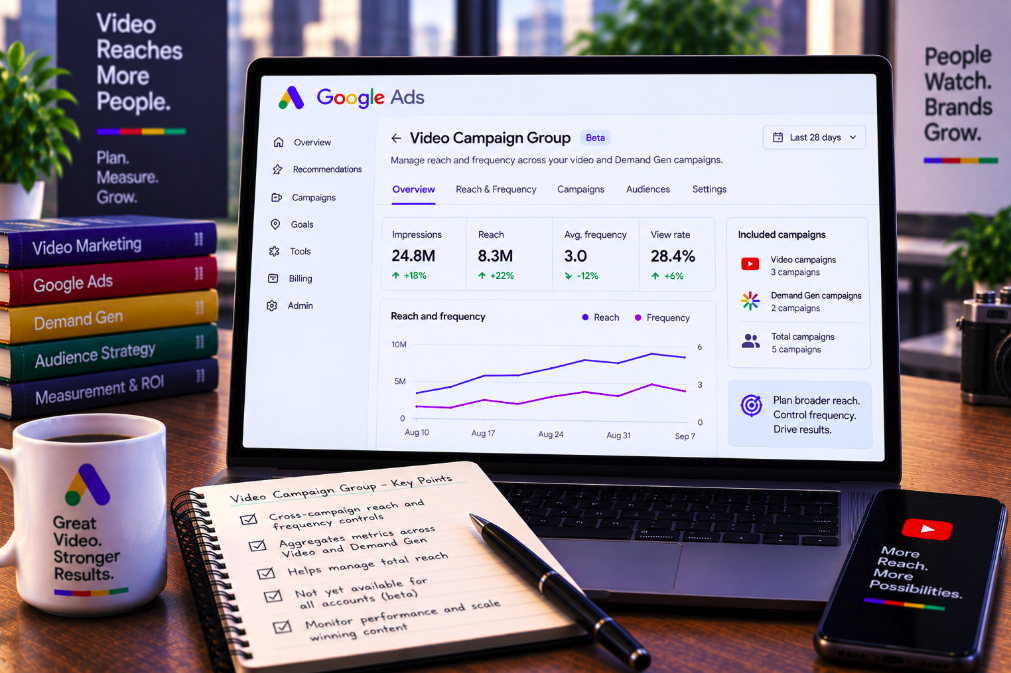
Google Ads is beta testing a new campaign-group structure that could give video advertisers something they have long struggled to manage cleanly: reach and frequency across several campaigns rather than one campaign at a time.
The new option is called “Video campaign group,” according to a Google Ads interface screenshot first shared by Vivek Gupta and reported by Search Engine Roundtable on September 11. The interface describes the feature as a way to “View aggregated metrics and control reach and frequency across campaigns.”
The beta supports Video and Demand Gen campaigns, according to the screen shown in the report. Because it is still a beta, Search Engine Roundtable notes that many advertisers will not see the option in their accounts.
That limited availability is important. Google has not published a comprehensive public rollout announcement for this specific feature, and the currently available evidence does not establish exactly which accounts, markets or Video and Demand Gen configurations are eligible. The safest interpretation is that Google is testing a new cross-campaign management layer, not that it has universally launched a new frequency-control system.
The new option appears when creating a Campaign Group
The beta was spotted in the campaign-group creation flow. Rather than treating every group as a generic organizational container, Google Ads presents “Video campaign group” as a specialized option.
The interface gives the feature two core purposes: aggregated measurement and cross-campaign reach and frequency control. It also identifies Video and Demand Gen as the supported campaign types.
Those three pieces of information are the substance of the currently observed beta. Google has not yet publicly documented a detailed setup workflow, control thresholds or the precise logic used to coordinate frequency across campaigns.
Advertisers should therefore resist filling in the gaps based on how other Google Ads frequency tools work. The concept is clear; the implementation details are not yet fully public.
Cross-campaign frequency is a real media-planning problem
Frequency is straightforward when one campaign is the only campaign reaching an audience. It becomes much harder when a brand runs several Video and Demand Gen campaigns simultaneously.
One campaign may be optimized for broad awareness, another for product consideration and another for remarketing. Each campaign can look reasonable in isolation while the same user encounters creative from all three.
That creates a portfolio-level problem. The advertiser may think it is managing frequency responsibly because no individual campaign is overly repetitive, while the user's actual exposure across the account is much higher.
A campaign group that can coordinate reach and frequency across multiple campaigns would address the problem at the level where the user actually experiences advertising.
Aggregated reach is more useful than adding campaign reach together
Reach cannot be calculated accurately by simply summing the reported reach of several campaigns. The same person may have been exposed to more than one campaign, creating overlap.
If Campaign A reaches one million people and Campaign B reaches another million, the combined audience is not necessarily two million. Hundreds of thousands of users could appear in both populations.
Aggregated measurement can account for that duplication and give planners a more realistic picture of total unique reach across the group.
The beta's emphasis on aggregated metrics therefore matters even before the control layer is considered. Better cross-campaign measurement can change how advertisers judge scale, overlap and marginal reach.
Frequency needs the same portfolio view
The same duplication problem applies to average frequency. A user who sees one campaign twice and another campaign three times has experienced five impressions from the advertiser, not two separate and unrelated exposure patterns.
Campaign-level reporting can obscure that reality. A cross-campaign group has the potential to show how often the audience is encountering the brand across the selected Video and Demand Gen activity.
That can help advertisers identify whether additional spend is expanding reach or simply increasing repetition among people already exposed.
For brand campaigns, this distinction is central to efficient media planning. The next impression has different value when it reaches a new person than when it becomes the tenth exposure for someone already saturated with the message.
The word “control” is the most interesting part of the beta
Google's interface does not merely say advertisers can report reach and frequency across campaigns. It says they can “control” them.
That implies a management function beyond aggregated dashboards, although the screenshot alone does not tell us exactly how those controls operate. Google has not publicly specified whether advertisers will set a hard cap, a target, a planning range or another type of cross-campaign constraint.
It is therefore too early to claim that the beta provides a universal account-level frequency cap. The observed language is broader and should remain broader until Google documents the mechanism.
Even so, coordinated control would represent a meaningful change from treating each campaign as an independent optimization island.
Video and Demand Gen increasingly share the same attention environment
The decision to support both Video and Demand Gen campaigns is strategically logical. Advertisers can use these campaign types to reach audiences across visually rich Google surfaces and across different stages of the customer journey.
Demand Gen campaigns can serve across YouTube and other Google inventory, while dedicated Video campaigns can pursue objectives ranging from reach to views and conversions.
From the campaign manager's perspective, those are different campaign structures. From the user's perspective, they can simply be repeated exposures to the same brand while consuming content.
A unified reach-and-frequency layer acknowledges that media experience rather than forcing measurement to follow internal campaign taxonomy.
The beta could help advertisers manage campaign overlap
Overlap is not inherently bad. Repetition can improve recall, and different campaigns can communicate different messages to the same person at different stages.
The problem is unmanaged overlap. A prospect can receive an awareness video, a product-focused Demand Gen ad and a remarketing message in a short period without the advertiser having intended that total exposure.
Cross-campaign visibility can make that pattern measurable. If Google also provides effective controls at the group level, advertisers could potentially coordinate the portfolio rather than reducing budgets manually whenever one campaign appears too aggressive.
The practical benefit would be less about eliminating repetition and more about making repetition deliberate.
Creative fatigue is another reason frequency matters
High exposure is not only a media-cost issue. Repeatedly showing the same or similar creative can reduce attention and create fatigue.
Video advertising is particularly sensitive because the format asks for more time and attention than a small static impression. A creative that is compelling on the first few exposures can become irritating when encountered too often.
Demand Gen can compound the issue if the same campaign theme appears across multiple Google surfaces while a Video campaign is running simultaneously.
A cross-campaign frequency view could help creative teams understand when poor performance is partly an exposure problem rather than simply a weak asset problem.
Frequency control can protect incremental reach
When budgets increase, advertisers often want to know whether they are buying access to more people or buying more impressions against the same people.
At lower spend levels, additional budget may expand unique reach efficiently. As saturation increases, marginal impressions can become increasingly concentrated among users already exposed.
A campaign-group view can make that tradeoff easier to evaluate across several campaigns. Instead of asking whether Campaign A can spend more, a planner can ask whether the entire video portfolio can spend more while still expanding meaningful reach.
That is a more strategic budgeting question and one that individual campaign dashboards are poorly designed to answer.
Cross-campaign measurement can improve reporting to brand teams
Executives and brand managers rarely care that one audience was reached through Campaign 17 and another through Campaign 23. They want to know how many people the overall initiative reached, how often those people saw the brand and what happened afterward.
Campaign-level fragmentation can make those simple questions surprisingly difficult. Analysts often export data into separate planning or measurement systems to estimate deduplicated reach and total frequency.
Google's beta suggests it wants to make more of that portfolio-level analysis available inside the Ads interface.
If the aggregated metrics are robust, Video Campaign Groups could become a more natural reporting unit for large video initiatives than the individual campaign.
The group could become a planning layer above campaigns
Campaign groups have historically been useful for organization and combined reporting, but the new Video-specific option points toward a more active role.
A group that can control reach and frequency is no longer just a folder. It becomes a layer of media governance sitting above the campaigns it contains.
That model resembles how large advertisers often plan media outside the ad platform. Individual campaigns execute tactics, while a broader plan defines total audience exposure and budget objectives.
Google Ads appears to be experimenting with bringing more of that planning logic into the campaign hierarchy itself.
The beta may reduce the need for manual coordination
Without a cross-campaign control, teams often manage frequency indirectly. They adjust budgets, audience exclusions, schedules, creative rotation or individual campaign settings after seeing signs of excessive repetition.
Those methods can work, but they are operationally expensive and can become inconsistent when several teams manage different campaigns.
A shared group-level mechanism could provide one place to coordinate the objective. That would be especially useful for advertisers running many campaigns around a product launch, seasonal event or major brand initiative.
However, Google has not yet documented enough about the beta to know how much manual work it will actually replace.
Demand Gen inclusion makes this more than a YouTube reporting feature
It would be easy to interpret “Video Campaign Group” as a YouTube-only planning tool. The screenshot specifically lists Demand Gen alongside Video campaigns, making the scope broader.
Demand Gen is designed around visually engaging inventory and can combine image and video assets across Google surfaces. Its inclusion suggests Google is thinking about cross-campaign audience exposure rather than one narrow campaign subtype.
That matters as campaign formats become more automated and inventory boundaries become less visible to advertisers. A user may encounter the brand across multiple Google experiences even when the advertiser thinks in terms of separate campaign products.
Portfolio-level controls become more valuable as those boundaries blur.
Advertisers should not assume every campaign can be mixed together
The observed beta says the supported campaign types are Video or Demand Gen, but it does not provide a complete public compatibility matrix.
Google Ads contains several Video campaign objectives, bidding approaches and inventory configurations. Demand Gen also has its own settings and optimization logic.
Until Google publishes fuller documentation, advertisers should not assume every subtype, objective or legacy campaign can be placed into a Video Campaign Group or governed identically.
The actual interface available in an eligible account should be treated as the source of truth during the beta.
There is no evidence this changes the ad auction itself
The existence of cross-campaign reach and frequency controls does not automatically imply a new auction ranking mechanism. Nothing in the observed interface says Google has changed how Ad Rank, bids or auction eligibility are calculated.
The feature is better understood as a campaign-management and measurement layer based on the information currently available.
If group-level frequency constraints affect delivery, Google will necessarily need to coordinate which eligible impressions are pursued, but that is different from announcing a new universal ranking factor.
Advertisers should avoid translating a beta management feature into unsupported claims about auction mechanics.
It is not yet a universal Google Ads capability
The beta label is one of the clearest facts in the current report. Search Engine Roundtable explicitly warns that many advertisers will not see the feature.
That means agencies should not promise clients immediate access or build mandatory workflows around it. Account availability may vary while Google collects feedback and tests the interface.
Beta features can also change substantially before broader release. Names, supported campaign types, controls and reporting metrics may evolve.
Teams that do receive access should document what the interface allows rather than assuming their implementation represents the final product.
Early access accounts should establish a baseline first
Advertisers who see Video Campaign Groups have an opportunity to learn from the beta, but measurement should begin before changing controls.
Record the current combined reach, frequency, spend, view metrics and conversion outcomes for the campaigns that will be grouped. Identify where overlap or high frequency already appears to be a problem.
Then make changes deliberately and observe whether the group-level controls alter unique reach, average frequency, cost efficiency and downstream results.
Without a baseline, it will be difficult to know whether the new feature improved the portfolio or simply changed delivery patterns.
Do not optimize frequency without considering creative variety
A numerical frequency target cannot fully describe the quality of repeated exposure. Seeing five different pieces of creative across a coordinated campaign can be a very different experience from seeing the identical 15-second video five times.
Cross-campaign controls should therefore be paired with creative planning. Advertisers can use different assets for awareness, proof, product education and action rather than relying on one message throughout the funnel.
If Video Campaign Groups eventually make total exposure easier to manage, creative sequencing and diversity may become even more important because teams will have a clearer picture of how often users encounter the overall program.
Frequency is a quantity; fatigue depends partly on what fills those impressions.
The feature reflects Google's move toward portfolio-level automation
Google Ads has spent years automating decisions inside individual campaigns: bidding, targeting, placements and creative combinations. The Video Campaign Group beta points toward automation and control one level higher.
Instead of optimizing only the campaign, the platform can begin coordinating several campaigns around a shared audience-exposure objective.
That is a logical progression for advertisers whose real business objective is not “make Campaign A successful.” It is to reach the right number of people, with an appropriate number of exposures, across an entire media initiative.
The campaign remains the execution unit, but the group can become the strategic unit.
The real value will depend on how much control Google exposes
The beta's promise is compelling because cross-campaign frequency is a genuine problem. The unanswered question is how much control advertisers will actually receive.
A reporting dashboard alone would be useful. A flexible mechanism that can coordinate delivery across Video and Demand Gen campaigns could be significantly more consequential.
For now, Google's interface confirms only the broad proposition: Video Campaign Groups can provide aggregated metrics and controls for reach and frequency across supported campaigns. Detailed public documentation is still limited, and availability is not universal.
That makes the feature worth watching without overclaiming what it can already do. If Google expands the beta successfully, video planning inside Google Ads may become less about controlling isolated campaigns and more about managing the total number of times a person encounters the brand across the entire campaign portfolio.