
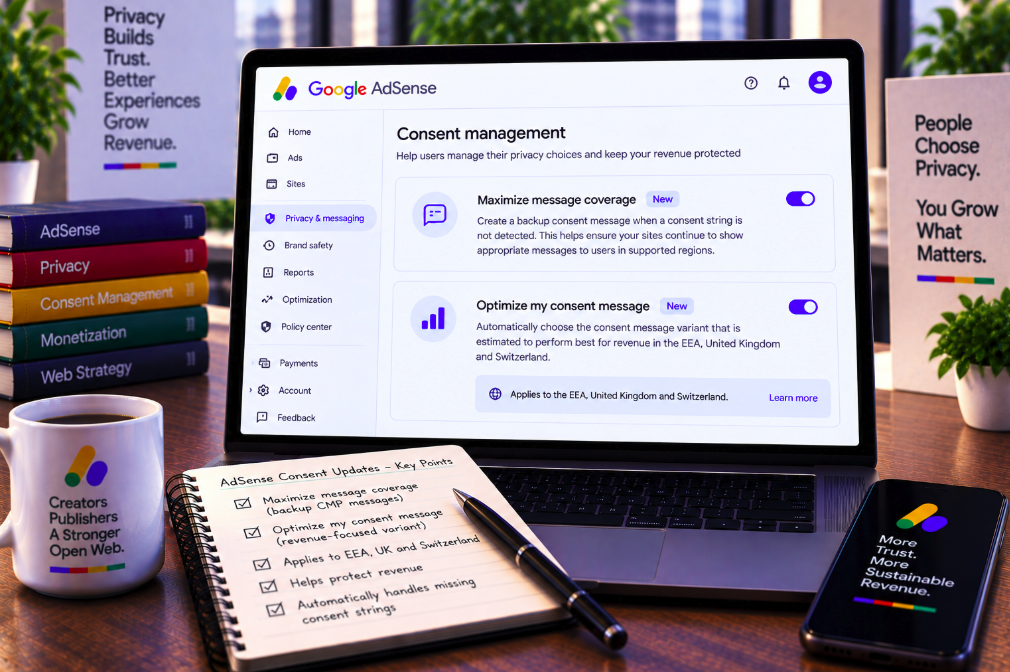
Google AdSense is automating two of the most operationally sensitive parts of publisher consent management: making sure a consent message appears when the normal CMP flow fails, and deciding which version of that message is most likely to preserve revenue.
Google detailed the changes on September 11 in an official AdSense Help announcement, alongside coverage from Search Engine Roundtable. The two controls are called “Maximize message coverage” and “Optimize my consent message,” and both apply to publisher traffic in the European Economic Area, the United Kingdom and Switzerland.
The features solve different problems. Maximize message coverage is a fallback mechanism: when Google detects that required consent information is missing, its CMP can step in and serve a consent message. Optimize my consent message is a selection mechanism: Google chooses between two consent experiences according to which one its system predicts is more likely to drive revenue.
The revenue language deserves careful interpretation. Google is not promising that every publisher will earn more, nor is it bypassing the need for valid privacy choices. The system is optimizing the consent experience within Google's documented CMP framework, while publishers remain responsible for ensuring that their implementation meets their own data-processing and compliance requirements.
Maximize message coverage acts as a CMP safety net
Google describes Maximize message coverage as an account-level control intended to improve IAB Transparency and Consent Framework coverage across all of a publisher's sites.
When the setting is enabled, Google's CMP attempts to serve a fallback consent message whenever it detects missing consent in a region where consent collection is required. Google gives several examples of how this can happen: a publisher may not have implemented a CMP, the CMP may not be integrated with the TCF, or an otherwise valid CMP may malfunction or fail to collect the user's decision.
The fallback message is served directly from the adsbygoogle tag on the site.
That architecture makes the feature a genuine safety net. The publisher's normal consent layer can fail, but the advertising tag still has a mechanism for attempting to obtain the required consent signal.
The trigger is the absence of a usable TCF consent signal
The technical issue at the center of the feature is the TC string, the Transparency and Consent string used within the IAB TCF ecosystem to communicate a user's choices.
If a site is successfully collecting end-user consent through Google's CMP or another certified CMP, Google says the fallback will not be served. The normal implementation continues to handle the visitor.
If no TCF CMP is detected when the adsbygoogle tag loads—for example because of a transient CMP error or because the site has no TCF-integrated CMP—Google can attempt to display the fallback message to visitors in the EEA, UK or Switzerland.
The feature is therefore not designed to replace a correctly functioning CMP on every page view. It is designed to cover gaps where consent collection is absent when Google expects it.
Google can automatically create consent messages for new sites
Maximize message coverage also changes what happens when a publisher adds a new site. Google says its CMP will automatically create a published consent message for every new site in the account while the setting is active.
If no custom message has been published for that site, the automatically created message uses default styles and the vendor list configured in the European regulations section of Privacy & messaging. Google's default fallback contains two buttons: “Manage Options” and “Consent.”
Publishers can later customize or unpublish the auto-created message.
This automation reduces the risk that a newly added property begins receiving regulated-region traffic before the publisher has manually configured a Google CMP message for it.
The coverage setting applies across the account
Unlike a message setting that can be configured independently for one property, Maximize message coverage operates at account level.
Google says the behavior applies to all existing sites and new sites associated with the account that use the adsbygoogle tag. It can also affect sites managed through Google Ad Manager when they use that tag.
This broad scope is operationally convenient but also means publishers should understand the consequences before enabling or leaving the control enabled. A central privacy setting can affect many sites with different designs, audiences and data-processing arrangements.
Google explicitly encourages publishers to verify that the resulting messages display correctly.
Consent optimization is a separate revenue-focused layer
The second feature, Optimize my consent message, was launched in May 2026. It does not exist primarily to fill a missing CMP gap. Instead, it chooses which consent experience an eligible visitor receives.
Google says consent optimization uses past performance and session data, including signals such as browser or location, to identify the consent message most likely to drive revenue for the publisher.
The system can select between two message types: a standard message and a limited message.
That turns consent presentation into an automated optimization decision rather than requiring the publisher to choose one universal message treatment for every eligible session.
The standard message requires an explicit decision before access
Google's standard consent message requires the visitor to make a consent decision before accessing the site's content.
This is the more familiar consent-wall interaction. The user is presented with the privacy choice and must respond before continuing into the publisher's experience.
When consent supports personalized advertising, that decision can allow the publisher to monetize through Google's personalized ad systems according to the applicable configuration.
The tradeoff is that any blocking interaction can introduce friction. Some users may abandon the page rather than engage with the consent dialog, creating a potential relationship between privacy UX and bounce behavior.
The limited message is non-blocking
Google's second option is a limited message. It does not block access to the site's content while waiting for a consent decision.
Google says this can reduce bounce rates and allow the publisher to monetize immediately through limited ads by relying on legitimate interest where configured and applicable.
This does not mean Google is simply treating a lack of consent as permission for personalized advertising. The documentation distinguishes the limited message and limited ads from the standard consent path.
Google also says that if the publisher has disabled legitimate-interest controls, the system will not serve limited messages.
Google chooses the variant it predicts will drive more revenue
The central change is automated selection. Rather than forcing the publisher to decide that every visitor should see the standard or limited message, Google's system predicts which message is most likely to drive revenue for the current session.
Past performance provides historical evidence about how different messages have performed. Session data such as browser and location gives the system context about the current visit.
Google does not publicly expose a simple rule such as “show limited messages to browser X” or “show standard messages in country Y.” The choice is presented as an optimization model based on the signals and performance information available to Google.
Publishers should therefore think of the feature as dynamic allocation rather than a static A/B split.
Revenue optimization does not mean personalized ads are always preferred
The most interesting aspect of the system is that the revenue-maximizing decision may involve showing a less obstructive consent experience rather than maximizing the number of users immediately eligible for personalized ads.
A blocking standard message can potentially generate valuable personalized-ad consent from users who proceed. But it can also create friction and contribute to abandonment.
A non-blocking limited message may generate lower advertising value per impression in some situations while preserving more page views and monetizable sessions.
Google's optimization problem is therefore broader than maximizing consent rate. According to its documentation, the goal is to choose the message expected to drive revenue, which can involve balancing user continuation against advertising value.
The two controls interact with each other
Google's September 11 announcement adds an important operational detail: in the majority of cases, both controls are enabled by default.
That means fallback consent messages and automatically created messages deployed through Maximize message coverage are generally opted into consent optimization as well.
A publisher may therefore encounter both layers at once. First, Google determines that a fallback message is needed because no functioning TCF CMP is detected. Then the consent-optimization system can determine which eligible message experience to show.
This interaction is why publishers should review both controls together rather than treating them as unrelated settings.
Turning off optimization completely requires attention to the coverage setting
Google says publishers can normally manage or disable consent optimization individually for each European regulations message through the “Optimize my consent message” control.
There is an exception for messages served through fallback consent collection under Maximize message coverage. Google currently does not support disabling optimization individually for those fallback messages.
As a result, a publisher that wants to opt out of consent optimization completely must also disable Maximize message coverage.
This dependency is easy to overlook and is one of the most important configuration details in Google's announcement.
The fallback message includes consent revocation
When Maximize message coverage is active, Google says its CMP automatically creates a consent-revocation link for messages served under the control.
This gives users a mechanism to revisit their privacy choice after the initial interaction rather than making the decision irreversible within the site experience.
Publishers should verify where that revocation mechanism appears and whether it integrates appropriately with the rest of the site's privacy experience.
Automation can generate the technical component, but it does not remove the need for UX and compliance review.
Publishers remain responsible for their consent implementation
Google's documentation contains an explicit warning that should not be lost behind the revenue-optimization headline: publishers are responsible for ensuring the consent banner works for their intended purposes.
Google also encourages publishers to evaluate whether Maximize message coverage aligns with their data-processing requirements and to verify that consent messages are displaying correctly.
That means the existence of an automated Google fallback should not be treated as a substitute for legal or technical governance. Publishers still need to understand what data they process, which legal bases they rely on and how their consent experience behaves across properties.
Google provides the tooling; the publisher retains responsibility for its implementation.
A fallback CMP should not become an excuse to ignore CMP failures
One risk of any safety-net system is that it can hide the underlying problem it was designed to mitigate.
If a third-party CMP repeatedly fails to load and Google's fallback keeps appearing, ad coverage may be better protected than it would have been otherwise. But the publisher still has a reliability issue that should be investigated.
Teams should monitor when and where fallback messages are appearing, test the normal CMP across browsers and devices and investigate changes after consent-platform deployments.
The best outcome is not merely that the fallback works. It is that the primary consent architecture works reliably enough that fallback behavior remains exceptional.
Publishers should test the user experience, not only revenue
Google's optimization objective is explicitly revenue-oriented, but publishers have additional objectives. Consent experiences can influence trust, bounce rate, engagement, accessibility and the perceived quality of a site.
A message that produces the highest short-term advertising revenue may not necessarily be the best experience for every publisher's brand or audience.
Teams should therefore monitor broader metrics when enabling automation, including engagement after consent, return visits, user complaints and the behavior of important audience segments.
Revenue is a central publishing metric, but consent is also a relationship with the reader.
The EEA, UK and Switzerland are the relevant regions
Both features are described in the context of European regulations and apply to traffic in the European Economic Area, the United Kingdom and Switzerland.
The fallback mechanism is specifically designed for cases in those regions where required consent information is missing. Consent optimization likewise chooses between eligible message types for visitors in the same geographic scope.
Publishers with global audiences should not assume that the same message logic applies identically to every country.
Regional privacy configuration remains an essential part of the implementation.
The adsbygoogle tag is becoming part of the resilience layer
Technically, one of the most notable details is that the fallback message can be served directly from the adsbygoogle tag.
Traditionally, publishers may think of that tag primarily as part of ad delivery. Under Maximize message coverage, it also becomes a detection and recovery point for missing consent collection.
This creates tighter integration between privacy messaging and monetization infrastructure. Google can detect that the expected TCF signal is unavailable and attempt to repair the consent flow before eligible personalized advertising opportunities are lost.
For publishers, that integration can reduce operational gaps but also makes it important to understand how Google-managed privacy behavior interacts with other site scripts.
Consent UX is becoming another machine-optimized publishing layer
Publishers already rely on automated systems to choose ads, optimize placements and maximize auction yield. Google's consent optimization brings a similar philosophy to the privacy interface.
The message itself becomes a variable. Historical performance and session context determine which experience Google predicts will produce the best revenue outcome.
This is a meaningful shift because consent banners have traditionally been treated as relatively static legal and UX components. They are increasingly becoming dynamic systems whose presentation can be optimized in real time.
That creates opportunity for efficiency, but it also raises the importance of governance. Privacy interactions are not ordinary conversion widgets.
The update is about protecting monetizable coverage, not bypassing consent
The most accurate way to interpret Google's two controls is as a combination of resilience and optimization.
Maximize message coverage attempts to prevent eligible traffic from falling through a consent-collection gap when a CMP is absent, incompatible or malfunctioning. Optimize my consent message then chooses between documented consent experiences according to which Google predicts will generate more publisher revenue.
Neither feature means consent requirements disappear. Google continues to distinguish standard consent from limited advertising, respects the publisher's legitimate-interest configuration and explicitly tells publishers to verify that the system fits their data-processing requirements.
For AdSense publishers, however, the operational direction is clear: Google is automating more of the machinery between privacy choice and monetization. The consent banner is no longer merely something a publisher configures once. It can now have a fallback, be automatically created for new sites and dynamically change its form according to predicted revenue performance.