
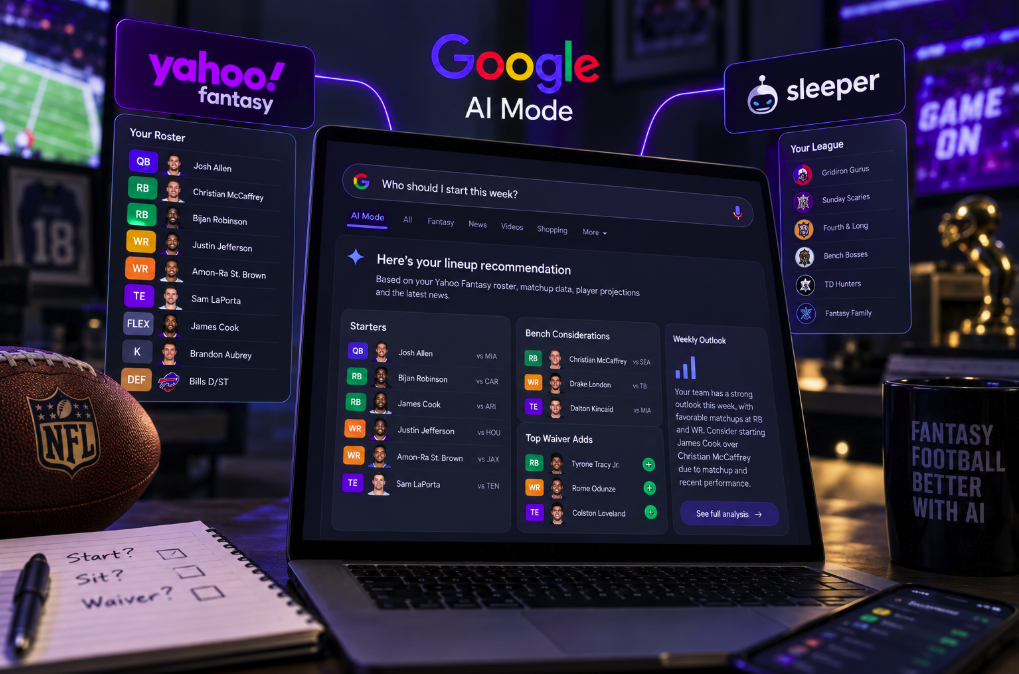
Google is turning AI Mode into something more personal than a general-purpose sports assistant. Fantasy football players in the United States can now connect their Yahoo Fantasy or Sleeper accounts to Google Search and let AI Mode use the context of their real rosters and leagues when answering questions about who to start, who to bench and which players may be worth adding.
The integration was announced as part of Google’s latest football features for Search, published on September 9, 2026. Rather than asking users to manually type out an entire roster or upload screenshots, Google says AI Mode can access the relevant fantasy context after the user securely links a supported account. The feature is currently available in the U.S. in English.
AI Mode can reason over your actual fantasy roster
The important change is the move from generic fantasy advice to account-aware recommendations. A question such as “Who should I start this week?” can now be answered with knowledge of the players actually on the user’s roster and the leagues in which that roster competes. That makes the experience fundamentally different from searching for individual player projections and then manually comparing them against lineup options.
Google specifically says the connected experience can help with start/sit recommendations and waiver-wire targets. Users can also ask AI Mode to assess their draft picks or generate a weekly recap covering what happened across their league. In other words, the integration is designed to support several stages of the fantasy season rather than functioning only as a game-day lineup tool.
The setup begins inside AI Mode. When a user asks for help with a fantasy lineup, Search can present an option to securely connect a Yahoo Fantasy or Sleeper account. Once the connection is established, Google says Search can bring in context from the user’s live roster and all of their leagues, eliminating much of the data-entry friction that normally comes with personalized fantasy questions.
Search is becoming an interface for private, connected data
For Google Search, the feature is interesting beyond fantasy football. Traditional web search generally starts with a public query and returns information from the public web. This experience combines public information with private account context, allowing the AI layer to tailor an answer around data that belongs to the individual user.
That model points toward a broader evolution of AI search. The usefulness of an answer no longer depends only on whether the system can find strong web sources; it can also depend on whether it understands the user’s current state inside another service. In fantasy football, that state includes roster composition and league context. In other categories, similar connected experiences could potentially make AI answers more actionable because users would not need to repeatedly explain their situation before asking a question.
Google’s announcement does not mean AI Mode is guaranteed to make the right fantasy decision. Start/sit calls and waiver recommendations still depend on projections, injuries, matchups, changing news and uncertainty around player performance. The significance is that the assistant can now begin its analysis from the user’s actual team rather than from a hypothetical roster.
Google is also expanding football directly inside Search
The fantasy integrations arrive alongside a wider set of football updates. Google introduced a Live Game Feed for professional football on mobile in the U.S. in English, combining an in-progress game recap with a timeline that can include play-by-play updates, social commentary, video highlights and AI-powered insights. Google says support for collegiate teams is planned later in the month, with broader international availability also expected.
Search is also adding richer league and player information. Google says users can see a carousel of scores from other games while viewing a matchup, along with league leaders and more detailed player metrics such as sacks, fumbles and yards after catch. Championship favorites and playoff brackets are also planned. Unlike the initial fantasy-account connection, Google says several of these broader Search upgrades will be available globally on mobile.
A new competitive layer for fantasy platforms
The connection with Yahoo Fantasy and Sleeper creates an unusual relationship between Google and fantasy platforms. The underlying league and roster remain in the fantasy service, but some of the analysis can now happen inside Search. For users, that could reduce the need to move between fantasy apps, player-news sites, projection tools and search results before making a lineup decision.
It also demonstrates how AI assistants can become a layer above existing applications rather than replacing them outright. Yahoo Fantasy and Sleeper provide the structured league environment; Search provides an AI interface capable of combining that private context with broader information. The value comes from the connection between the two.
For publishers in the fantasy sports ecosystem, this evolution is worth watching. If more users ask AI Mode directly for personalized lineup advice, the path from sports content to the end user may increasingly run through an AI-generated recommendation. That raises familiar questions about visibility, sourcing and referral traffic, but with an additional complication: the answer can now be personalized using data that no public fantasy article could know on its own.
Google says it plans to keep improving the fantasy feature throughout the season and is asking users to provide feedback through AI Mode. For now, the rollout is narrowly defined—Yahoo Fantasy and Sleeper connections, U.S. users and English—but it provides a clear example of where AI-powered search is heading. Search is no longer limited to answering what is happening on the web; with permission, it can increasingly answer what a user should do next based on the live data inside their own accounts.