
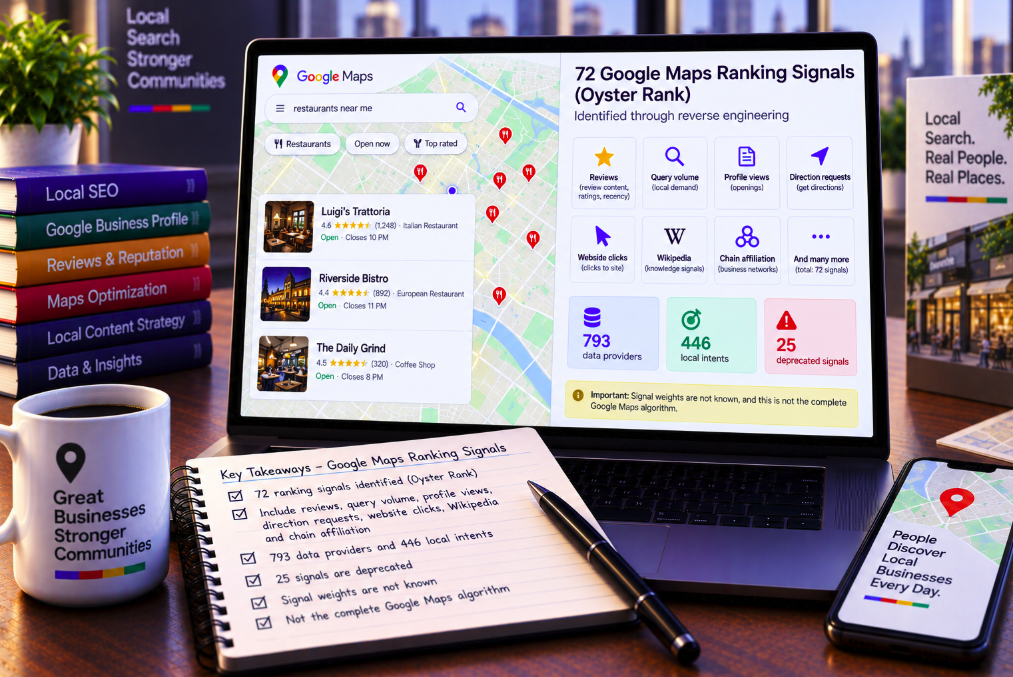
Reverse engineering of Google Maps has exposed one of the most detailed public views yet of the vocabulary behind Google's local-search infrastructure: 72 named ranking signals inside an internal Geostore system called Oyster Rank.
The list includes signals associated with Google reviews, web query volume, listing impressions and opens, requests for directions, website clicks, chain membership, Wikipedia, popularity, prominence, landmarks and road usage. The same investigation recovered 793 data-source providers and 446 local-search intent types, offering a much broader picture of how Google can construct and interpret geographic entities.
But the headline number comes with two restrictions that should stop local SEOs from turning the discovery into a 72-point ranking checklist. Twenty-five of the 72 Oyster Rank values are explicitly marked deprecated, and the researchers did not recover the coefficients that reveal how much any active signal currently contributes.
Most importantly, Oyster Rank is not the complete Google Maps algorithm. It appears to be one scoring layer inside a much larger architecture that still has to understand the query, interpret geography, generate candidates, evaluate semantic relevance, rerank results and decide what can ultimately appear on the map.
The discovery comes from reverse engineering Google's Geostore architecture
The technical investigation was published by Olivier de Segonzac in Search Engine Land on September 8, 2026.
The team obtained a binary exposing a non-public scope of Geostore, Google's system for representing geographic entities, then cross-referenced that material with Maps protocols, network traffic, the web index, mobile services, style tables, on-device components and documentation associated with Google's 2024 leak.
The newer binary supplied structures, field numbers and enumerations. Older documentation helped explain what some of those internal structures meant.
That combination makes the research more useful than simply discovering a list of unfamiliar internal names.
Oyster Rank contains 72 visible ranking signals
Geostore has an internal ranking system identified in the recovered material as Oyster Rank.
The researchers found a complete visible enumeration containing 72 signal names. Among them are Google reviews, web query volume, listing impressions, listing opens, direction requests, website clicks, chain membership, Wikipedia signals, popularity, prominence, landmark information and road usage.
The presence of those names provides unusually direct evidence that these concepts exist inside the ranking vocabulary associated with Geostore.
It does not reveal how strongly they influence a particular Maps result.
Twenty-five of the 72 signals are marked deprecated
This is the first major qualification.
Of the 72 enumerated values, 25 are explicitly labeled deprecated. A deprecated field can remain visible in code or schemas after it has stopped participating in the current production behavior for which it was originally designed.
That means a substantial portion of the recovered list should not automatically be treated as active ranking input.
Any article presenting all 72 values as current Google Maps ranking factors without this caveat would overstate what the evidence shows.
The researchers found names, not weights
The second limitation is even more important for practical SEO.
The recovered schema indicates that observations can be extracted, normalized and combined into a Feature's rank. What the researchers did not recover are the coefficients that would tell us how much each observation contributes.
A field called SIGNAL_GOOGLE_REVIEWS, for example, demonstrates that reviews belong to Oyster Rank's internal vocabulary. It does not establish that reviews account for a particular percentage of ranking, nor that one additional review moves a listing by a predictable amount.
No credible weighting formula can be reconstructed from the names alone.
Oyster Rank is not “the Google Maps algorithm”
This is the distinction most likely to disappear as the list circulates through the SEO industry.
Search Engine Land's analysis explicitly warns against treating the 72 signals as a complete Maps ranking formula. Oyster Rank appears to characterize the importance of a geographic entity inside Geostore.
A real user query still passes through additional systems involving query understanding, semantic matching, candidate generation, geography, quality assessment, reranking and result composition.
Knowing one layer's vocabulary is valuable. It is not the same as knowing the final ranking function.
Google Maps is better understood as a pipeline
A simplified model from the research looks more like a sequence than a single score.
Google first has a geographic entity represented inside Geostore. It then needs to understand what the user means, identify the geographic context, find plausible candidates, evaluate relevance and quality, reorder candidates and determine what can be rendered in the final experience.
Different signals can matter at different stages.
This explains why searching for one universal list of “Maps ranking factors” can obscure how a modern local-search system actually works.
There is also a separate on-device scorer
The investigation found another reason to reject the single-formula model.
Researchers identified a distinct scorer that runs entirely offline on the device. It contains eight signals organized across 13 tiers and is separate from both Oyster Rank and server-side Places ranking.
That indicates Google Maps can apply different ranking or prioritization mechanisms in different contexts and execution environments.
Oyster Rank is therefore one component in a network of scoring systems rather than the only ranking engine.
The 793 data providers may matter more than the 72 signals
The ranking enumeration is the obvious headline, but the provenance architecture may be more useful for understanding persistent local SEO problems.
The recovered Geostore corpus exposes 793 source providers. A business's name can come from one source, its phone number from another, its category from another and its geometry from somewhere else.
Google can retain provenance at the field level rather than treating a listing as one indivisible record.
This helps explain why the information a business owner enters into Google Business Profile is not necessarily the only evidence Google uses to define that business.
A Google Business Profile is not the underlying entity
One of the strongest conceptual takeaways from the research is the distinction between the listing and the entity.
Google represents geographic objects internally as Features. A Feature can describe a business, building, road, city, station, area, transit element or even a three-dimensional object.
For a business, that entity can contain identity, geometry, source information, websites, chain relationships, Knowledge Graph references, concepts and ranking information.
The familiar Maps listing is assembled later. Google Business Profile is an interface through which owners contribute information; it is not necessarily the canonical entity Google maintains underneath.
This can explain why Business Profile edits sometimes revert
Local businesses frequently encounter a frustrating pattern: an owner corrects an attribute, only to see the old value return later.
The Geostore architecture offers a plausible technical explanation.
An owner edit enters a system that may already contain conflicting evidence from several providers. Google has mechanisms for provenance, source priority, trust and conflation—the process of deciding how multiple records describing the same real-world object should be reconciled.
The edit is therefore another piece of evidence, not necessarily an unconditional overwrite of Google's canonical representation.
Trust appears to exist at the source level
The recovered structures include mechanisms for different trust states associated with source information.
Search Engine Land describes levels ranging from blocked or untrusted sources through trusted and super-trusted sources.
This suggests that two identical factual claims can be treated differently depending on their provenance.
For local SEO, consistency across authoritative sources may therefore be more strategically important than repeatedly changing a single profile field while conflicting evidence remains elsewhere.
Conflation is central to local entity management
Conflation is the process of deciding whether multiple records describe the same real-world place and how their attributes should be combined.
This is fundamental to Maps because local data is messy. Businesses move, rebrand, change phone numbers, operate multiple branches, share addresses or close and reopen under different ownership.
A system built from hundreds of providers needs to resolve those conflicts before ranking can even become meaningful.
That makes entity identity a prerequisite to visibility rather than merely another optimization tactic.
Google recovered 446 local-search intent types
The investigation also exposed 446 intent types associated with local search.
This provides another reason not to reduce Maps ranking to category matching and distance.
Google can interpret local searches through a rich semantic layer describing what kind of place, action, attribute or situation the user may be looking for.
A query for a late-night pharmacy, a scenic restaurant, a child-friendly museum and a wheelchair-accessible entrance can all require different combinations of concepts and geographic constraints.
Categories and concepts are not the same thing
Google Business Profile categories are important administrative labels, but a semantic local-search system can reason beyond those fixed categories.
An entity can be associated with concepts, attributes, Knowledge Graph identifiers and evidence from the wider web.
That means a business may become relevant to a query because Google understands what the business offers or represents, even when the user's wording does not exactly match the primary category name.
This aligns local SEO more closely with entity and semantic search than with simple category selection.
Reviews are part of the vocabulary, but their exact role remains unknown
The presence of Google reviews among Oyster Rank's named signals will attract obvious attention.
Reviews already matter commercially because they influence consumer trust and provide descriptive language about products, services and experiences. The recovered enumeration confirms that review-related information also exists inside Oyster Rank's ranking vocabulary.
What it does not reveal is the active weighting, the precise review features extracted, how those features interact with query relevance or whether their influence changes by vertical.
“Get more reviews because they are 12% of Maps ranking” is not a conclusion supported by this research.
Query volume suggests real-world demand can become an entity signal
Web query volume is another notable name in the enumeration.
Conceptually, search demand associated with an entity can act as evidence of prominence or real-world interest. A restaurant, landmark or brand frequently searched by name is different from an otherwise similar entity that almost nobody seeks out.
But again, the internal label does not tell us the calculation method or weight.
It should be interpreted as evidence that query-demand information exists in the system, not as an invitation to manufacture branded searches.
Listing opens and impressions appear in Oyster Rank too
The recovered vocabulary also contains listing impressions and listing opens.
These names suggest that interaction with Maps entities can feed internal observations used by Geostore's ranking layer.
The temptation will be to call them direct behavioral ranking factors. The evidence does not justify that level of specificity because the schema does not expose the current coefficients, anti-abuse logic, normalization or contexts in which the fields are active.
Behavioral signal names are not a license to engineer artificial engagement.
Direction requests are a particularly local form of interaction
A request for directions is qualitatively different from a generic web click.
It can indicate that a user intends to physically visit a place, making it a potentially meaningful observation in a geographic system.
Oyster Rank's visible enumeration includes direction requests, confirming that the concept exists in the recovered ranking vocabulary.
What remains unknown is whether all requests are treated equally, how they are normalized by business size or category and how abuse is detected.
Website clicks connect Maps with the wider web
Website-click signals reinforce another theme of the research: Maps is not isolated from web search.
A local entity can be connected to websites, Knowledge Graph identifiers and broader web evidence. The click from a listing to an official site is one possible interaction within that ecosystem.
This weakens the idea that local SEO consists only of optimizing Google Business Profile.
The business's website and its broader entity footprint remain part of the information environment Google can use to understand the place.
Wikipedia signals show the connection to entity knowledge
Wikipedia appears explicitly among the named Oyster Rank signals.
That does not mean every local business needs or deserves a Wikipedia page. Most do not meet Wikipedia's independent notability requirements, and creating promotional pages is not a legitimate local SEO strategy.
The more important insight is architectural: Google can connect geographic entities with broader knowledge sources used to establish prominence, identity and context.
For notable landmarks, institutions and well-known organizations, those connections can help define the entity beyond its Business Profile.
Chain membership is part of the model
The recovered signals include business-chain relationships.
That matters because a chain location is simultaneously an individual geographic place and a member of a larger brand network.
Google needs to understand both levels to answer queries accurately, resolve duplicate entities and interpret brand demand.
The existence of a chain signal does not establish whether chain membership is beneficial or harmful to ranking. It shows that the relationship itself is represented.
Landmarks and road usage reveal how broad Geostore really is
Some Oyster Rank signals extend well beyond conventional business SEO.
Landmark information and road usage make sense because Geostore represents geographic objects generally, not merely commercial listings.
A road, station, public space or landmark can require different importance signals from a restaurant or dentist.
This is another warning against treating every one of the 72 values as a tactic relevant to every local business.
One enumeration can serve many types of geographic entities
Because Geostore Features can represent multiple kinds of real-world objects, some signals may apply only to particular entity classes or contexts.
A signal useful for road ranking may be irrelevant to a retail store. A landmark-specific field may matter for tourist attractions but not service-area businesses.
Without the missing weighting and activation logic, SEOs cannot know which fields participate in which query pathways.
The 72 names are therefore a map of possible internal concepts, not 72 universal levers.
Google's rendering layer adds another distinction between ranking and visibility
Even after an entity is retrieved and ranked, Google still has to decide what appears visually on the map.
Maps has limited screen space and different zoom levels, device sizes, map styles and user contexts. A place can be relevant without receiving a visible label at every zoom level.
The investigation recovered 50,998 Mapcore styles and 12,936 label styles, illustrating how extensive the presentation layer is.
Ranking and map rendering are related but not identical problems.
The research recovered 10,936 searchable Geostore declarations
The archive built from the reverse-engineering work contains 10,936 searchable Geostore declarations.
Researchers can inspect message names, package names, field types, documentation text, tag numbers and status information.
This is useful because internal terminology can quickly mutate into unsupported SEO theories once screenshots and isolated names circulate online.
Making the underlying declarations searchable gives analysts a way to distinguish recovered evidence from speculation built around that evidence.
The practical lesson is entity completeness, not signal chasing
The strongest strategic implication is not to optimize individually for 72 internal labels.
Businesses should instead make it easy for Google to construct a coherent, accurate geographic entity. That means maintaining correct business information, a crawlable and informative official website, consistent location details, legitimate reviews, clear relationships between branches and brands, and reliable evidence across relevant external sources.
Those practices help multiple parts of the local-search architecture at once.
They are also more durable than attempting to manipulate one newly discovered field whose weight may be zero, contextual or deprecated.
Fix conflicting information beyond Google Business Profile
When a profile repeatedly reverts to an incorrect phone number, category or location attribute, the Geostore model suggests looking beyond the profile itself.
The same incorrect value may exist on the official website, a major directory, a data provider, an old branch page or another source Google trusts.
Correcting the broader evidence can be more effective than repeatedly resubmitting the same edit.
Local entity management therefore becomes a data-consistency problem as much as a profile-management problem.
Do not manufacture behavioral signals
The appearance of impressions, opens, direction requests and website clicks will inevitably attract manipulation attempts.
That would be a poor interpretation of the research.
Google operates at enormous scale and has extensive anti-abuse systems. The recovered names reveal neither how interactions are validated nor how suspicious activity is discounted.
Generating fake directions, artificial profile opens or manufactured searches can violate platform policies and contaminate the very behavioral data a business wants Google to trust.
Reviews should be improved as a business system, not a ranking hack
The same principle applies to reviews.
Businesses benefit from legitimate customer feedback because it improves trust, reveals service problems and gives prospective customers richer evidence. The Oyster Rank discovery adds another reason to take reviews seriously, but not a justification for buying or fabricating them.
Review quality, authenticity and descriptive usefulness are more sustainable goals than chasing a numerical count because an internal signal name was recovered.
The weights remain unknown anyway.
Local SEO tools should resist fake precision
Whenever internal ranking terminology becomes public, software vendors and consultants face pressure to convert it into scores.
A tool might be tempted to assign arbitrary percentages to reviews, directions, clicks and Wikipedia because the labels now have documentary evidence.
That would create a false level of certainty. The recovered material explicitly lacks the coefficients needed for such calculations.
A responsible audit can identify whether relevant entity evidence exists without pretending to know Google's proprietary weighting.
The 25 deprecated signals are a warning about leaked systems data
Internal code accumulates history.
Fields can survive after experiments end, systems migrate or ranking logic changes. Deprecated labels are especially useful because they demonstrate how easy it would be to mistake an old mechanism for an active one.
This is a broader lesson for interpreting leaks and reverse engineering.
The existence of an internal name proves existence in the recovered artifact; it does not automatically prove present-day production influence.
The weights could also vary by context
Even if the missing coefficients were recovered, a single global weighting table might still be an oversimplification.
Local-search systems can behave differently by query type, geography, entity class, device, freshness requirements and available evidence.
A signal associated with landmark prominence may be critical for one retrieval problem and irrelevant for another.
Modern ranking systems frequently combine models and context-dependent features rather than applying one static formula to every search.
Proximity remains only one part of geographic retrieval
Local SEO discussions often reduce Maps to distance from the searcher.
The recovered architecture shows a more complicated interaction among entity importance, semantic intent, geography and candidate generation.
Distance can constrain or influence candidate selection without explaining the entire ranking.
This is why two users in similar locations can receive different results when their query wording, context or interpreted intent changes.
Semantic relevance can override simplistic radius thinking
The 446 local intent types suggest Google has a rich vocabulary for understanding what users want from places.
A search system can widen or narrow its geographic candidate set depending on the scarcity and relevance of matching entities.
A highly specific query may justify retrieving a more distant business if nearby candidates do not satisfy the interpreted intent.
That makes fixed-radius local SEO theories less useful than understanding how geography interacts with relevance.
Local visibility increasingly connects SEO, Maps and the Knowledge Graph
The recovered Feature structure includes Knowledge Graph references and websites alongside geographic information.
This supports an entity-first view of local search in which Google's understanding of a business is assembled across systems rather than confined to one product interface.
The official site establishes facts and relationships. Business Profile supplies owner-managed local data. Reviews contribute customer evidence. External sources contribute corroboration and prominence. Knowledge systems connect the place to broader concepts.
Local SEO becomes the practice of keeping those representations coherent.
Conversational Maps makes the entity layer even more important
Google Maps is increasingly capable of answering natural-language questions about places rather than only returning category lists.
A conversational query can ask for attributes that do not map neatly to one Business Profile field.
To answer well, Google needs a richly described entity connected to semantic concepts and evidence.
The recovered architecture helps explain why the future of local visibility may depend less on exact category manipulation and more on whether Google's underlying representation contains enough trustworthy information to satisfy complex intent.
What local businesses should actually do with this research
The safest response is operational rather than tactical.
Audit whether Google's core facts about each location are correct across the official website, Business Profile and major authoritative sources. Make location pages genuinely useful. Keep brand and branch relationships explicit. Earn authentic reviews. Ensure contact, opening-hour and service information is current. Resolve duplicates and contradictory records.
Those actions improve the quality of the entity Google is trying to construct.
They do not depend on guessing an Oyster Rank coefficient that nobody outside Google currently knows.
What the 72 signals genuinely reveal
The Oyster Rank enumeration is valuable because it replaces some speculation with internal vocabulary. Google reviews, query volume, listing interactions, direction requests, website clicks, chain relationships and Wikipedia-related information are not merely concepts invented by local SEO case studies; they appear in a recovered Geostore ranking enumeration.
At the same time, 25 of the 72 values are deprecated, the weights were not recovered and the enumeration covers only one layer of a much larger Maps architecture. Query understanding, semantic matching, candidate generation, geography, quality, reranking, personalization, on-device scoring and rendering can all affect what a user ultimately sees.
The more consequential discovery may be the infrastructure around Oyster Rank: 793 data providers, 446 local intents and a canonical entity model capable of reconciling conflicting evidence from many sources.
That points toward a more durable local SEO strategy than chasing 72 supposed factors. The listing is only the interface. Google's underlying entity is the thing being understood, reconciled, retrieved and ranked—and the reverse engineering shows just how much larger that system is than a Google Business Profile.