
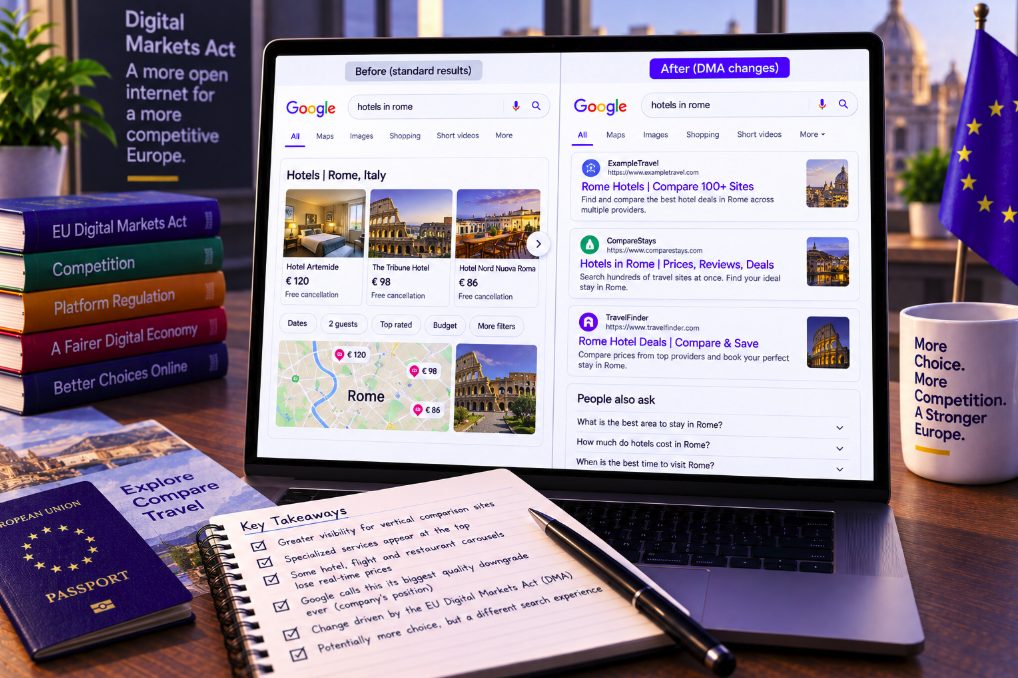
Google Search in Europe is beginning to look materially different from Search elsewhere in the world, and Google says the latest regulatory redesign is the most damaging change to the quality of its search service in the company's history.
The new European results format gives specialized vertical search services—comparison and aggregation platforms in categories such as hotels, flights and restaurants—more prominent positions. According to Reuters, one specialized search service can appear prominently at the top of the results, followed by two additional services with less information. Traditional category carousels can remain below, but some of the rich functionality users previously saw, including real-time pricing, is being stripped out.
Google describes the redesign as the largest reduction in Search quality in its 29-year history. That is an extraordinary statement, but it is also Google's position in a long-running regulatory dispute. It should not be presented as an independently established fact about user experience.
The European Union sees the issue through a different lens. The Digital Markets Act is designed to prevent designated gatekeepers from unfairly favoring their own services and to make digital markets more contestable. From that perspective, giving independent comparison services more visibility can be a competition remedy even if the resulting interface is less convenient by Google's preferred product-quality measures.
The new European SERP puts specialized search services first
The most visible change is the hierarchy of results.
Reuters reports that the redesigned page can highlight one specialized search engine at the top, followed by two other vertical services with fewer details. These services can include travel comparison and aggregation businesses operating in sectors such as accommodation, airlines and restaurants.
Google's algorithm still determines the ranking among eligible results.
What changes is the amount and location of search real estate reserved for these intermediaries relative to Google's own specialized search experiences and direct supplier results.
Hotel, flight and restaurant carousels can lose real-time prices
The redesign is not only about moving links upward.
Some category carousels remain on the page but with reduced functionality. Reuters says key features such as real-time prices are removed from examples involving hotels, airlines and restaurants.
That can change the task the searcher completes directly inside Google. Instead of comparing live offers immediately in the SERP, users may need to click into a comparison service or supplier website to see current pricing and availability.
Google argues that this creates more friction. Supporters of the DMA can counter that moving the commercial interaction outside Google's interface gives competing services a greater opportunity to participate.
Google calls it the biggest quality reduction in Search history
Google's language is unusually strong.
As summarized by Search Engine Land, the company told Reuters that the changes represent the largest reduction in quality of service at Google Search in its 29-year history.
That claim deserves attention because Google has redesigned Search repeatedly across desktop, mobile, local, shopping, travel and AI experiences. Saying a regulatory change is worse than every previous product compromise is a deliberate escalation in the company's public criticism of the DMA.
It remains a corporate assessment rather than a neutral quality score.
There is no universal metric for “search quality” here
The dispute exposes a fundamental problem with the word quality.
Google can measure how quickly users complete tasks, whether they reformulate queries, how often they click back, whether they reach direct suppliers and how useful people find rich features. Those signals can support a product-quality argument.
Regulators are evaluating a broader market structure. A result page that lets Google answer a hotel query more efficiently could still be problematic if Google's own vertical product receives an advantage that competing comparison services cannot realistically overcome.
A page can therefore become less efficient for some users while becoming more contestable for competing businesses. Those are different objectives.
The DMA is trying to limit gatekeeper self-preferencing
The Digital Markets Act imposes obligations on large platforms designated as gatekeepers.
For Search, one central concern is whether Google gives its own specialized services preferential treatment compared with third-party services that compete for the same user journey.
Travel is the clearest example. Google can provide maps, hotel modules, flight information, prices, ratings and booking pathways directly inside Search. Comparison services argue that such integrations can push their links lower or make clicking them less necessary.
The European redesign attempts to create more visible pathways to those competitors.
Google says comparison sites benefit more than direct suppliers
Google's objection is not simply that its own products lose prominence.
The company argues that the DMA implementation can shift traffic toward large intermediaries such as comparison sites while making it harder for hotels, airlines, restaurants and merchants to reach customers directly.
In earlier DMA compliance updates, Google said it had already made more than 20 changes to Search in Europe and claimed that some direct suppliers reported free direct booking clicks falling by as much as 30% after the original changes.
That 30% figure is Google's reported evidence from affected businesses, not an independently audited estimate for every European supplier.
The latest design can favor intermediaries over businesses themselves
This is one of the most politically difficult parts of the DMA Search debate.
A regulation intended to constrain a dominant intermediary can produce a result in which other intermediaries gain visibility. A hotel seeking a direct booking may compete not only with Google's hotel interface but with Booking.com, Expedia and other comparison platforms receiving dedicated prominence.
Google uses that outcome to argue that the changes do not necessarily help small businesses.
The counterargument is that competition law does not guarantee direct suppliers the highest position either. Its immediate concern is preventing a gatekeeper from structuring the market around its own vertically integrated services.
The European SERP is becoming structurally different
For SEO professionals, this is more than a regulatory headline.
Google's result-page architecture in Europe is diverging from what users may see in other regions. The same commercial-intent query can produce different modules, different information density and different opportunities for intermediaries and direct suppliers.
That means international SEO teams can no longer assume that a screenshot or ranking analysis from the United States accurately represents the European search experience.
Region-specific SERP monitoring is becoming essential.
A number-one organic ranking may not mean the same thing visually
Traditional rank tracking compresses a complicated result page into a number.
If a query triggers a specialized-search unit above conventional organic results, the first blue-link result can be pushed substantially farther down the visible page. A site can remain “position one” in an organic tracker while losing visual prominence and click opportunity.
The DMA redesign increases the importance of measuring actual SERP composition rather than only rank position.
For travel, restaurants and other affected verticals, marketers need to know which modules appear before their listing and what information those modules contain.
Vertical comparison sites may gain a new SEO advantage
The new units create obvious opportunities for comparison services.
A platform selected for the prominent specialized-search positions can receive visibility that previously belonged to Google's own vertical modules or to other page elements.
This may increase the value of being eligible, relevant and competitive within Google's vertical-service ranking systems.
However, the redesign does not guarantee permanent placement to any named comparison brand. Reuters reports that Google's algorithm determines the rankings.
Direct suppliers need to monitor referral mix
Hotels, airlines and restaurants should pay particular attention to how the changes affect where bookings originate.
A business may see fewer direct organic visits from Google while receiving more traffic or bookings through an intermediary. That can alter acquisition economics even if total demand remains stable.
Direct traffic generally gives suppliers more control over customer relationships, merchandising and fees. Intermediary traffic can provide reach but may carry commissions or weaker ownership of the customer journey.
SEO reporting should therefore track channel quality, not merely total search visibility.
Real-time price removal changes user intent signals
Rich prices in the SERP do more than save a click.
They let users filter options mentally before visiting a website. A traveler seeing that one hotel costs €120 and another €260 arrives at the next page with stronger expectations and a more advanced purchase decision.
If those prices disappear from the Google interface, clicks may occur earlier in the decision process.
That could change conversion rates, bounce behavior and the relative value of traffic even when click volume stays similar.
Comparison sites may become the place where the richer decision happens
Removing information from Google's own carousel does not eliminate the user's need for that information.
It can move the comparison step to another website.
If a vertical service receives prominent placement and offers live prices, availability, filters and reviews after the click, it may capture more of the research journey that previously happened directly on Google.
This is precisely why the design has competitive consequences beyond cosmetic SERP changes.
The change follows years of DMA experimentation
Google did not arrive at this format overnight.
Before the DMA took full effect, the company said it would test dedicated units containing links to comparison sites and query shortcuts that could focus results on comparison services. Its early DMA preparations also described dedicated spaces where comparison sites and direct suppliers could show richer information.
Google subsequently tested multiple formats and publicly argued that some changes reduced direct traffic to suppliers.
The latest redesign is another stage in a regulatory negotiation that has been unfolding through live product experiments.
Google has already removed or reduced other European Search features
Earlier compliance changes affected features beyond the current vertical-service layout.
Google has said DMA implementation led it to remove or reduce certain Search functionality in Europe, including aspects of flight information and clickable maps.
These changes reflect a broader tension: many Google Search features work by integrating information from other services into the result page.
The more Google integrates, the more useful the interface can become for some tasks—but the greater the regulatory concern that Google's own services can occupy privileged positions.
Reuters reports the changes followed EU enforcement pressure
The latest redesign comes in the context of continuing European Commission scrutiny and financial penalties.
Reuters reports that the changes were introduced as Google sought to comply with the DMA and avoid further fines after EU enforcement actions concerning its conduct as a gatekeeper.
This matters because the product design is not simply a voluntary A/B test aimed at improving engagement.
It is a compliance response shaped by legal obligations and negotiations with regulators.
Google's incentives should be part of how its quality claim is read
Google has a legitimate product interest in preserving features it believes users prefer.
It also has a commercial and legal interest in arguing that regulatory restrictions make its service worse. Demonstrating consumer harm can strengthen its case for a less restrictive interpretation of the DMA.
That does not make the company's quality concerns false.
It means journalists, marketers and analysts should attribute the claim clearly instead of presenting “biggest quality downgrade ever” as a neutral empirical conclusion.
Comparison services have different incentives
Vertical search companies likewise have commercial interests.
They benefit when Google is required to give them more visibility and when users leave the Google results page to complete comparison tasks elsewhere.
Their argument that greater access improves competition should therefore be evaluated with the same awareness of incentives.
The policy debate is not between an interested company and disinterested critics. It involves competing businesses, regulators, direct suppliers and consumers with different definitions of a desirable search market.
Users may experience more clicks before completing a task
Google's strongest consumer-facing criticism is friction.
If Search previously displayed live prices, availability and direct comparison tools, removing those features can require users to visit additional pages before making a decision.
For a straightforward hotel or flight query, that may feel like a regression.
The DMA's policy bet is that some additional friction may be acceptable if it prevents one gatekeeper from absorbing too much of the commercial journey into its own interface.
More choice does not always look like more convenience
Competition policy and interface design optimize for different things.
A highly integrated product can be exceptionally convenient because one company controls every layer. A more open market can expose more providers and pathways while asking users to make additional choices.
The European Google Search redesign makes that tradeoff visible on the page itself.
Whether the outcome is better depends partly on whether the evaluator prioritizes immediate task completion, long-term market competition, supplier access or intermediary diversity.
SEO teams should segment Europe from other regions
For businesses operating internationally, Europe should increasingly be treated as a distinct search environment.
Reporting should separate European Economic Area traffic and SERP behavior where practical, especially in verticals directly affected by DMA units.
Teams should compare impressions, clicks, CTR, direct bookings, intermediary referrals and conversion rates before and after layout changes.
A global organic dashboard can conceal substantial regional shifts if U.S. performance remains stable while European result pages change structurally.
Travel SEO needs more than traditional blue-link monitoring
Hotel and airline marketers should capture screenshots or structured SERP-feature data for high-value queries.
The relevant questions now include which vertical services appear, whether prices are shown, whether supplier modules remain visible, how much screen space each unit occupies and how the layout differs by country and device.
This information can explain traffic movements that rankings alone cannot.
A stable ranking with a falling CTR may be a SERP-design problem rather than a relevance problem.
Comparison-platform visibility becomes part of distribution strategy
Direct suppliers may need to treat prominent comparison services as distribution channels rather than merely organic competitors.
If a specialized service consistently occupies one of the DMA-created positions, being accurately represented there can become important even for businesses whose preferred outcome is a direct booking.
That creates an uncomfortable but practical reality: regulation intended to constrain Google's intermediation may increase the strategic importance of other intermediaries.
Businesses need to evaluate the economics channel by channel.
Local data consistency becomes more important
Restaurants and hotels appear across multiple ecosystems: their own sites, Google Business Profiles, online travel agencies, review platforms and vertical comparison services.
As more of those third-party services gain prominent SERP positions, inconsistent pricing, opening hours, addresses, availability or descriptions can create a fragmented user journey.
Maintaining accurate structured data and partner feeds becomes more important when users can enter through several intermediaries before reaching the business.
That is a durable operational lesson regardless of how the DMA dispute is ultimately resolved.
The redesign could change click distribution without changing demand
A fall in direct Google traffic does not necessarily mean fewer people are searching for hotels, flights or restaurants.
The same demand can be redistributed across comparison sites, direct suppliers and Google's remaining modules.
Marketers should therefore distinguish demand loss from channel displacement.
Search Console, analytics, booking systems and partner-platform reports need to be read together to understand where the user journey moved.
Attribution may become harder
Additional intermediary steps can complicate attribution.
A user may discover a comparison service through Google, evaluate several suppliers there, later search a hotel brand directly and finally book through another channel.
Last-click reporting can assign the conversion to the final touch while hiding the DMA-created discovery path that influenced it.
Travel marketers may need stronger multi-touch or incrementality analysis as European SERPs send users through more varied pathways.
Google's algorithm still controls a critical layer
The DMA redesign increases visibility for competing vertical services, but it does not remove Google from the ranking decision.
Reuters says Google's algorithm determines which specialized services occupy the available positions.
This creates a second-order regulatory question: even when Google reserves more space for competitors, the gatekeeper still controls the system that selects and orders them.
The fairness of those ranking criteria will therefore remain important to both regulators and vertical-search providers.
The change is European, not global
Nothing in the reporting indicates that Google is adopting this reduced-feature format as its preferred worldwide Search design.
The changes are tied to European DMA compliance.
Publishers should avoid showing an EU screenshot and describing it as “the new Google Search” without geographic qualification.
For global audiences, the correct framing is that regulatory requirements are producing a distinct European search experience.
Search is becoming jurisdiction-dependent infrastructure
The deeper trend extends beyond one travel carousel.
Large technology platforms increasingly adapt features according to local regulation. Privacy law, competition rules, copyright frameworks and AI regulation can all affect what users see in a particular market.
Google Search was once treated as a broadly standardized global product with localized language and ranking.
The DMA shows how regulation can now reshape the actual architecture of the results page.
This creates a new layer of technical SEO complexity
SEO already varies by language, country, device and intent.
Regulatory SERP variants add another dimension. A business may need different visibility strategies for the same query depending on whether the search occurs inside or outside the DMA's geographic scope.
Rank-tracking vendors, enterprise SEO platforms and agencies will need to model these differences accurately.
Otherwise, reports can compare environments that are no longer structurally equivalent.
Google's “30%” direct-booking claim also needs attribution
Google has repeatedly cited feedback that free direct booking clicks to airlines, hotel operators and small retailers fell by as much as 30% after earlier DMA changes.
The figure is relevant because it illustrates the type of supplier impact Google says the regulation has caused.
It is not a universal European traffic-loss statistic. Google's public compliance update attributes the claim to affected businesses and does not provide an independently audited market-wide methodology.
As with the “biggest quality downgrade” statement, the source and scope should travel with the number.
The Commission may judge success differently from Google
If more comparison services receive traffic and have a realistic opportunity to compete with Google's own vertical products, regulators may see progress even if Google's internal engagement metrics deteriorate.
The DMA is not a product-design award. It is a market-regulation framework.
The central policy question is whether gatekeepers allow fairer access and contestability, not whether every regulated interface maximizes convenience according to the gatekeeper's preferred metrics.
That is why the two sides can look at the same SERP and reach opposite conclusions about whether it improved.
Consumers ultimately provide the most important evidence
The strongest assessment will come from behavior over time.
Do users complete travel and restaurant tasks more slowly? Do they reformulate queries more often? Do comparison sites gain meaningful traffic? Do direct suppliers lose bookings? Do consumers find better prices because they encounter more services, or do they simply face more clicks?
Independent data across these questions would make the debate more informative than competing statements from interested parties.
The current rollout creates an opportunity for researchers and marketers to measure those outcomes.
Google's European SERP is now a live competition-policy experiment
The new DMA search format makes a long-running regulatory argument visible to ordinary users. Specialized comparison services can receive prominent placement at the top of commercial results, while familiar hotel, flight and restaurant modules may lose rich features such as real-time prices.
Google says this is the largest quality reduction in Search's history and argues that the design benefits comparison intermediaries at the expense of direct suppliers and user convenience. That is the company's assessment, supported by its own interpretation of user and business impacts, not an independently settled verdict.
The European Union's objective is different: reduce gatekeeper self-preferencing and create more room for competing services. From that perspective, a less integrated Google experience can be an intentional consequence of opening the market rather than evidence that the regulation failed.
For SEO teams, the practical conclusion is clearer than the political one. Europe now has a more distinct Search architecture. Rankings, SERP features, intermediary visibility, direct traffic and conversion paths need to be measured regionally, because the same Google query can now represent a different marketplace depending on which side of Europe's regulatory boundary the user is searching from.