
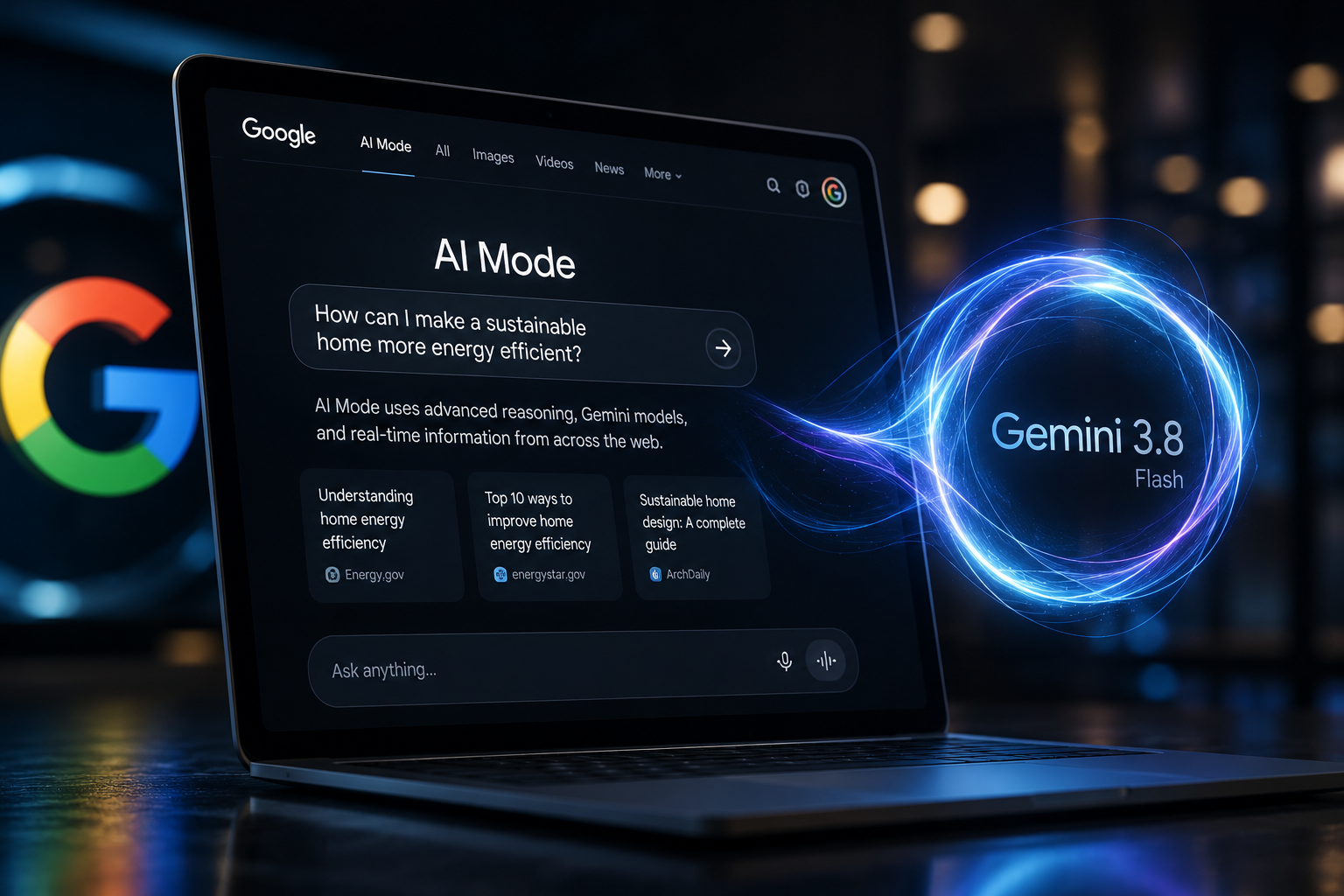
Google Search’s AI Mode Gets Another Gemini Upgrade
Google Search’s AI Mode is moving fast enough that the model behind it is now becoming the story. According to Barry Schwartz at Search Engine Roundtable, Google Search AI Mode can now use Gemini 3.8 Flash, only a short time after the company brought Gemini 3.7 Flash into the same experience. The rollout is aimed at Google AI Pro and Google AI Ultra subscribers globally, with users able to select the model from the plus icon and model dropdown inside AI Mode.
That may sound like a routine product update, but it points to a larger shift in how Google is positioning Search. AI Mode is no longer merely a feature layered on top of classic search results. It is increasingly behaving like a Gemini delivery surface: a place where Google can expose its latest reasoning, agentic and multimodal models directly inside the search habit that billions of users already understand.
From Search Box to Model Interface
Robby Stein, Google’s vice president of product for Search, described Gemini 3.8 Flash as landing in Search and emphasized improvements over 3.7 Flash in software engineering, agentic tasks and multi-step reasoning, as reported by Schwartz. Nick Fox, another senior Google Search executive, framed the timing even more sharply, noting that the new model is arriving less than three weeks after the previous 3.7 Flash upgrade. For users, the immediate impact may be a more capable AI Mode response. For Google, the strategic implication is bigger: Search can become a constantly refreshed interface for Gemini models rather than a static destination updated only through traditional ranking changes.
This is important because Google has spent the past year reducing the boundary between Search and Gemini-powered answers. At Google I/O 2026, the company presented a more fluid Search experience in which AI Overviews, AI Mode and longer natural-language queries sit much closer together. The Verge reported that Google’s redesigned search box was intended to make it easier for users to move from AI Overviews into AI Mode, while also supporting richer inputs such as documents, photos, videos and Chrome tabs. In that context, Gemini 3.8 Flash is not just a better model option. It is another step toward making Search feel like an AI workspace.
The Flash Line Is Becoming Google’s Search Workhorse
The choice of a Flash model also matters. Flash is Google’s branding for models designed to balance capability, speed and cost, making them better suited for high-volume consumer and enterprise workloads than heavier frontier systems. Google’s own recent messaging around the Gemini 3.5 generation described Flash as central to AI Mode in Search and to agentic experiences across Google’s ecosystem, with the company saying that 3.5 Flash powered the Gemini app and AI Mode globally while supporting agentic capabilities in Search.
Gemini 3.8 Flash therefore fits a clear pattern. Google is using the Flash family as the practical engine for AI Search: fast enough to serve many users, capable enough to handle complex prompts and adaptable enough to support features that go beyond summarizing web pages. The emphasis on agentic tasks and multi-step reasoning is especially relevant, because AI Mode is increasingly expected to do more than return information. Google has already discussed AI information agents, generative UI and more action-oriented Search experiences. A stronger Flash model gives those ambitions a more plausible technical foundation.
Why This Matters for Publishers and SEOs
For publishers, marketers and SEO professionals, the change reinforces a difficult reality: Google Search is becoming less predictable as a traffic source because the interface itself is changing. Traditional ranking still matters, but AI Mode introduces an additional layer where model behavior, source selection and answer synthesis can shape visibility. When Search becomes a Gemini-powered answer system, the question is not only where a page ranks, but whether the model chooses to use, cite or ignore it in a generated response.
That makes Google’s rapid model cadence significant. A new model can alter how AI Mode interprets intent, handles ambiguous queries, follows instructions, selects citations or structures answers. Even if the visible user interface does not change dramatically, the underlying answer behavior may shift. This is why Barry Schwartz’s report is more than a small Search note. It is a signal that model updates may become part of the operational rhythm of search visibility, alongside core updates, product changes and interface experiments.
AI Mode Is Becoming the Product
The most interesting reading of the Gemini 3.8 Flash rollout is that Google is quietly turning AI Mode into a Gemini product embedded inside Search. The classic framing has been that Google Search is adding AI features. The more accurate framing may soon be that Gemini is being distributed through Google Search, with AI Mode serving as the consumer interface for whatever model Google wants to push next.
That distinction matters. A Search feature is usually judged by how it improves search results. A Gemini product inside Search is judged by how well it understands intent, completes tasks, reasons across inputs and keeps users inside Google’s environment. The former protects the old web-search model; the latter gradually replaces parts of it with an AI-native experience.
Gemini 3.8 Flash will not, by itself, settle the future of search. It is currently positioned for paid Google AI subscribers inside AI Mode, and users will need real-world testing to see how much better it performs than earlier Flash models. But the direction is unmistakable. Google is not treating AI Mode as a side experiment anymore. It is becoming the place where Search, Gemini and Google’s agentic ambitions meet.