
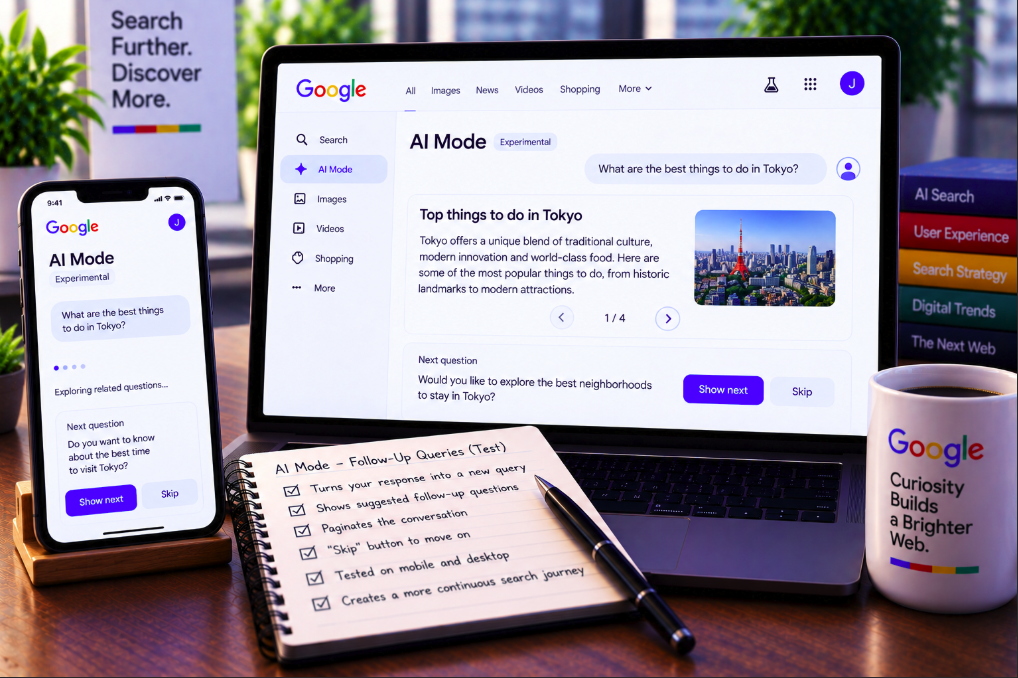
Google is testing a new AI Mode interface that can turn a user's response into another search query inside the same conversation, then move through additional questions and answers as a paginated sequence.
The experiment includes a “Skip” control, giving the user a way to bypass the next suggested step rather than following every question Google generates. It has been observed on both mobile and desktop.
Search Engine Roundtable documented the test on September 8 after Sachin Patel shared examples of the experience. According to the report and screenshots, AI Mode generated a new query within the same chat after the user's response, effectively pushing the conversation forward with a machine-selected follow-up.
Google has not announced this exact pagination-and-Skip interface in the official sources reviewed for this article. It should therefore be treated as a Search experiment, not a confirmed global rollout.
AI Mode is testing paginated follow-up responses
The visible change is a more structured conversational sequence.
Instead of showing one AI answer and waiting indefinitely for the user to type the next question, the test can present another follow-up as the next step in the same thread. The experience is paginated, allowing the conversation to advance through successive questions and responses.
The Skip button is important because it preserves some user control over that sequence. Google can suggest where the exploration goes next, but the user does not have to accept every generated step.
This turns AI Mode into something closer to a guided research flow than a traditional search-results page.
The follow-up itself can become a new query
Patel described the behavior as AI Mode generating a new query within the same chat based on the user's response.
That wording matters because it suggests more than a static list of “People also ask”-style suggestions.
The system is using conversational context to determine a plausible next information need, then continuing the search journey around that need.
The user's original query becomes the starting point of a chain rather than the sole unit of search.
The experiment was seen on mobile and desktop
Search Engine Roundtable published examples for both form factors.
That makes the test strategically more interesting than a mobile-only interface experiment because it suggests Google is exploring the interaction pattern as part of AI Mode itself rather than as a solution to one screen-size constraint.
It does not tell us how broadly the test is being served.
Google can run Search experiments against small user cohorts, accounts, regions or query classes without announcing them publicly.
Follow-up questions are not new to AI Mode
The experimental part is the way Google is orchestrating and paginating the next steps, not the existence of conversational follow-ups.
When Google first introduced AI Mode in 2025, it explicitly positioned the product as a way to ask complex, multi-part questions and then continue with follow-ups.
Google designed the interface with a persistent search box that encouraged users to keep exploring after the first response.
The September 2026 test pushes that principle further by allowing the system itself to take a more active role in deciding what the next question could be.
Google has already been turning Search into a continuous conversation
In January 2026, Google announced a more seamless transition from AI Overviews into AI Mode conversations.
The company's official announcement said users could ask a follow-up directly from an AI Overview while preserving the context of the original search.
At Google I/O in May, the company expanded that vision, saying users could move from a search-results page with an AI Overview into a conversational AI Mode exchange while keeping context intact.
The new pagination test fits naturally into that product direction: Search is becoming less about submitting isolated queries and more about maintaining an evolving information state.
The difference is who formulates the next question
Traditional search makes the user responsible for every query.
Conversational AI reduced that friction by allowing natural-language follow-ups without repeating context. The user still generally decided what to ask next.
This experiment shifts part of that responsibility toward Google. The system can infer a likely next step and surface it as part of the interaction flow.
That is a subtle but important change in search behavior because the platform is no longer only answering demand; it can help shape the sequence of demand.
The Skip button is a signal that Google expects branching intent
If every generated follow-up were obviously useful, a Skip button would be unnecessary.
Its presence acknowledges that the model's preferred next question may not match the user's actual goal.
A traveler researching Tokyo might want hotel neighborhoods after learning about attractions, while another user may want transportation, restaurant reservations or simply to end the session.
Skip gives the interface a way to remain proactive without completely locking the user into the machine-generated path.
AI Mode already uses query fan-out behind the scenes
Google's Search Central documentation explains that AI Mode can use a technique called query fan-out.
Instead of resolving a complex question with one conventional search, the system can issue multiple related searches across subtopics and data sources, then synthesize the results into a response.
That process happens behind the interface.
The new test appears to add another layer: after one synthesized answer is delivered, AI Mode can generate an explicit next query for the user-facing conversation.
Automatic follow-ups and query fan-out should not be conflated
They may look similar because both involve additional queries, but they operate at different levels.
Query fan-out is a retrieval technique used to gather information needed to answer a question. A paginated follow-up is an interaction step that advances the visible conversation into a new question.
One user-facing follow-up could itself trigger another set of fan-out searches behind the scenes.
Google has not disclosed whether this experiment changes the underlying fan-out architecture, so any claim that pagination increases or decreases retrieval breadth would be speculative.
The search session could become much longer
A conventional Google session can involve several separate queries, each producing a new results page.
AI Mode can compress those steps into one persistent thread. Automatic follow-ups could reduce even more friction by offering the next question before the user has to formulate it.
If users accept those suggestions, session depth could increase substantially.
There is no published engagement data for the experiment, so we do not yet know whether users actually continue for more steps or use Skip to exit the generated path.
This could change how search demand is measured
SEO has traditionally treated queries as relatively discrete expressions of intent.
In a guided AI Mode journey, the second, third and fourth queries can be influenced by the system's interpretation of the first one.
That means some future search demand may be partly machine-mediated. Users still choose whether to continue, but Google can influence which refinements are presented as natural next steps.
Keyword research models built around isolated queries may therefore capture less of the actual journey.
The unit of optimization may shift from keyword to journey
For publishers and brands, appearing in the first answer remains valuable, but it may not be the only meaningful opportunity.
A business can become relevant on a later follow-up even if it was not relevant to the initial broad question.
A user searching for “best things to do in Tokyo” might eventually move into neighborhoods, transport passes, hotels, restaurants or seasonal events. Each follow-up creates a new retrieval and citation opportunity.
Content strategies that cover connected subtopics coherently may be better positioned for these deeper journeys than pages optimized around one isolated phrase.
Google says AI Mode users ask longer and more complex questions
Google has repeatedly said its AI Search products are changing how people formulate queries.
In its May 2026 analysis of AI Mode usage, the company said the product had surpassed one billion monthly users globally and that query volume had more than doubled every quarter since launch.
Google also said its AI features were a major reason overall Search query volume had reached an all-time high.
Those are Google's own product metrics, but they provide important context for why the company would invest in interfaces designed to keep exploration moving.
More queries do not automatically mean more publisher clicks
An endless search journey can create more moments when websites are cited, but it can also allow Google to answer more of the user's questions without requiring an external visit.
Those forces work in opposite directions.
A five-step AI Mode session could expose a user to dozens of supporting sources, increasing discovery opportunities. The same session could satisfy several information needs entirely inside Google, reducing the need to click any one source.
No data from the pagination experiment currently establishes which effect dominates.
Later-stage follow-ups may produce higher-intent clicks
The value of a click can change as the conversation becomes more specific.
A broad first query may be informational, while a later follow-up could involve a concrete product, hotel, service, comparison or booking decision.
If AI Mode guides users deeper into a task, websites cited near those later decision points may receive fewer but more qualified visits.
This is a hypothesis that should be tested with conversion and referral data rather than assumed from the interface alone.
Source selection can change at every step
Google says AI Mode identifies supporting links as it explores complex questions and subtopics.
As the visible query changes, the relevant source set can change with it.
A general travel publisher might support the opening answer, a transit authority might become relevant for the next question, and a local hotel or restaurant site could appear later.
This makes AI visibility inherently more dynamic than tracking one fixed answer for one fixed prompt.
GEO trackers will need to model conversation depth
Most generative-search tracking starts with a prompt and records the brands, domains or URLs cited in the answer.
Automatic follow-up journeys complicate that model because one seed prompt can generate several subsequent queries that the user did not type independently.
A mature tracker may need to record the seed query, generated follow-up, conversation step, cited sources and whether the path was accepted or skipped.
Otherwise it will measure only the first page of a search experience designed to continue beyond it.
Prompt tracking may become probabilistic
Traditional rank tracking assumes that a known keyword can be rerun and compared over time.
Conversational systems are less deterministic. The same opening query can generate different follow-up suggestions, and user responses can push the thread into different branches.
Measuring visibility may therefore require repeated journeys and distributions rather than one canonical path.
The question becomes not only “Are we cited?” but “Across plausible conversation branches, how often do we enter the journey and at what stage?”
The experiment could create a new form of query suggestion
Google has influenced query refinement for years through autocomplete, related searches and People Also Ask.
Automatic AI Mode follow-ups are conceptually related but potentially more personalized to the conversational context.
Instead of suggesting a generic query because many users searched it, the system can formulate a next question based on what has already been discussed in the thread.
That makes the suggestion more contextual and potentially more influential over the user's next information need.
Brands should watch the questions Google chooses to ask next
If the feature expands, generated follow-up questions could become a useful research signal.
They may reveal how Google's systems decompose a topic, which attributes it considers relevant and which comparisons naturally follow from a broad query.
That does not make every generated question a keyword-volume signal. An AI suggestion is not evidence that large numbers of people independently search the same phrase.
It can still help content teams understand the semantic pathways Google is constructing around a topic.
Do not create thin pages for every generated follow-up
The wrong response would be to capture screenshots of AI Mode suggestions and automatically create one page for each question.
Google's official SEO guidance for AI Search continues to emphasize useful, original, people-first content rather than special pages designed solely for generative features.
A coherent resource that genuinely answers several connected needs may be more valuable than dozens of thin pages built around machine-generated variants.
The interface is changing; the requirement for useful content is not.
Analytics needs to distinguish entry query from conversation path
If AI Mode eventually exposes more granular referral or visibility data, the initial query alone may not explain why a page was cited.
A user could begin with a broad topic and click a website only after three automatically generated follow-ups.
For the publisher, that referral belongs to a deeper information need even though the overall session began somewhere else.
Understanding that path would help explain why AI referrals can sometimes look different from classic search referrals built around one visible keyword.
Search Console now gives publishers a better baseline for AI visibility
In June 2026, Google introduced dedicated generative AI performance reports in Search Console, and the company says those insights were rolled out to all websites worldwide by August 31.
The reports provide a dedicated view into visibility from generative AI features such as AI Overviews and AI Mode.
They do not, based on Google's public documentation reviewed here, provide a conversation-step report that reveals whether a site appeared on the first response or after an automatically generated follow-up.
If paginated journeys become important, that distinction could become increasingly valuable to publishers.
The Skip button may be as important as the automatic query
The most interesting metric for Google may not be how many follow-ups it generates but how often users accept them.
A high Skip rate would suggest the model is frequently guessing the wrong next intent. A low Skip rate could indicate that users value the guided sequence.
Those interaction metrics would help Google refine which questions appear and when the system should stop suggesting more.
No such engagement figures have been published for this test.
“Endless search” should remain a metaphor for now
The interface creates the possibility of a long, continuously generated journey, but there is no evidence that Google literally intends an infinite sequence of questions.
The experience will still encounter natural stopping points when the user has enough information, leaves for a website, skips the suggestion or begins a different task.
“Endless” captures the strategic shift away from one-query-one-results-page interaction, not a documented technical limit.
That distinction keeps the product analysis grounded in what the experiment actually shows.
The test makes Search more active in shaping the journey
Google AI Mode was already conversational. This experiment makes it more proactive.
By turning the user's response into another query, presenting that query as the next page of the thread and offering Skip as an escape hatch, Google is testing whether Search can guide exploration instead of merely waiting for the next instruction.
That could have significant consequences for SEO measurement. Search demand becomes more sequential, source opportunities move across conversation stages, and the visibility of a page may depend on whether Google's generated path reaches the subtopic it serves.
For now, there is no announced rollout and no evidence about traffic impact. But the direction is clear enough to watch: the future Google search session may be less like a sequence of queries a person independently invents and more like a jointly constructed journey in which the user and the search engine take turns deciding what question comes next.