
Google AI Mode may be turning one of generative search’s most important hidden mechanisms into something users can increasingly steer on screen.
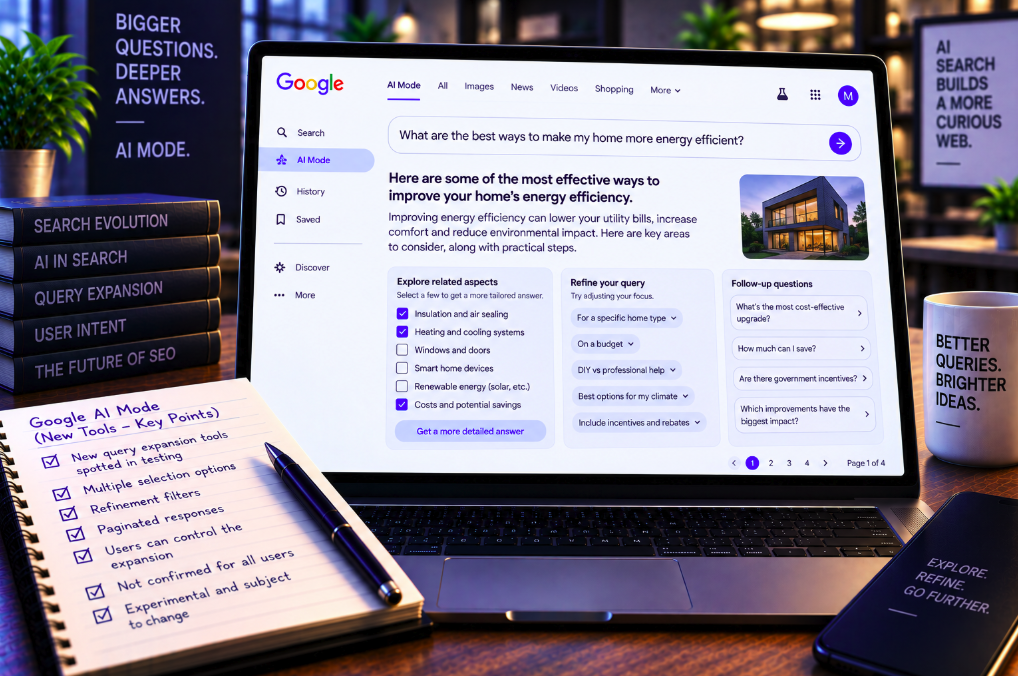
A new interface test spotted by Sachin Patel and reported by Search Engine Roundtable on September 14 adds several ways to expand a search beyond the familiar conversational follow-up. Observed versions include multi-selection tools, query-refinement options and the paginated follow-up experience Google was already testing earlier this month.
None of these controls has been announced by Google as a general rollout, and the interfaces are not reproducible for every AI Mode user. Search Engine Roundtable’s Barry Schwartz also cautions that he is not certain how new every variation is.
Still, the direction is notable. Google has long described AI Mode as using query fan-out behind the scenes—breaking a question into related searches across subtopics. These experiments suggest that parts of that expansion process may increasingly become visible as an interactive layer that lets the user choose where the search should go next.
AI Mode already expands one question into many searches
Query fan-out is central to how Google explains its generative Search products.
In its Search Central documentation for AI features, Google says AI Mode and AI Overviews can issue multiple related searches across subtopics and data sources while generating a response. Those searches help the system discover additional supporting pages and produce a broader set of links than a conventional single-query search might retrieve.
Google’s more recent guide to generative AI optimization defines query fan-out similarly: the model generates concurrent related queries to request more information and retrieve additional relevant search results.
Historically, most of that expansion happens invisibly. The user asks one question; Google performs the decomposition internally.
The new interface experiments potentially change that relationship.
Multi-selection tools let users choose several directions at once
One of the reported test formats presents multiple selectable follow-up options.
Instead of requiring the user to formulate a new sentence, AI Mode can offer several possible aspects of the topic and allow more than one to be selected.
That is different from the conventional “People also ask” model, where each question is essentially a separate branch. Multi-selection creates the possibility of combining several constraints or interests into the next stage of the conversation.
A travel search, for example, could theoretically be narrowed simultaneously by budget, neighborhood and family suitability rather than requiring three separate searches. A product investigation could combine durability, price and compatibility.
The observed test does not establish exactly how Google translates those selections into retrieval operations. But as a user experience, it makes query expansion more explicit.
Refinement controls reduce the need to rewrite the prompt
A second observed interface provides query-refinement options.
That moves AI Mode closer to a faceted-search experience, where the system proposes dimensions that can sharpen the original information need.
Traditional ecommerce and travel search have used filters for years. What is different here is that the dimensions can emerge from a generative understanding of the user’s question rather than from a fixed database schema.
The model can potentially identify that a broad query contains unresolved variables and offer controls for those variables directly.
For users, that means less prompt engineering. Instead of learning how to write increasingly elaborate instructions, they can interact with structured choices generated from the conversation.
Google is also testing paginated AI Mode responses
The third piece of the emerging interface appeared in a separate experiment earlier in September.
Search Engine Roundtable reported on September 8 that Google was testing paginated follow-up questions and responses inside AI Mode, including a Skip control.
In the version spotted by Patel, after the system produced an answer, AI Mode generated a new query within the same chat based on that response. The user could continue through the sequence or skip ahead.
Pagination changes the rhythm of generative search. Rather than presenting one enormous response or waiting passively for the user to invent the next question, the system can guide the research process through successive stages.
That makes AI Mode feel less like a results page and more like an interactive research workflow.
The interface is not exposing Google’s actual internal fan-out queries
It is tempting to describe the tests as Google revealing query fan-out to users.
That would be too strong.
Google has not said that the visible options correspond one-to-one with the internal searches AI Mode sends to its retrieval systems. A refinement button may represent a conceptual branch while Google still issues many hidden queries underneath it.
The visible interface and the internal retrieval process should therefore be treated as separate layers.
What appears to be changing is not necessarily transparency into the exact fan-out. It is user control over the direction of expansion.
Query expansion is becoming part of the search product itself
Classic Google Search generally required the user to reformulate a query manually.
If the first results were too broad, the searcher added another word. If the intent changed, the searcher rewrote the query. Google suggested related searches, but the user remained responsible for constructing the next request.
AI Mode can invert that process.
The system understands the original question, generates possible dimensions of exploration and offers those dimensions back as interface controls. The user can then choose among them rather than starting from an empty search box.
That makes query formulation collaborative: Google proposes the search space, while the user steers through it.
The change could make complex search easier for ordinary users
One of generative AI’s promises is that users should not need to understand search syntax to investigate a complicated topic.
Multi-select controls and refinements could advance that goal.
A person researching home energy upgrades may not initially know that insulation type, climate, incentives, upfront cost and payback period are the variables worth comparing. AI Mode can potentially surface those dimensions and let the user select the ones that matter.
The interface therefore does more than answer the initial query. It can teach the user how to ask a better second question.
That is a significant change in the role of a search engine—from matching queries to helping construct them.
Pagination could keep users inside AI Mode for longer research sessions
There is also an obvious engagement consequence.
If AI Mode continually generates useful next steps, the user has less reason to return to the search box or leave the session to reformulate the task elsewhere.
A paginated sequence can turn one query into a multi-stage exploration that remains inside the same interface.
That may be convenient for users, but it also changes the competitive environment for publishers. Websites are no longer competing only to answer the initial query. They may be competing across a sequence of model-generated subquestions that the user never typed.
Understanding that expanding query space is becoming increasingly important for SEO.
For SEO, the addressable query is no longer just what the user typed
In a fan-out system, one visible query can trigger many retrieval requests.
A page can therefore become relevant to an AI Mode session even if it is not the best answer to the original wording. It may instead answer one subproblem generated during the decomposition process.
That creates a broader concept of search relevance.
A comprehensive guide might support the initial question. A comparison table may support one refinement. A technical specification could support another. A forum discussion or first-hand review might become relevant later in the exploration.
The SEO opportunity moves from ranking for one phrase toward supplying useful evidence across the information structure surrounding the user’s task.
Visible refinements may provide clues about how Google understands intent
If these interfaces expand, they could also become a useful qualitative research signal for content teams.
The refinements Google proposes can reveal which dimensions its systems consider meaningful for a topic.
That does not mean every visible option is an SEO keyword to target. It does mean the interface can expose the conceptual structure Google believes users may want to explore.
For a complex commercial query, those dimensions might include price, use case, compatibility, location or trade-offs. For informational research, they might include definitions, causes, comparisons, evidence or implementation steps.
Those are often more useful editorial signals than a flat list of keyword variations.
Google explicitly warns against creating pages for every fan-out variation
The obvious SEO temptation is to turn every possible subquery into a separate page.
Google has already warned against that strategy.
Its generative AI optimization guidance says publishers should not create separate content for every possible variation of what people might search—including fan-out queries—primarily to manipulate rankings or generative AI responses.
Producing large volumes of low-value pages can violate Google’s scaled content abuse policy.
The more sustainable interpretation is to understand the information need and build genuinely useful coverage, not manufacture hundreds of near-duplicate pages for hypothetical hidden queries.
Google says ordinary SEO foundations still apply
Despite the new interface, Google has not introduced special technical requirements for appearing as a supporting link in AI Mode.
A page must be indexed and eligible to appear in Google Search with a snippet. Google says the same foundational SEO practices continue to apply: accessible pages, useful content, good page experience and clear relevance.
AI Mode uses Google’s core Search systems as part of its retrieval and grounding process.
That means the user interface can change dramatically while the underlying publisher requirement remains familiar: create content Google can crawl, understand and retrieve when it is useful.
The test could create more opportunities for specialized pages
Query expansion can broaden the number of information needs generated during a single search session.
That may create opportunities for pages that are not broad enough to rank for the initial head query but are exceptionally useful for a specific subproblem.
A niche technical guide, original dataset, specialist comparison or detailed case study may become relevant when AI Mode expands the question into a narrower branch.
Google has said query fan-out can identify a wider and more diverse set of supporting web pages than classic search.
User-controlled refinements could make that diversity even more visible if the user deliberately chooses less obvious branches.
But the tests could also reduce direct query reformulation
There is another side to the change.
Traditional keyword research observes the queries users explicitly type. If AI Mode increasingly generates the refinements itself, some of the information demand may never appear as a manually entered query.
The user may click a suggested refinement rather than type a new phrase.
For marketers, that could make conventional query logs a less complete representation of the research journey. The semantic path still exists, but more of it is mediated by interface choices rather than typed keywords.
That reinforces the need to analyze topics, tasks and information needs alongside literal query strings.
There is no evidence these interfaces are rolling out universally
The screenshots are evidence of testing, not a product launch.
Google routinely experiments with Search interfaces among subsets of users, devices, accounts and markets. Some tests expand; others disappear without ever becoming standard.
Search Engine Roundtable says the new controls were spotted by Patel and notes uncertainty around how new some of the variations are.
Google has not issued an announcement saying that multi-select query expansion, refinement controls or paginated AI Mode responses are now available to everyone.
Any SEO strategy that assumes these exact controls will become permanent would therefore be premature.
The more important signal is the direction of travel
Individual UI experiments come and go. The broader design direction is more durable.
Google built AI Mode around complex, multi-part questions and follow-up exploration. Query fan-out already lets the system decompose those questions behind the scenes. The new tests explore ways to make that exploration easier to steer without requiring users to formulate every follow-up manually.
Multi-selection, refinement controls and pagination are different interface solutions to the same product problem: how to help users navigate a large information space after the first answer.
That is why the tests matter even if their exact visual designs never ship.
AI search is moving from answering queries to managing exploration
The conventional search engine waits for the next query.
The emerging AI search engine can suggest what the next query should be, offer several branches, combine multiple constraints and carry the user through a sequence of related questions.
Google’s latest AI Mode experiments make that transition unusually visible.
The reported multi-select tools, refinements and paginated responses remain unconfirmed tests, and there is no evidence that they reveal the exact internal fan-out searches Google performs. But they point toward a Search experience in which users can increasingly steer the expansion process through interface controls.
For publishers, the strategic implication is larger than any single button. The search journey is becoming a graph of related information needs generated jointly by the user and the model. Winning visibility in AI Mode may increasingly depend on being the best source for one of those branches—even when the user never typed that branch as a query at all.