
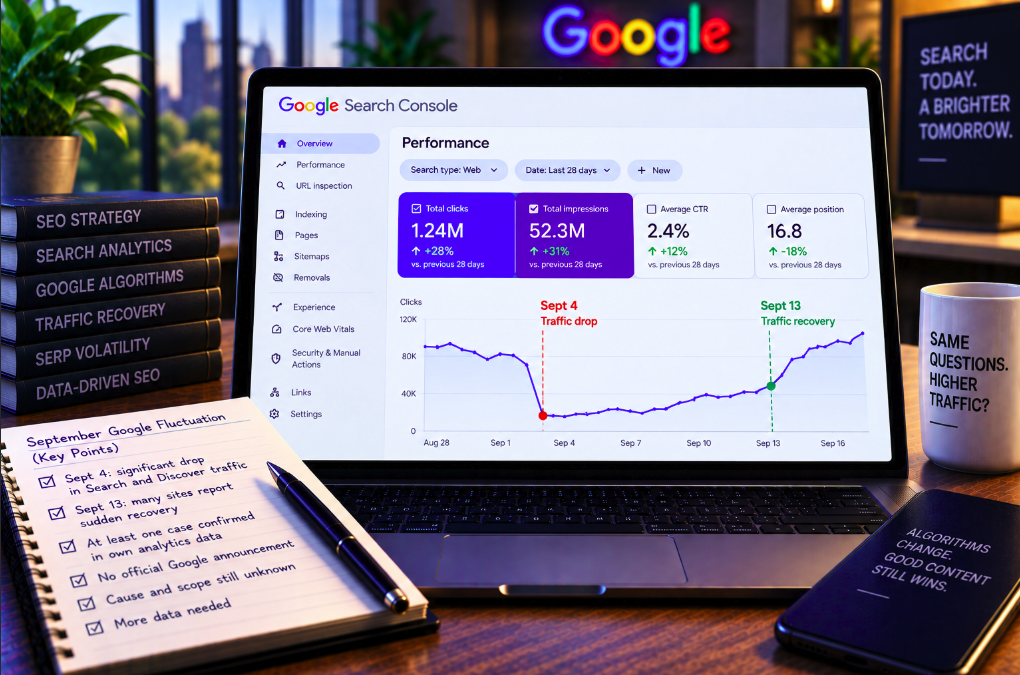
Some large websites that lost substantial Google Search visibility around September 4 appear to have recovered almost as abruptly nine days later. For several of the affected sites, the September 13 surge looked less like a gradual SEO recovery and more like the earlier decline had suddenly been switched off.
The pattern was documented by Glenn Gabe and reported on September 14 by Search Engine Roundtable. Gabe had been tracking multiple large sites that dropped sharply around September 3 and September 4. On September 13, a number of them surged back, with some apparently reversing most or all of the earlier loss.
The movement affected conventional Google Search traffic and, for some sites, Google Discover as well. Importantly, Search Engine Roundtable says at least one of the examples was not merely a third-party visibility-tool anomaly: the site’s own first-party analytics showed both the original decline and the subsequent recovery.
What changed is unknown. Google has not announced a ranking update tied to either September 4 or September 13, and the available evidence is too limited to determine whether this was a rollback, a recalculation, an unannounced ranking-system adjustment or something else entirely.
The first movement appeared around September 3–4
Barry Schwartz says he had been relatively quiet about unconfirmed Google ranking updates in recent weeks because most of the broader search ecosystem appeared comparatively calm.
September 4 was an exception.
Several large sites tracked by Gabe experienced pronounced visibility and traffic losses beginning around September 3 and continuing into September 4. Some fell sharply in Search, while others also experienced losses in Discover.
The pattern was large enough to stand out in the affected sites’ charts even though it did not generate the level of industry-wide discussion normally associated with a major confirmed core or spam update.
Aggregate volatility data cited by Search Engine Roundtable also showed September 4 as more volatile than the surrounding period.
Then some sites surged back on September 13
Nine days later, the direction changed.
Gabe reported that a number of the sites that had “fallen off a cliff” around September 4 surged back on September 13. In some examples, the recovery appeared to reverse the earlier loss almost completely.
That timing is what makes the episode unusual.
SEO recoveries commonly unfold gradually as sites are recrawled, content changes are reassessed or broader ranking systems update. A sharp decline followed by an equally sharp restoration on a common date across several sites can instead suggest that a system-level variable changed.
That interpretation is plausible, but it remains an inference. Google has not confirmed that any ranking system was changed or reverted.
At least one recovery is visible in first-party analytics
Ranking-tool screenshots can sometimes exaggerate the importance of a change.
Third-party visibility platforms monitor their own keyword sets and estimate search exposure. A dramatic movement in those tools can occur even when a site’s actual traffic changes less substantially.
Search Engine Roundtable explicitly addresses that limitation in this case.
Schwartz says the charted site experienced a real traffic decline and a real reversal in its own first-party analytics and data. That strengthens the evidence that at least one observed pattern represented actual user traffic rather than a tracking artifact.
It still does not establish how widespread the phenomenon was.
Discover appears to be part of the story for some publishers
The September movement was not confined to traditional web search.
Gabe says some affected sites also lost Discover traffic during the September 4 decline. Community comments collected by Search Engine Roundtable subsequently described Discover beginning to return over the September 12–13 weekend.
One WebmasterWorld participant said Discover traffic had started picking up again and that their private feed looked more normal. Another reported that stories were no longer being dropped as aggressively and that the remaining decline had narrowed substantially.
These reports are anecdotal and cannot establish a platform-wide Discover change. They do, however, align directionally with the recovery pattern Gabe observed.
For publishers, the overlap matters because simultaneous Search and Discover changes can produce much larger traffic swings than movement in conventional rankings alone.
Google has not announced an update
The most important fact is also the simplest: there is no confirmed Google ranking update to attach to this movement.
Google’s public Search documentation does not list a September 4 or September 13 ranking rollout. The company’s Search Status Dashboard likewise showed no ranking, indexing, crawling or serving incident in the period displayed through September 11.
That does not prove nothing changed internally.
Google makes many adjustments that are never announced as named updates. The company generally reserves formal announcements for changes it considers sufficiently significant or actionable for site owners.
But without confirmation, labeling the September pattern a “Google update” is shorthand for observed ranking movement, not a verified description of its cause.
An unconfirmed reversal is not necessarily a rollback
The most tempting explanation is that Google launched something around September 4 and rolled it back on September 13.
The charts can certainly look that way.
But several other mechanisms could produce a similar pattern. A classifier could have been recalculated. A ranking signal could have received new data. A system could have been corrected after producing unintended results. Discover and Search systems could have shifted independently but at similar times. A limited experiment could have ended.
It is also possible that different affected sites had different causes and merely shared a similar timeline.
Calling the September 13 movement a recovery is supported by the observed data. Calling it a rollback would require evidence that Google actually reverted a specific change.
The affected-site sample is not representative
The available examples come from sites being actively tracked by experienced SEO observers and from community reports.
That is useful for detecting unusual behavior but not for estimating prevalence.
We do not know what percentage of the web declined on September 4, what percentage of those sites recovered on September 13 or whether the movement was concentrated in particular industries, content types, countries or site architectures.
Search Engine Roundtable itself notes that general SEO chatter remained relatively calm despite the dramatic movement in some individual sites.
That could mean the event was narrow. It could also mean large ranking swings are generating less discussion as publishers increasingly focus on declining click opportunities from Google overall. The current evidence cannot distinguish those explanations.
The September 4 volatility signal is real but nonspecific
Search Engine Roundtable’s aggregate volatility chart shows September 4 as more turbulent than the surrounding days.
Volatility tools are useful for detecting broad movement because they monitor how frequently search-result positions change across large keyword sets.
They cannot explain why the movement occurred.
A spike can reflect an algorithm adjustment, a SERP feature change, localization differences, data refreshes or many smaller ranking movements occurring simultaneously.
It therefore supports the observation that September 4 was unusual without proving that Google launched a discrete ranking update on that date.
The August spam update is relevant context, not an explanation
Google had recently completed a confirmed spam update before this episode.
The August 2026 spam update began on August 18 and finished rolling out on August 21. Search volatility continued to be reported afterward.
The proximity makes it natural to wonder whether the September movement was connected to post-spam-update recalibration.
There is currently no evidence establishing that connection.
The September 4 decline occurred roughly two weeks after the spam rollout finished, and Google has not said that a follow-up action, correction or second phase was underway.
Any direct causal link should therefore remain speculation.
The speed of the recovery argues against simplistic site-level explanations
When a site loses traffic, the standard SEO response is to investigate content quality, technical problems, crawling, indexing, internal linking and competitive changes.
Those checks remain appropriate.
But if a site loses substantial traffic on one day and recovers nearly the same amount nine days later without a corresponding site change, a purely site-level explanation becomes less convincing.
A technical fix can create a sharp recovery, but it would need to line up with the timing. A major content improvement normally requires Google to recrawl and reassess the affected pages. Competitive changes rarely reverse across multiple large sites on the same date.
This is why temporal clustering matters in algorithm analysis. It does not prove a Google-side change, but it changes the probability of competing explanations.
Site owners should preserve evidence before changing everything
A sudden traffic collapse creates pressure to act immediately.
In an unconfirmed volatility event, aggressive changes can make diagnosis harder.
If a site was hit around September 4, the first priority should be to preserve the before-and-after evidence: Search Console exports, analytics data, Discover performance, page-level traffic, query groups, country and device segments, crawling patterns and deployment history.
That allows the team to determine whether the September 13 recovery occurred without intervention or whether it followed a specific technical or editorial change.
If rankings recover spontaneously, that information can prevent teams from incorrectly attributing the improvement to a change that happened to occur at the same time.
Search and Discover should be analyzed separately
Because some sites reportedly moved in both systems, aggregated Google traffic can conceal useful clues.
Search and Discover have different distribution mechanisms and user contexts. A site can recover in Search while remaining depressed in Discover, or vice versa.
Publishers should therefore segment the data rather than relying on total organic traffic.
For Search, useful dimensions include query, page, country, device and search appearance. For Discover, publishers should examine page-level clicks and impressions, content freshness and whether the recovery affected the same articles that declined earlier.
A synchronized recovery across both surfaces is more interesting than a change isolated to one.
Page-level patterns could reveal whether the recovery was selective
A site-wide graph can make a recovery look complete even when Google has changed which pages receive visibility.
Teams should compare the URL sets generating traffic before September 4, during the decline and after September 13.
If the same pages return to approximately the same visibility, the pattern looks more like a reversal of the original suppression.
If different pages drive the recovered traffic, the site may have regained aggregate visibility through a new ranking distribution rather than a literal restoration of the previous state.
The distinction could help determine whether the event affected site-level classification, individual URLs or query-specific ranking behavior.
Do not use the recovery as proof that “doing nothing” is always correct
The episode will inevitably reinforce the familiar SEO advice to wait during unexplained volatility.
That advice is useful only within limits.
If a site has a robots.txt error, accidental noindex, broken canonicalization, server outage or rendering failure, waiting nine days is not a strategy. Technical incidents should still be fixed immediately.
The better principle is to separate confirmed site defects from unexplained ranking movement.
Fix objective problems. Be more cautious about rewriting large amounts of content or restructuring a site solely because rankings moved during an unconfirmed Google fluctuation.
Google’s silence leaves several plausible explanations open
Without an announcement, outside observers can only work from behavioral evidence.
The September 4 and September 13 dates could represent a limited ranking experiment, a system refresh, a correction to an earlier adjustment, a classifier update or another internal change that Google does not consider worth publicly naming.
They could also represent overlapping phenomena rather than one coherent event.
That uncertainty should be preserved in reporting.
The strongest factual statement is that multiple large sites tracked by Gabe dropped around September 4 and that a number of them recovered sharply on September 13, with at least one pattern confirmed in first-party analytics. Everything beyond that is an attempt to explain the observation.
The next few days will determine whether the reversal holds
A one-day surge is not yet a durable recovery.
The affected sites need to maintain their regained Search and Discover traffic before the September 13 movement can be treated as a stable return to the previous baseline.
Further reversals would make the event look more like an experiment or unstable ranking recalculation. A sustained recovery across multiple sites would strengthen the interpretation that something affecting them around September 4 was later changed.
Additional site owners may also recognize the same pattern once delayed Search Console and analytics data becomes available.
For now, the evidence is strong enough to identify a notable reversal but not strong enough to define its scope.
The dates are clearer than the cause
The September episode is a useful reminder of the limits of real-time algorithm reporting.
On September 4, several large sites experienced severe Search losses, with some also losing Discover visibility. On September 13, a number of those sites surged back. At least one example is confirmed by the site’s own analytics rather than only an external visibility tool.
Google has announced no corresponding ranking update, and there is not enough public data to determine whether the movement was a rollback, recalculation, correction or another type of system change.
That makes the headline recovery real for the observed sites while leaving the explanation unresolved.
For SEO teams, the practical lesson is to document before diagnosing. When Google traffic falls off a cliff and then returns almost overnight, the most important evidence may be what the site did not change between those two dates.