
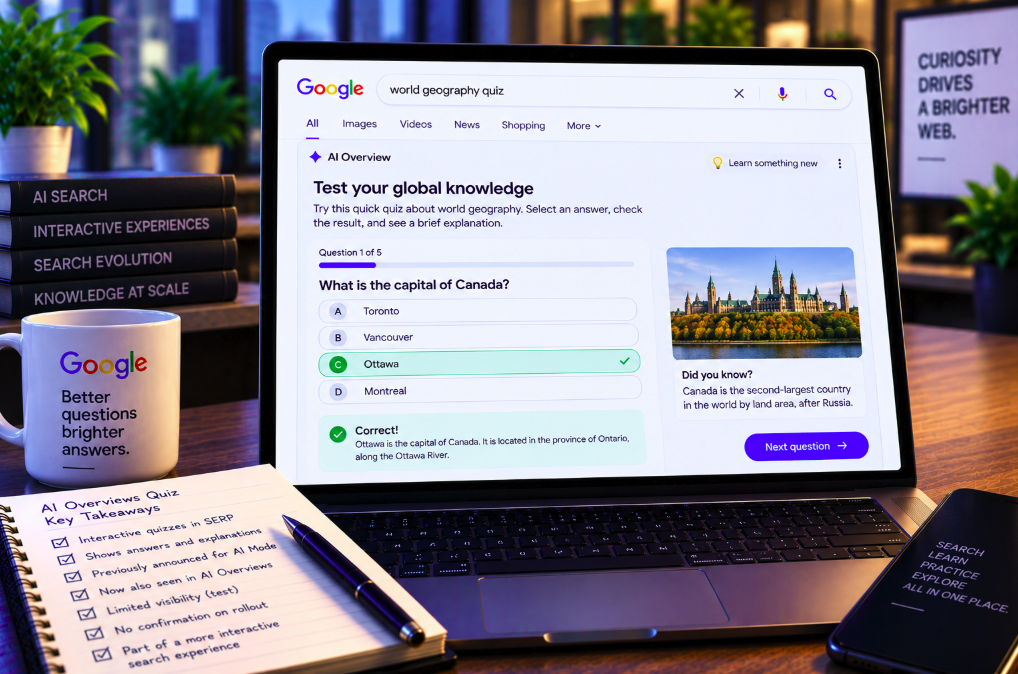
Google Search is increasingly behaving less like a page of links and more like an application that can complete a task before the user ever visits a website. Interactive quizzes inside AI Overviews are a particularly clear example.
On September 14, Search Engine Roundtable documented quiz interfaces appearing inside AI Overviews in ordinary Google results. The experience can present questions, accept an answer, reveal whether it is correct and guide the searcher through the rest of the exercise directly in the SERP.
There is an important timeline clarification, however. This is not simply an AI Mode feature that Google has now unexpectedly extended to AI Overviews. In its official August 19 learning announcement, Google already said that practice quizzes were available globally in English in both AI Overviews and AI Mode.
The September screenshots are therefore most useful as evidence of what that announced capability looks like in live Search—and of a broader transformation in AI Overviews from generated summaries into interactive destinations.
Google officially announced quizzes for AI Overviews in August
Google introduced the feature as part of a package of AI-powered study tools for the new school year.
In its August 19 Search announcement, the company said users could generate personalized practice quizzes directly in Google Search across subjects ranging from science and mathematics to humanities and foreign languages.
Google also supports quiz prompts for standardized-test preparation, including ACT, AP, GRE, LSAT and SAT.
Most importantly for the September observation, Google explicitly said the practice quizzes were available in English globally in both AI Overview and AI Mode.
That means the presence of a quiz in an AI Overview is consistent with an announced product capability, even if the exact general-knowledge interface seen in September is not reproducible for every query or user.
The quiz can keep the entire exercise inside Search
The interaction goes beyond generating a list of trivia questions.
The user can select an answer, receive feedback and continue through the quiz without navigating to a conventional quiz website first.
Google says its practice quizzes include explanations for each answer, helping the user understand why a response is correct rather than simply displaying a score.
This changes the role of the SERP. Search is no longer only locating a learning resource. It can become the learning resource’s interface.
For publishers, that distinction is strategically important because an informational query that once created a click opportunity can now turn into a multi-step activity completed inside Google.
“Without sending users to a website” needs one qualification
The interactive task can be completed in Search, but Google is not eliminating external sources from the experience entirely.
Its official announcement says the quizzes include links that let users learn more about the topic.
That means the correct framing is not that AI Overview quizzes contain no outbound links. It is that a user no longer has to click an external website in order to begin answering questions, receive feedback and move through the core exercise.
The distinction matters when evaluating publisher impact.
Links can remain available while the interface simultaneously reduces the functional necessity of clicking them.
Google is using expert educational content for some quiz material
Google says standardized-test quizzes draw on content from education companies including The Princeton Review, Careers360, PhysicsWallah and Akira Enem.
The company describes those partnerships as a way to ground exam preparation in material created by organizations with relevant test-preparation expertise.
This adds another layer to the publisher question.
AI Search is not only synthesizing information from the open web. In some interactive experiences, Google can combine generative interfaces with content supplied through specific partnerships.
The resulting product may look like a native Google quiz even though external organizations contribute to the underlying learning material.
The September observation extends beyond formal test preparation
Search Engine Roundtable’s report focuses on a general-knowledge quiz observed in an AI Overview.
That matters because it illustrates how the format can work outside a narrowly defined standardized-test workflow.
A quiz is a reusable interaction pattern. It can theoretically apply to geography, history, science, language learning, entertainment knowledge and countless other informational categories.
Google’s official announcement already described broad subject coverage, so general-knowledge use is consistent with the larger educational direction.
What remains unclear is how frequently Google chooses to trigger the experience and which query formulations are most likely to produce it.
Availability is broader than a tiny test, but triggering remains uncertain
The distinction between product availability and SERP reproducibility is important.
Google says practice quizzes are available globally in English. That is stronger than an isolated unconfirmed A/B test.
It does not mean every English-language user will see a quiz for the same query, that every subject triggers the same interface or that the precise version captured in September is universal.
Search features can depend on query interpretation, device, account state, model behavior and ongoing interface experiments.
So the quiz capability itself is officially announced, while the exact presentation and trigger conditions observed in individual Search results can still vary.
AI Overviews are becoming interactive software surfaces
The quiz is part of a broader design shift.
In the same August announcement, Google described interactive visuals that can appear directly in AI Overviews to help users understand complex concepts. Its example was a generated interactive tool for learning the pH scale.
A static answer explains something. An interactive visual lets the user manipulate or explore it. A quiz asks the user to respond and adapts the next step based on that interaction.
Those are application behaviors, not merely search-result formatting.
The boundary between “answer” and “tool” is becoming increasingly difficult to draw.
The SERP can now absorb activities that once required destination sites
For years, Google has answered simple factual questions directly in Search through knowledge panels, featured snippets, calculators, weather modules and other specialized results.
Generative interfaces expand that model to more complex activities.
A quiz website traditionally provides question generation or curation, answer selection, scoring, explanations and progression through an exercise. AI Overview can now reproduce much of that workflow inside Google’s own page.
The same product logic can extend to other categories: planning, comparison, calculation, simulation and guided research.
That is why the quiz feature matters beyond education SEO. It is an example of Search absorbing the interaction layer of a destination website.
Publisher links may compete with a completed task
In classic Search, a publisher link competes with other links.
Inside an interactive AI Overview, the publisher link can also compete with the convenience of staying in the current interface.
If the user’s goal is “test me on world geography,” and Google can immediately administer the quiz, the user has already begun completing the task before considering an external result.
A supporting link may still be valuable when the user wants deeper context, source verification or a more extensive learning experience.
But the click is now an optional continuation rather than the necessary first step.
There is no evidence yet quantifying lost publisher clicks from quizzes
The zero-click implications are obvious enough to discuss, but they should not be converted into unsupported traffic claims.
No public dataset tied specifically to Google’s interactive quiz feature currently establishes how much publisher click-through rate falls when the module appears.
User behavior could vary substantially by query. A casual trivia searcher may never leave Google, while a student preparing for a high-stakes exam may click multiple supporting sources after completing the practice questions.
Some educational partners may also benefit from explicit links or deeper integration.
The defensible conclusion is that Google has reduced the need for an immediate click, not that a measured percentage of traffic has already disappeared.
The source relationship becomes more complicated
Interactive generative results raise a question that is less visible in conventional blue-link Search: what exactly is the source contributing?
A webpage may provide a factual statement used to ground an explanation. Another source may provide the underlying educational material. Google’s model can then transform that material into a question-and-answer interaction that did not exist in the same form on either page.
The user experiences a Google-native tool, while the informational inputs may come from multiple external sources.
That makes citation visibility, attribution and publisher value harder to evaluate than a conventional ranked result.
The more useful the native interface becomes, the more important those questions will become for the web ecosystem.
Interactive answers change what “ranking” means
Traditional SEO performance is easy to conceptualize: a page ranks at a position, earns an impression and may receive a click.
AI Overviews complicate all three concepts.
A source can contribute to a generated answer without occupying a familiar numbered position. The user can interact with the answer for an extended period. Several sources may support one experience, and the interface may generate additional content as the session continues.
Google has already acknowledged that classic position reporting becomes harder to interpret in generative Search experiences.
Interactive quizzes push the problem further because engagement can happen inside the result before any source click occurs.
Educational publishers need to offer value beyond the first interaction
If Google can generate a basic practice quiz, a publisher’s competitive advantage cannot rely solely on presenting multiple-choice questions.
Destination sites can differentiate through deeper capabilities: structured curricula, persistent progress tracking, adaptive difficulty, teacher tools, original expert explanations, proprietary question banks, community features, certification or highly specialized subject expertise.
Those experiences are harder to compress into a single Search module.
The strategic goal is not necessarily to prevent Google from answering the query. It is to give the user a reason to continue beyond what the SERP can provide.
That principle increasingly applies to informational publishing outside education as well.
Original expertise becomes more valuable when generic interaction is commoditized
Generative systems are particularly effective at creating standard-format educational exercises from broadly available knowledge.
That makes generic “10 questions about geography” content easier to reproduce.
What remains more defensible is material based on distinctive expertise or assets: original research, proprietary datasets, specialist pedagogy, expert-authored explanations, unique examples and trusted assessment frameworks.
Google’s own decision to work with established test-preparation providers for standardized-exam content illustrates the value of authoritative material when accuracy and exam relevance matter.
As the interface layer becomes commoditized, source quality becomes a more important differentiator.
Quiz content can still create discovery opportunities
The shift is not purely defensive for publishers.
Google says its quizzes include links for users who want to explore topics in greater depth. A publisher that provides a strong explanation of a concept can potentially become useful at the moment the learner discovers a knowledge gap.
That is a different intent from the initial quiz request.
The first query may be “quiz me on chemistry.” After an incorrect answer, the user’s need becomes “explain why this reaction works.”
Publishers that answer the second, deeper need may still earn valuable discovery even when Google owns the first interaction.
SEO should focus on being the best explanation, not merely the quiz container
For educational sites, this changes content strategy.
Pages that exist primarily as thin containers around easily generated questions face more competition from native AI experiences.
Pages that explain difficult concepts exceptionally well, demonstrate reasoning, cite primary material or provide expert-created practice resources can remain useful sources for both users and generative systems.
The objective becomes to contribute information that improves the learning experience rather than simply reproduce an interaction Google can generate on demand.
That aligns with the broader direction of Search: utility is moving into the SERP, while differentiated knowledge remains a reason to visit the web.
Google is collapsing the distance between searching and doing
The deepest significance of interactive quizzes is not the quiz format itself.
It is the disappearance of a traditional step in the search journey.
The old flow was search, choose a result, visit a site, then interact. The new flow can be search, interact immediately, and visit a site only if additional depth is needed.
AI Overviews are becoming capable of hosting that middle layer directly.
Interactive visuals, generated explanations and quizzes all move Search from information retrieval toward task execution.
The September screenshots show an announced capability becoming tangible
The chronology matters because it changes how the story should be understood.
Google did not merely announce quizzes for AI Mode and then quietly surprise the industry by moving them into AI Overviews. Its August 19 announcement already stated that practice quizzes were available globally in English in both products.
The September 14 Search Engine Roundtable observation is still useful: it shows the AI Overview quiz experience appearing in ordinary SERPs and demonstrates how self-contained the interaction can become.
What remains uncertain is the exact frequency, trigger logic and interface consistency across users and queries.
Those details will determine how significant the feature becomes for publishers in practice.
AI Overviews are no longer just overviews
The name increasingly understates the product.
An overview summarizes. An interactive quiz asks questions, evaluates responses, explains mistakes and guides the user through a task.
Google Search can now do both inside the same generative surface.
For users, that can make Search more useful and reduce friction. For publishers, it means the competition is no longer only over which page Google ranks or cites. Websites increasingly compete with native Google experiences capable of delivering the activity the user came to perform.
The open-web opportunity does not disappear—Google’s quizzes still include links for deeper learning—but the click comes later in the journey. The strategic challenge for publishers is therefore becoming clearer: if Google can satisfy the first interaction itself, the website needs to offer enough depth, authority or unique value to make the next interaction worth leaving Search for.