
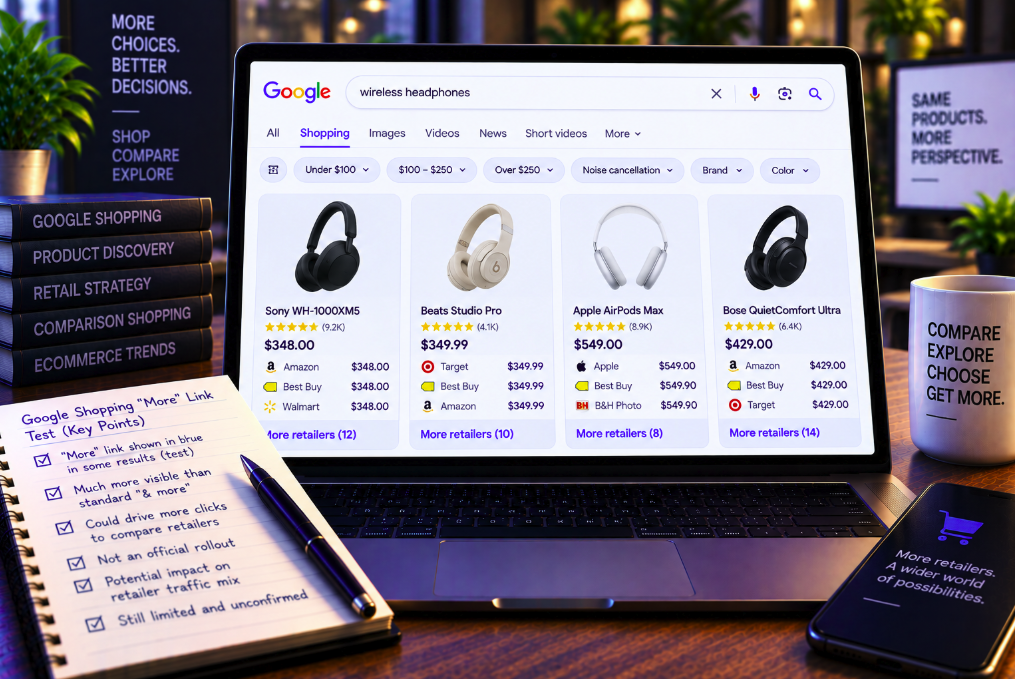
Google is testing a small Shopping interface change that could have an outsized effect on where product-search clicks go.
In some product grids, the normally understated link indicating that additional sellers are available has been replaced by a much more conspicuous blue More treatment. The experiment was spotted by Brodie Clark and documented by Search Engine Roundtable on September 14.
The standard presentation can show a low-emphasis “& more” indication when multiple retailers stock the same product. In the observed test, Google instead uses a blue-highlighted “More >” label that is considerably harder to overlook.
There is no evidence yet that this is a rollout. Search Engine Roundtable’s Barry Schwartz could not reproduce it, Google has not announced the interface, and there is no public click-through data showing whether the stronger visual treatment actually changes shopper behavior.
The test changes prominence, not the underlying shopping concept
Google already organizes product information from multiple merchants across its shopping experiences.
The experiment does not introduce the idea that several retailers can sell the same item. What changes is how visibly Google invites the shopper to explore those additional offers.
That distinction matters because interface prominence can influence behavior even when the underlying inventory remains identical.
A muted text label is easy to treat as metadata. A blue button-like control looks actionable. It tells the user that another comparison step is available and gives that step visual priority within the product card.
The product result therefore becomes slightly less like a single destination and slightly more like an entry point into a seller-selection flow.
Brodie Clark spotted the blue “More” label in product grids
According to Search Engine Roundtable, Clark observed Google using a prominent blue “More >” label within product grids when additional retailers were available for a product.
He contrasted the treatment with the normal “& more” text, which receives substantially less visual emphasis.
The screenshots are evidence that Google is experimenting with the presentation. They do not establish the percentage of users seeing the variant, the markets involved, the devices covered or the duration of the test.
Schwartz says he could not replicate it himself.
For that reason, merchants should treat the interface as a live experiment rather than a new standard Shopping design.
A brighter link could move attention from the product to the seller set
The potential significance is behavioral.
When a shopper sees a product card with one visible merchant and a subtle indication that other sellers exist, the most obvious action may be to choose the visible offer.
When the interface strongly highlights More, comparison becomes a first-class action.
That could encourage shoppers to inspect alternative sellers before committing to the initially displayed merchant. The result could be more competition over price, shipping, availability, returns, reputation and other offer-level differences.
This is a plausible product-design consequence, not a measured outcome. No public experiment data currently shows that the blue link increases retailer-comparison clicks.
Google already wants shoppers to compare products and merchants
The test fits the broader architecture of Google Shopping.
Google’s Merchant Center documentation on free listings explains that eligible products can appear across Search, the Shopping tab, Maps, Images, Lens, Gemini and other Google surfaces.
In product-oriented Search experiences, Google can organize information about products, retailers and brands and provide links that help shoppers explore available offers.
For merchants, that means product visibility is not always equivalent to a direct merchant click. Google can act as an intermediate comparison layer between product discovery and the retailer’s website.
A more prominent More link would strengthen that intermediary role at the interface level.
The exact paid-versus-free mix behind the test is unclear
One detail should not be overstated.
Clark described the test as highlighting when additional retailers are “advertising” a product, while his comparison with the normal interface refers to free listings displaying the quieter “& more” text when multiple retailers stock an item.
The public report does not provide enough information to determine whether every seller revealed through the experimental control is a paid advertiser, a free listing or a mixture of both.
Google Shopping surfaces routinely combine different merchant participation mechanisms, and the exact composition can vary by experience.
Until Google documents the test, it is safer to describe the control as exposing additional retailers rather than assigning a specific commercial status to every underlying offer.
Merchant eligibility depends on accurate product and offer data
Whatever the final interface becomes, merchants still need to supply Google with usable product information.
Google’s merchant listing documentation explains that product pages can become eligible for enhanced merchant experiences by implementing supported Product and Offer structured data.
Merchant listings can surface information including price, availability, shipping and return details.
Google can also receive product information through Merchant Center feeds, which remain important for managing richer catalog and offer data.
A more visible route to alternative retailers increases the importance of those offer attributes because users who enter comparison mode are evaluating more than the product itself.
The competition could shift from ranking to offer quality
Traditional ecommerce SEO often frames visibility as a ranking problem: can the merchant’s product page appear prominently for the query?
Multi-retailer product experiences add a second competition.
First, the product needs to appear. Then the merchant needs to win within the set of sellers offering that product.
If Google makes access to the seller set more prominent, price competitiveness, shipping speed, availability, return policy and merchant trust can become more important to the click decision.
This does not make SEO less important. It means SEO visibility can increasingly deliver the merchant into a comparison environment rather than directly into a one-retailer click path.
A small UI test could change attribution patterns
If shoppers use the blue More control more frequently, merchants could see changes in traffic distribution without any change in product ranking.
One retailer might lose clicks because users are exposed to additional alternatives. Another retailer that previously appeared only behind the subtle “& more” treatment might gain clicks because the comparison layer receives more engagement.
That would create an analytics challenge.
A merchant could experience a change in Google Shopping traffic even though its feed quality, rankings and product eligibility remained stable. The cause would be interface redistribution rather than an algorithmic ranking loss.
Again, there is no evidence yet that the current experiment is producing this effect. It is the behavior merchants should monitor if the test expands.
The initially visible retailer may have more to lose
The strongest potential downside falls on the seller that benefits from being displayed before the shopper opens the comparison layer.
That merchant currently receives the advantage of default visibility.
A stronger More control reduces some of that friction advantage by making competing offers easier to discover.
The retailer can still win the comparison, but the click may depend more heavily on the quality of its offer rather than simply being the first seller the user notices.
This is analogous to other marketplace interfaces where making filters or comparison tables more prominent changes the value of the default selection.
Secondary retailers could benefit from the same change
For merchants hidden behind the existing low-emphasis “& more” indicator, the experiment could be positive.
A shopper who would otherwise never open the additional-offer view may be more likely to do so when Google presents a bright, clearly actionable label.
That could increase the addressable click opportunity for retailers that are not the initially surfaced merchant.
The test therefore would not necessarily reduce merchant traffic overall. It could redistribute it among sellers.
Only Google’s experiment data—or merchant-level traffic data from a sufficiently broad rollout—could determine the net effect.
Price transparency becomes more powerful when comparison is one click away
Google Shopping already reduces the cost of comparing offers.
A prominent More link can reduce it further.
When competing retailers are easier to expose, a price premium becomes more visible. So do differences in shipping costs, delivery dates, stock status and return policies when those attributes are available.
Merchants selling identical branded products therefore compete in an unusually transparent environment.
For those businesses, feed accuracy and operational competitiveness are not separate from search marketing. They directly shape the offer Google can present once the shopper begins comparing sellers.
Retailers should keep Merchant Center data synchronized
A comparison-heavy interface punishes stale offer data.
If Google shows an outdated price, incorrect availability or an inaccurate shipping estimate, the merchant can lose the comparison even if its actual offer is competitive.
Retailers should therefore keep Merchant Center feeds, structured data and landing-page information aligned.
Google may verify product information before displaying merchant listings, and inconsistencies can create eligibility or user-experience problems.
This is standard Shopping hygiene rather than a special requirement created by the More-link experiment, but the potential cost of poor data rises when shoppers are encouraged to compare merchants directly.
Structured data can support merchant listing eligibility
Google has expanded merchant-listing eligibility beyond businesses that rely exclusively on Merchant Center feeds.
Product pages with appropriate structured data can qualify for merchant listing experiences, provided they meet Google’s requirements.
For sellers, supported markup should accurately describe the product and offer rather than merely chase visual enhancements.
Google’s documentation says merchant listing pages must allow shoppers to purchase the product on the site, and Offer information is required for merchant-listing eligibility through structured data.
Retailers should also monitor Search Console’s Merchant listings report for implementation errors and warnings.
The experiment is another example of Google owning the comparison layer
For ecommerce publishers and merchants, the broader strategic issue is where the comparison happens.
If a shopper clicks directly from Search to one retailer, the merchant controls the next stage of the experience.
If Google first opens a richer seller-comparison interface, more of the purchase decision happens inside Google’s environment.
The search engine can help the user evaluate alternatives before the retailer receives the visit.
A blue More link is a tiny visual change, but it points toward that larger product direction: Search increasingly mediates not only product discovery but also seller selection.
Google has not said why it is testing the design
There is no official explanation for the experiment.
Google has not said that the blue treatment is intended to increase retailer comparison, improve merchant competition, generate more ad engagement or solve a usability problem.
Those possibilities should not be presented as confirmed intent.
Search interfaces are routinely A/B tested for engagement, comprehension and task completion, and many variants never ship.
The only directly observable change here is prominence: the additional-retailer link is visually stronger than the standard treatment.
Merchants should not redesign strategy around one screenshot
Because the experiment is not broadly reproducible, immediate tactical changes would be premature.
Retailers do not need a new markup type for the blue link, and there is no documented optimization that guarantees inclusion behind it.
The sensible response is to maintain high-quality product data and monitor whether Google expands the interface.
If it becomes more common, merchants can compare Shopping traffic, Merchant Center performance and conversion behavior before and after the UI change.
That evidence would be more useful than trying to infer click impact from the color blue alone.
The metric to watch is retailer-level click distribution
If Google rolls the treatment out more broadly, the most revealing question will be whether clicks redistribute among sellers of the same product.
Aggregate product impressions may remain stable while merchant-level traffic changes.
A retailer should therefore monitor product-specific clicks and conversions rather than only total Shopping visibility.
Products sold by many competing merchants are the most useful cohort because the More control has the largest set of alternatives to expose.
Comparing those products with exclusive or low-competition inventory could help isolate whether a more prominent retailer-expansion interface is affecting behavior.
The blue More link is a test, but the comparison trend is bigger
Google’s current experiment is modest: a previously subdued additional-retailer link receives a prominent blue treatment in some product results.
Search Engine Roundtable could not reproduce the variant consistently, and Google has not announced a rollout. There is no public evidence yet showing higher click-through rates or a measurable impact on merchants.
But the design question behind the test is strategically important.
When Google makes alternative retailers harder to ignore, product search becomes more explicitly about comparing sellers rather than simply discovering an item. That could benefit merchants previously hidden behind “& more,” while increasing competition for the retailer initially shown.
For ecommerce teams, the right response is not to optimize for a blue button that may disappear tomorrow. It is to recognize that Google Shopping increasingly turns every product result into a marketplace decision—and make sure price, availability, shipping, returns and product data are strong enough to win when the shopper clicks More.