
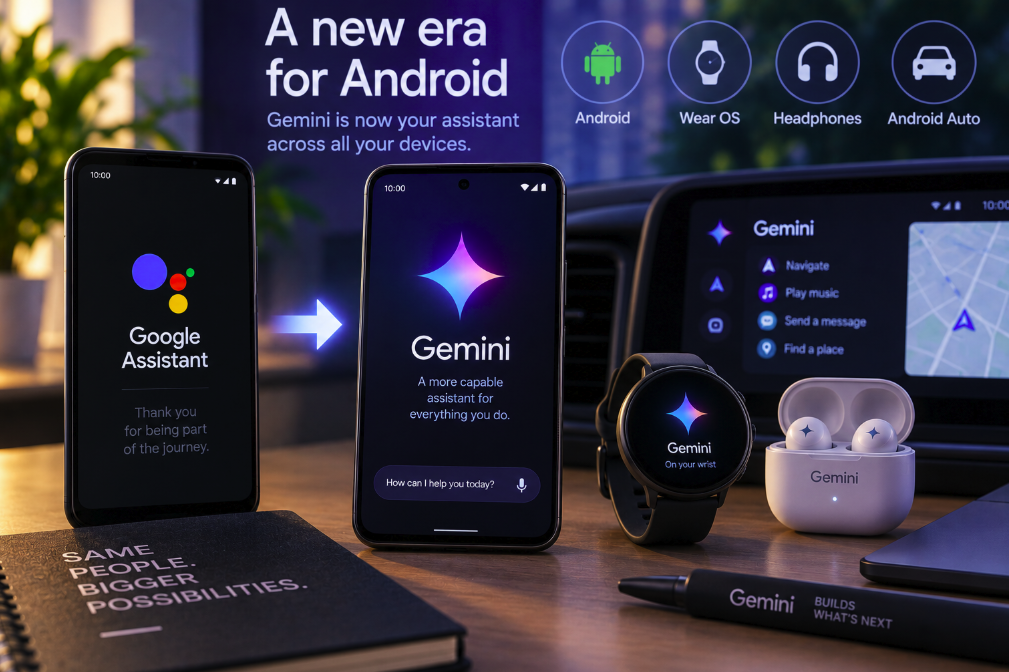
After a decade of being the default voice behind Android, Google Assistant is reaching its end on most mobile devices. September 4 is the key cutoff in Google's migration to Gemini, with the company removing the ability for most users to keep using — or switch back to — the classic Assistant on Android phones and tablets. Because paired accessories inherit the phone's assistant, the change also extends into Wear OS watches, compatible headphones and Android Auto.
The transition is not a single global switch flipping at midnight. 9to5Google reported the September 4 deadline in August, while Google's own community notices describe access removal as a phased process that may take several weeks to reach everyone. The direction, however, is definitive: on the affected mobile ecosystem, Gemini is becoming Google's assistant and the old Google Assistant is no longer the fallback.
September 4 is a milestone, not an instant worldwide blackout
Google's official communications contain a small timing nuance worth preserving. An Assistant community announcement says removal began September 3 and may take a few weeks to reach all users. An updated Gemini community notice says that on September 4 most users will no longer be able to use or switch back to Google Assistant on their phone or tablet.
In practical terms, September 4 is the major cutoff rather than a guarantee that every device in every country loses Assistant simultaneously. Rollout timing can vary, and Gemini itself remains subject to device, language and regional availability.
That distinction matters because the headline “Google Assistant dies today” describes the platform transition accurately but can sound more universal than Google's actual rollout. The mobile Assistant era is ending now; individual devices may cross the line at slightly different times.
The change starts on the phone and spreads to paired devices
The migration is broader than replacing one Android app. Google says that once Gemini becomes the assistant on a mobile device, it also becomes the assistant for compatible peripherals paired with that device.
That includes Wear OS watches, headphones or earbuds that support Gemini and vehicles using Android Auto projected from the user's phone. The phone effectively acts as the center of the assistant identity across a personal device network.
This is strategically important for Google. Assistant was historically implemented as a voice feature appearing in many different products. Gemini is being positioned as a common intelligence layer that can follow the user from phone to wrist to headphones to car.
Android Auto is moving from commands to conversation
The car is one of the clearest examples of what Google wants to change. Assistant was highly effective for predictable voice commands such as calling a contact, starting navigation or playing music. Gemini is designed to preserve those functions while accepting more natural and complex language.
Google's current Android Auto documentation says Gemini can follow a conversation and understand detailed questions rather than requiring users to rely on traditional command phrasing. Drivers can still invoke it with “Hey Google,” the microphone control or a steering-wheel voice button, but the interaction behind that familiar trigger is changing.
Gemini Live extends the experience further. Google gives examples such as asking the assistant to act as a tour guide during a road trip, brainstorming a gift while driving or practicing a speech conversationally. That is a different product category from the rigid voice-command systems that originally defined in-car assistants.
Not every car loses Google Assistant today
The automotive transition also has an important exception. Google says vehicles using Android Auto projected from a phone are part of the mobile migration, but cars with Google built-in can continue using Google Assistant beyond the September cutoff.
Google has separately begun making Gemini available in supported vehicles with Google built-in, but the migration path is not identical to projected Android Auto. That means an owner may still encounter Assistant in one car while Gemini has already replaced it on the phone.
This illustrates why Google's ecosystem transition cannot be reduced to one shutdown date. The company is retiring the classic mobile Assistant while upgrading different hardware categories on their own schedules.
Wear OS makes Gemini an assistant that can understand incomplete context
Google has been preparing the smartwatch transition for more than a year. In its original expansion announcement, the company described Gemini on Wear OS as an assistant designed for moments when pulling out a phone is inconvenient.
The difference is intended to be conversational rather than cosmetic. Instead of constructing a precise command, a user can speak more naturally and rely on the model to interpret context. That is particularly valuable on a watch, where the small display makes long manual interactions unattractive.
Current Google support documentation still reflects a mixed transition state because support varies by watch and region. Gemini is available on supported Wear OS devices, while some documentation continues to mention Assistant for devices where the migration has not completed. The September mobile cutoff accelerates that change for watches paired with affected phones.
Headphones inherit the assistant configured on the phone
Headphones and earbuds show the same ecosystem logic. Google's Gemini headphone documentation explains that compatible headphones can interact with Gemini when Gemini is set as the primary digital assistant on the connected phone or tablet.
Users can still invoke the assistant through “Hey Google” or supported touch gestures. Gemini Live can also be used through headphones, turning an audio accessory into an interface for an ongoing AI conversation.
From Google's perspective, this continuity is useful. The company does not have to retrain users to say a new wake phrase across every device. “Hey Google” survives while the intelligence answering it changes underneath.
Gemini is not simply Google Assistant with a new name
The replacement reflects a fundamental shift in Google's definition of a digital assistant. Assistant was built primarily around intents: identify what the user wants, map that request to a supported action and execute it. That architecture was reliable for commands but could become brittle when requests moved outside predefined patterns.
Gemini begins from a generative model capable of reasoning over less structured language and maintaining conversational context. It can answer open-ended questions, discuss what appears on a screen, work with images and support longer exchanges through Gemini Live.
Google is increasingly adding action-taking capabilities on top of that generative foundation. The result is an assistant expected to both understand a loosely expressed goal and execute tasks across applications and devices.
Google has spent more than a year closing the feature gap
The migration was not immediate because early versions of Gemini could not perform every routine device action that Assistant users expected. Timers, reminders, messaging, smart-home controls and app integrations are mundane compared with generative AI demos, but they are essential for an assistant that replaces a mature system.
Google therefore spent the transition period adding extensions and device controls while moving more users to Gemini. In its original mobile migration announcement, the company said millions had already switched and that it would continue upgrading the experience before removing classic Assistant from most mobile devices.
The September 2026 cutoff is evidence that Google now considers Gemini sufficiently complete to become the default rather than an optional alternative for the affected devices.
The old Assistant survives outside the mobile shutdown
Google Assistant is not disappearing from every piece of hardware today. Google explicitly says the mobile changes do not affect Google Nest and Google Home speakers, smart displays or other Assistant-enabled speakers and displays covered by separate migration plans.
Google has already announced that home devices will receive new Gemini-powered experiences, but the transition is being handled separately. That means the Assistant brand can continue to appear in parts of Google's installed hardware base even after most Android users can no longer choose it on their phones.
This is another reason to distinguish “Assistant is dead on mobile” from “every Google Assistant service has shut down.” The former is the significant event happening now; the latter is not yet true.
Google is replacing a voice assistant with an ecosystem agent
The bigger strategic shift is visible in Google's recent Android roadmap. The company increasingly describes Gemini as intelligence that spans devices and can act proactively, automate multi-step work and understand context from the user's applications and surroundings.
Google's Gemini Intelligence announcement describes capabilities that move well beyond asking for weather or setting a timer. The system is being designed to automate multi-step tasks across apps and extend across phones, watches, cars, glasses and laptops.
That creates a much larger ambition than Assistant ever fulfilled. The goal is no longer to provide a voice front end for individual services. It is to create a persistent AI layer capable of reasoning about the user's objective and coordinating actions across the Android ecosystem.
A more capable assistant also creates a larger privacy surface
The same capabilities that make Gemini more useful can require access to more context. An assistant that understands what is on the screen, works across apps and performs multi-step tasks potentially interacts with a wider range of personal information than one handling isolated voice commands.
Google emphasizes user control and privacy in its Gemini products, but the transition makes permission design increasingly important. Users need to understand which extensions are connected, which information Gemini can access and when data from one service can inform actions in another.
This becomes particularly sensitive as the assistant follows users across devices. A request initiated through headphones or a watch may rely on information and permissions associated with the phone. The experience can feel seamless only because the ecosystem is sharing enough context to make it seamless.
Developers are also losing an old interaction model
For Android developers, Assistant's retirement closes a chapter built around voice intents and predefined actions. Gemini's generative interface changes how users may discover and interact with apps because they can describe an outcome rather than knowing which application or command should accomplish it.
If Gemini becomes better at orchestrating tasks, the assistant can increasingly sit between the user and the app. That creates opportunities for services that integrate deeply with Google's AI layer, but it also raises familiar platform questions about mediation. The assistant may decide which service should satisfy a request before the user explicitly chooses an app.
In that sense, Gemini is not only replacing Assistant. It may become another discovery surface inside Android, one capable of influencing which apps, businesses and information sources receive user attention.
The unchanged “Hey Google” hides a major platform replacement
For many users, the migration may initially feel surprisingly small. They can continue saying “Hey Google,” asking for directions, sending messages and playing music. The device still responds with a familiar Google identity.
Behind that continuity, however, the underlying computing model is changing dramatically. A deterministic voice assistant built around supported intents is giving way to a generative system designed for conversation, multimodal understanding, reasoning and increasingly autonomous action.
Keeping the wake phrase while replacing the intelligence is a clever transition strategy. Google preserves years of learned user behavior while changing what the phrase can summon.
Google Assistant's retirement marks the end of the first voice-assistant era
Google Assistant launched in 2016 into a market defined by Siri, Alexa and the idea that voice would become a new computing interface. Those systems became ubiquitous, but their practical use often settled around a limited set of routines: weather, timers, music, navigation, messaging and smart-home commands.
Generative AI has reopened the original ambition. Large models can handle language that was too ambiguous for classic assistants, maintain longer context and work across information that does not fit into a predefined intent. The challenge now is making those systems reliable enough to act, not merely talk.
By removing Assistant from most mobile devices, Google is making a clear bet that the generative architecture has won. The company is no longer maintaining Gemini as an experimental companion beside its established assistant. Gemini is the assistant.
September 4 is the point of no return for Android's assistant strategy
The rollout will take time, exceptions remain and Google's smart-home transition follows a separate schedule. But the strategic ambiguity is over. Most Android users are losing the ability to switch back to Google Assistant, while paired watches, headphones and Android Auto increasingly inherit Gemini from the phone.
That makes September 4 more than a product deprecation date. It is the moment Google commits its core Android assistant experience to generative AI across an ecosystem measured in phones, wearables, audio devices and cars.
Google Assistant taught millions of people to speak to their devices. Gemini inherits that habit with a much larger promise: understand the conversation, reason about the goal and eventually carry out the work across the devices around you. The old Assistant is leaving mobile not because voice interfaces failed, but because Google believes the next assistant should be far more than a voice interface.