
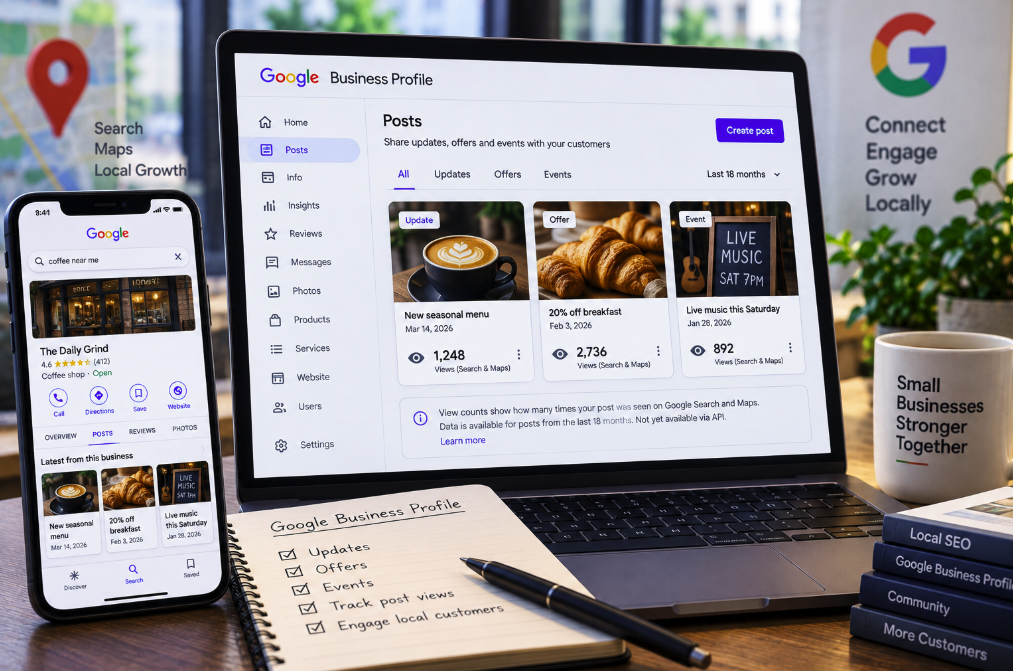
Google is restoring a piece of local-search reporting that Business Profile managers lost more than three years ago: view counts for individual posts. The company says post-level reporting is now rolling out globally inside the Google Business Profile dashboard, giving businesses a direct way to see how many views each update, offer or event generated across Google Search and Google Maps.
The feature was announced in Google's September Small Business Bulletin in the Google Business Profile Help Community and is described as Google Posts Reporting. According to Search Engine Journal's September 11 coverage, the dashboard will report views for posts published during a rolling 18-month window and combine exposure from Search and Maps into a single number.
For local marketers, that makes Google Posts measurable at the individual-content level again. But the return comes with two important limitations: Google says the data is not yet available through the Business Profile API, and it has not publicly defined exactly what constitutes a post “view.” Until that definition arrives, marketers should resist treating the new number as either unique reach or a conventional impression metric.
View counts now appear on individual post cards
The new reporting is designed to be simple. Businesses can open the Posts section of their Business Profile dashboard and see a view count attached to each eligible post. Google says reporting covers all major post types, including standard updates, offers and events, rather than limiting the metric to one format.
The 18-month window is rolling. That means the dashboard can provide enough history to compare different promotions, seasonal messages and event posts without becoming a permanent lifetime archive. Views from Google Search and Google Maps are combined, so the figure represents the post's visibility across Google's two primary local-discovery surfaces rather than providing separate Search-versus-Maps counts.
That aggregation makes the metric easy to scan but limits diagnostic depth. A restaurant may see that a weekend event post earned far more views than a standard update, for example, but the post-level number alone will not reveal whether that difference came primarily from Maps discovery, branded Search activity, broader local queries or another change in exposure.
Google removed the old post metrics in 2023
The feature is a return rather than an entirely new capability. Google Business Profile previously provided post views and post button clicks, but those metrics were retired in February 2023 during the transition to the newer Business Profile Performance API. Google's developer deprecation documentation listed both metrics as discontinued without a replacement.
That removal left a gap for businesses that publish regularly. Profile-level metrics could still show broader interactions such as calls, directions and website clicks, but marketers had less visibility into whether one individual post attracted more attention than another. The restored view count brings back part of that content-level feedback loop.
There had already been signs that Google was testing the feature. Search Engine Journal notes that screenshots of post view counts began circulating in August for some accounts while other profile managers could not see them. Google's bulletin now turns that limited observation into a confirmed global rollout and defines the 18-month reporting scope.
The metric combines Search and Maps views
Google's decision to combine Search and Maps matters because Business Profile posts can surface in different local contexts. A customer may encounter an offer while researching a named business in Search or discover the profile while navigating Maps. The post-level counter rolls those exposures into one number.
For day-to-day content planning, that may be enough. A local business can compare which topics, images, offers or event announcements tend to earn more visibility and use that information to inform future posts. A multi-location marketer can also inspect whether certain post formats consistently outperform others at individual locations, at least manually within the dashboard.
What the number cannot currently do is establish business impact by itself. A highly viewed post may create awareness without generating a call, booking or website visit. Conversely, a lower-view post aimed at a highly qualified local audience could produce more revenue. Post views should therefore sit alongside downstream Business Profile actions and business outcomes rather than becoming a standalone success metric.
Google has not defined what a “view” means
The biggest analytical ambiguity is the denominator. Google's announcement describes the metric as the number of times local customers viewed a post, but the available documentation does not explain whether repeated exposure from the same person counts multiple times, whether views are deduplicated over a particular period or whether the number effectively functions as an impression count.
That distinction can materially change interpretation. If the metric counts unique viewers, 2,000 views would describe approximate reach. If every eligible appearance can count, the same figure would describe exposure frequency instead. Without a formal definition, comparing the number with reach or impression metrics from advertising and social platforms risks creating false precision.
There is precedent for Google applying specific deduplication logic to other Business Profile metrics. The Performance documentation has defined profile views in ways that avoid counting the same user repeatedly within certain periods. But that definition cannot simply be assumed for the new post metric. Google has not yet said that post-level views use the same methodology.
The API gap is the bigger problem for agencies and multi-location brands
For a single-location business, dashboard-only reporting may be perfectly usable. The owner or marketer can open the profile, scan recent posts and learn which ones received the most attention. The limitation becomes much more significant for agencies and brands managing dozens, hundreds or thousands of locations.
Google explicitly says the feature is “not yet available in the API.” That means post-level view counts cannot currently be pulled automatically into the reporting pipelines, dashboards and data warehouses that large local-search programs use to aggregate performance. Teams that want the metric immediately are effectively restricted to Google's interface.
The wording “not yet” leaves open the possibility of API support later, but Google has not announced a date. Until then, organizations should be cautious about building manual processes around a metric that may be expensive to collect at scale. It may be more sensible to use the dashboard selectively for qualitative content analysis while continuing to rely on established API-accessible metrics for centralized reporting.
Post clicks have not returned with views
The old Business Profile post reporting included both views and button clicks. Google's current announcement focuses on views, and there is no corresponding announcement restoring individual post button-click reporting. That means the new feature solves the visibility question more directly than the engagement question.
This matters when comparing post types. An offer can be successful because it earns substantial exposure, but marketers often care more about what happened after someone saw it: whether they visited the website, called the business, requested directions, booked or redeemed an offer. Without post-specific click data, attributing those actions to an individual update remains limited.
Businesses can still use broader profile performance and web analytics to evaluate downstream behavior. Website links with appropriate campaign parameters can also help isolate traffic from links where Google allows them. But the restored post view count should not be mistaken for a complete post analytics suite.
How local marketers can use the metric without overreading it
The most practical use is comparative. Businesses can look at posts published under similar conditions and identify which subjects or formats attract more visibility. A retailer could compare product-launch updates with promotional offers; a restaurant could compare menu announcements with live-event posts; a service business could compare educational updates with seasonal promotions.
The analysis becomes stronger when marketers record context. Post type, publication date, image style, topic, offer value, seasonality and location can all influence views. Comparing an ordinary Tuesday update with a major holiday promotion and attributing the difference entirely to copy style would be misleading. The new metric is useful precisely when it is treated as one signal inside a controlled editorial learning process.
It can also help identify posts that underperform despite being strategically important. If an event announcement receives unusually low visibility, the lesson may not be that the event lacks interest. Timing, profile exposure, creative execution or local demand could all be factors. The view count tells the marketer where to investigate; it does not supply the diagnosis.
Google is slowly expanding the Business Profile measurement layer
The restored metric arrives during a broader period of change in local reporting. In 2026 Google also documented a native connection that can bring selected Business Profile metrics into Google Analytics, including interactions such as calls, directions and website clicks. That integration still has limitations, particularly for multi-location reporting, but it shows Google continuing to connect local-profile activity with wider measurement workflows.
Post-level reporting fills a different gap. It helps answer a content question—what did people actually see?—before the interaction metrics answer what some of them did next. If Google eventually exposes post views through the API and publishes a precise definition of the metric, agencies could begin connecting those two layers at much larger scale.
A useful metric returns, but with unfinished documentation
For now, the value of the update is straightforward. Google Business Profile managers once again have a native way to compare the visibility of individual updates, offers and events, with reporting available for the previous 18 months and exposure from Search and Maps combined.
The two missing pieces determine how far marketers can take it. Without API access, large-scale reporting remains cumbersome. Without a formal definition of a view, analysts cannot confidently say whether the count represents unique people, impressions or another deduplicated measure. Those are not reasons to ignore the feature, but they are reasons to avoid building overly precise conclusions around it.
Google has restored a useful feedback signal for local content. The best immediate use is to learn which Business Profile posts earn comparatively more attention and then connect that observation to calls, directions, clicks, bookings and revenue where possible. The number is back; the full measurement framework around it is not—at least not yet.