
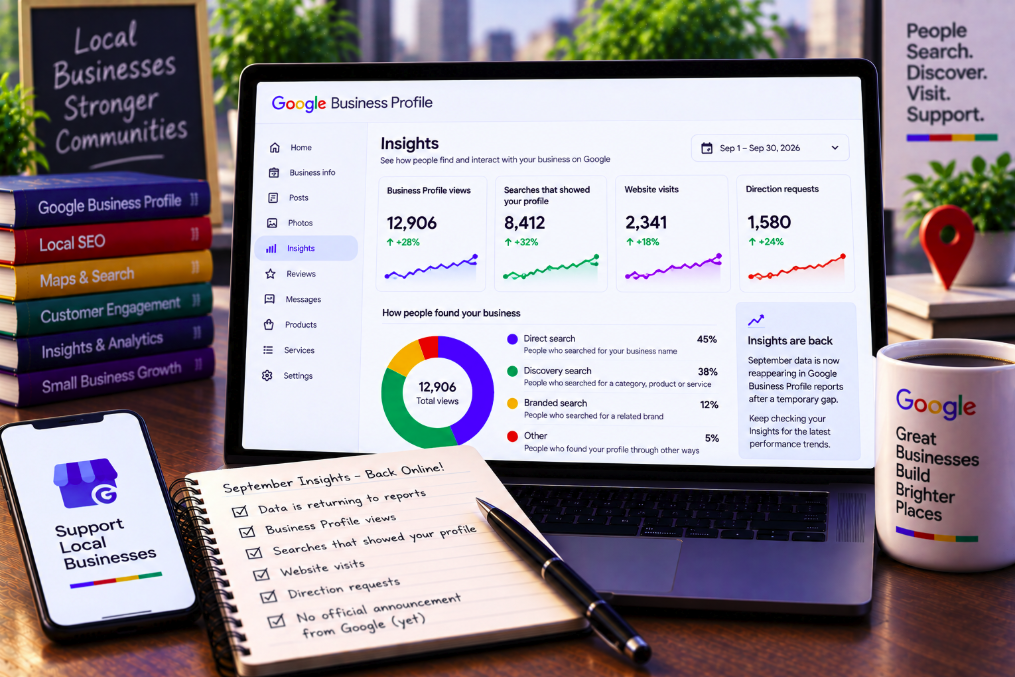
Google Business Profile performance data for September is beginning to reappear after several days in which business owners and local search professionals were seeing an empty month in their reporting.
The issue was first documented by Search Engine Roundtable on September 8, when Barry Schwartz reported that his Business Profile Insights contained no data for the entire month despite being eight days into September. On September 11, the article was updated with a more encouraging development: the missing data appeared to be populating again.
There is still an important qualification. No official Google incident announcement or public explanation for the reporting gap surfaced in the sources reviewed for this article. The evidence currently supports saying that September data is returning, not that Google has formally declared a resolved outage across every Business Profile.
For local SEO teams, that distinction matters. A temporary analytics gap can look exactly like a sudden collapse in customer discovery if the dashboard is read without checking whether the reporting system itself is current.
The problem became visible on September 8
Search Engine Roundtable's original report was straightforward: September 2026 was blank in Google Business Profile Insights.
A short delay would not normally have been surprising. Google Business Profile reporting is not always real time, and some metrics update on different schedules. But by September 8, Schwartz noted that the absence had continued well beyond the first few days of the month.
At that point, he could find some complaints in the community but did not describe the issue as a widely acknowledged outage. His expectation was that Google would eventually backfill the missing data.
Three days later, that prediction appeared to be coming true.
The September 11 update says data is populating again
Schwartz updated the original article on September 11 after observing that Google Business Profile Insights data had begun to populate.
This is the strongest available evidence that the reporting gap is resolving. It also suggests the blank September period was a data-availability problem rather than proof that customer interactions had stopped being recorded.
However, one observer seeing restored data does not establish that every account, location and metric has fully backfilled at the same moment.
Multi-location organizations should therefore check their own properties before marking the issue resolved internally.
Google's documentation says some monthly data can take up to five days
Google's official Business Profile performance documentation provides useful context for normal reporting delays.
Google says the Searches metric is updated at the beginning of each month and may take up to five days to appear. Search queries are recorded when a Business Profile appears for a particular search.
The September gap reported by Search Engine Roundtable had therefore extended beyond that documented five-day window by the time the issue was published on September 8.
That does not prove a specific technical incident occurred, but it explains why the missing data was notable rather than an ordinary first-of-the-month delay.
Business Profile performance covers more than search queries
The Business Profile Performance report helps owners and managers understand how customers discover and interact with their locations across Google Search and Maps.
Google's documentation lists metrics including views, searches and customer actions or interactions. Depending on the business type and available features, those interactions can help local marketers understand how profile visibility turns into customer behavior.
Not every metric is available for every business, and Google notes that only applicable metrics appear.
That makes it important to distinguish a missing metric from a missing reporting period. The September incident was notable because the month itself appeared empty rather than because one optional metric disappeared from one business category.
A blank dashboard is not evidence of zero demand
The practical risk during a reporting delay is misdiagnosis.
A local business might open its dashboard, see no September activity and assume a ranking loss, profile suspension, demand collapse or technical problem with its listing.
An agency could make the same mistake at scale, triggering unnecessary investigations across dozens or hundreds of locations.
When a reporting platform suddenly shows zeros or blanks across a clean date boundary, data freshness should be checked before performance conclusions are drawn.
Do not calculate September trends until the backfill stabilizes
Even when data begins to return, the first populated numbers may not represent the final complete dataset.
Backfills can arrive progressively by metric, date or account. A report that looks partially restored on September 11 may continue changing as additional events are processed.
Local SEO teams should therefore avoid comparing an incomplete September period with August or with the same period last year until they are reasonably confident the underlying data has stabilized.
A temporary undercount can create false month-over-month declines that disappear once reporting catches up.
Multi-location brands should check whether recovery is consistent
The issue is especially important for businesses managing large location portfolios.
One store showing September data does not prove that every store has been restored. Different profiles can occasionally experience reporting availability differently, and bulk dashboards can hide gaps at individual locations.
A sensible audit is to sample locations across regions and business types, compare the latest available dates and identify whether particular metrics remain blank.
If the restoration is uneven, analysts should annotate the affected locations rather than combining incomplete records into a network-wide performance report.
Exports can help preserve a clean historical record
Google allows Business Profile owners and managers to download performance data, including for multiple profiles.
That capability is useful beyond routine reporting. Periodic exports provide an independent historical snapshot when a live dashboard experiences a delay, interface change or retrospective revision.
For agencies and enterprise teams, maintaining regular exports can make it easier to distinguish a new reporting gap from an older data-quality issue.
Exports do not prevent Google-side delays, but they reduce dependence on whatever date range happens to be visible in the interface at the moment an anomaly appears.
The incident should not be confused with the normal metric cadence
Google Business Profile metrics do not all refresh identically.
Google's documentation explicitly warns that the Searches metric is monthly and can take several days to arrive. Other interaction data can operate on different schedules.
That means local marketers should build expected latency into dashboards and client reporting rather than assuming every number is complete through yesterday.
The September situation became noteworthy because the delay extended beyond the documented normal window and appeared broad enough to attract community attention.
There is no confirmed root cause
Without an official Google explanation, it would be speculation to attribute the missing September data to an API problem, migration, database failure, interface bug or intentional reporting change.
The available evidence tells us what users observed: September data was absent, and several days later it began appearing again.
It does not tell us why.
This distinction is important because temporary Google reporting issues are often quickly assigned technical explanations in social media discussions that later turn out to be unsupported.
There is also no evidence that historical data was permanently lost
The fact that data is now repopulating points in the opposite direction.
Search Engine Roundtable's original expectation was that Google would backfill the month, and the September 11 update indicates that process is occurring.
Businesses should still verify their own totals, especially if September data is used for billing, franchise reporting, executive dashboards or performance-based agency agreements.
But describing the incident as permanent data loss would go beyond the evidence currently available.
Local SEO reports need a data-freshness layer
The incident is a reminder that performance reporting should include metadata about the reporting system itself.
A dashboard can display the latest date available for each source, the expected update cadence and a warning when a feed is stale. That small addition prevents a missing-data event from being interpreted as a business event.
For example, if Google Business Profile is current only through August 31 while website analytics is current through September 10, the dashboard should make the mismatch obvious.
Without that context, clean visualizations can create false confidence from incomplete inputs.
Cross-checking other signals can prevent overreaction
When Business Profile reporting looks abnormal, teams can compare it with independent indicators such as website sessions from local search, call tracking, reservation systems, store visits, lead forms and point-of-sale activity where available.
If GBP Insights suddenly shows nothing while calls, bookings and local landing-page traffic remain normal, a measurement problem becomes more plausible than a real demand collapse.
No alternative dataset will perfectly reproduce Google Business Profile metrics, so these checks are not substitutes for the missing report.
They are diagnostic evidence that can stop teams from making premature ranking or budget decisions.
Agencies should annotate reports rather than rewriting the narrative
Reporting gaps are particularly awkward when monthly client reports are due during the incident.
The safest approach is to flag the affected date range, state that Google Business Profile data was delayed and avoid filling missing values with zeros.
Once the backfill is complete, the report can be refreshed with the restored figures.
This is more defensible than explaining an apparent September decline through algorithm updates, competitive activity or local demand before the source data is complete.
Google Business Profile remains a critical local measurement source
The temporary gap does not change the underlying value of Business Profile performance reporting.
Search and Maps remain central discovery environments for local businesses, and GBP data provides a direct view into how users encounter and interact with a location inside Google's ecosystem.
That makes data availability problems particularly visible to local marketers because there is no perfect third-party replacement for Google's own interaction reporting.
The stronger the dependency on one source, the more important it becomes to monitor its freshness and preserve historical exports.
The September incident appears to be resolving, but verification still matters
As of September 11, the best available evidence is positive: Google Business Profile Insights data for September is returning after several days of blank reporting.
Search Engine Roundtable has updated its original story to reflect the recovery, while Google's official help documentation continues to describe the normal Performance reporting system and its expected update cadence.
What remains absent is an official incident notice explaining the cause, scope or precise completion status of the backfill.
For businesses and local SEO teams, the immediate action is therefore simple: check September again, verify that the relevant metrics and locations are populating, and wait for the data to stabilize before treating early-month changes as real performance trends. The reporting gap looks temporary; the lesson about validating data freshness before diagnosing an SEO problem should be permanent.