
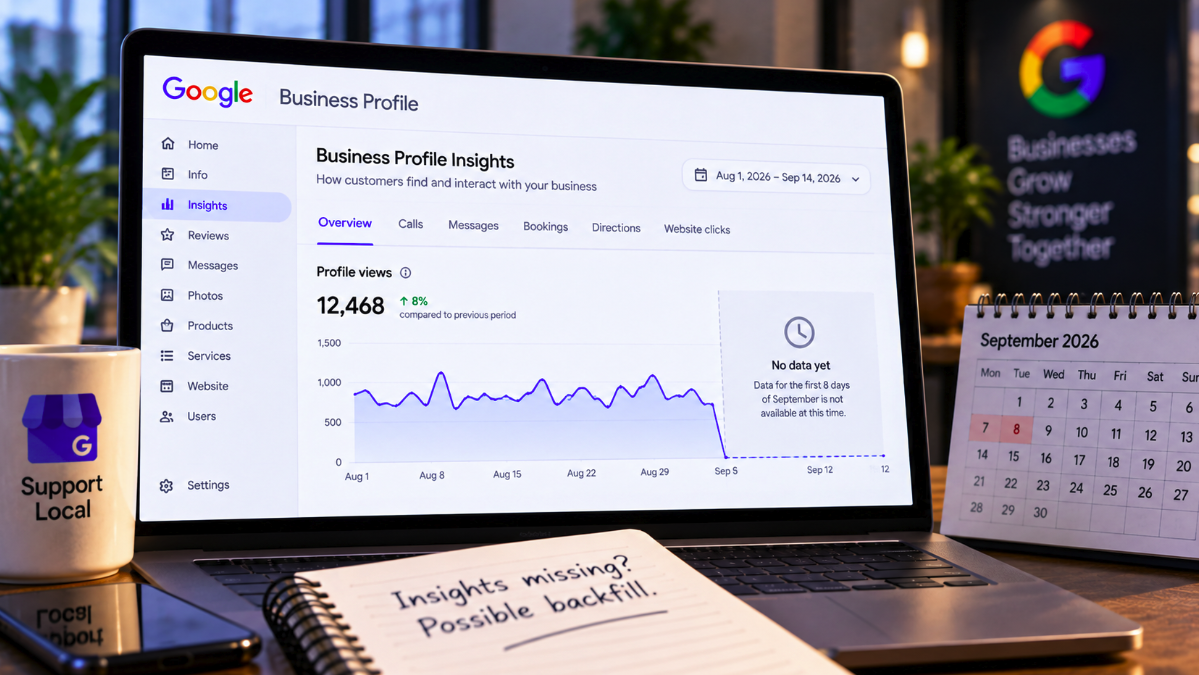
Some Google Business Profile owners may be looking at an empty September dashboard even though their businesses have continued operating normally.
Google Business Profile Insights appears to be missing data for the first eight days of September on at least some properties, according to Search Engine Roundtable. Barry Schwartz reported on September 8 that his own profile was still showing no Insights data for the month, well beyond the short reporting delay users commonly expect.
The evidence is still limited. There is no official Google confirmation of a Business Profile reporting outage, and the available reports do not establish that every property, country or metric is affected. The most accurate description is therefore that some Business Profile Performance dashboards appear to be missing early-September data and that a delayed backfill remains possible.
Most importantly, an empty analytics chart is not evidence that a business disappeared from Google Search or Maps.
Eight blank days are longer than a routine short delay
Google Business Profile Performance reporting is not perfectly real time. Delays of a day or several days can occur while Google processes customer interaction data, and different metrics do not necessarily finalize on exactly the same schedule.
Eight days of missing data, however, is enough to attract attention. Schwartz noted that he could see no September data at all in his Business Profile Insights as of September 8 and cited other users seeing similar behavior.
That pattern is what makes the situation newsworthy. A single property with missing metrics could have an account-specific issue. Several unrelated properties showing the same date boundary raises the possibility of a reporting delay on Google’s side.
It still does not establish the scale of the problem.
Google has not confirmed a bug
There is currently no official Google statement identifying the September gap as a product incident.
That distinction matters because local SEO reporting problems are easy to overgeneralize. Business Profile data can vary by property, metric and processing schedule, and isolated screenshots do not prove a global outage.
Until Google confirms a problem or a much larger set of profiles shows the same behavior, publishers should avoid headlines suggesting that all Google Business Profile analytics are broken.
The observed fact is narrower: multiple reports indicate that early-September Performance data has not appeared where users expected it.
Google’s own documentation acknowledges reporting delays
Google’s official Business Profile Performance documentation explains that Performance data shows how customers discover and interact with a verified Business Profile across Google Search and Maps.
The available metrics can include profile views, searches and customer actions such as website clicks, calls and other interactions, depending on the type of business.
Google specifically notes that the searches metric is updated at the beginning of each month and may take up to five days to appear. That statement applies to search terms rather than every metric in the dashboard, but it demonstrates that Business Profile reporting already includes normal processing latency.
By September 8, however, an eight-day absence would exceed that stated five-day window for the monthly searches metric.
Missing Insights data does not mean customers stopped finding the business
The most damaging mistake would be to interpret zeros or blank September charts as proof of a sudden local-search collapse.
Analytics systems and discovery systems are different layers.
A restaurant can continue appearing in Maps, receiving calls and sending visitors to its website while the dashboard responsible for aggregating those actions temporarily fails to display them. A retailer can continue receiving direction requests while the reporting interface remains behind.
If real-world activity looks normal but Insights suddenly falls to zero across a clean date boundary, reporting latency should be investigated before making SEO changes.
That does not mean every drop is a bug. It means the dashboard should be cross-checked against independent evidence.
Cross-check calls, website traffic and real business activity
Businesses affected by the apparent gap can use several external signals to determine whether customer demand actually changed.
Website traffic from local landing pages can be checked in analytics. Properly tagged Business Profile website links can provide additional evidence of visits. Call-tracking systems or telephone records can show whether customers continued calling. Booking platforms, direction requests where independently observable, point-of-sale activity and lead systems can also help establish whether the business continued receiving normal demand.
No single source perfectly recreates Google Business Profile Insights. The objective is not to manufacture a replacement dashboard but to answer a simpler question: did customer activity disappear, or did only Google’s report disappear?
If the external signals remain broadly normal, an empty Performance report becomes much less credible as evidence of a business problem.
Google Business Profile reporting has shown delays before
The September reports are not the first time Business Profile users have encountered missing or delayed Performance data.
A Google Business Profile Community thread from July 2026 described several profiles with incomplete June data, ranging from a few missing days to roughly two weeks. The recommended community response advised users to allow time for processing because delayed data can later be backfilled and to compare Business Profile reporting with other analytics sources in the meantime.
That guidance came from community contributors and Product Experts, not from a formal Google engineering incident report. It should therefore be treated as historical operational experience rather than a guarantee that September’s missing data will be restored in the same way.
Still, it provides a plausible precedent for waiting before treating blank dates as permanently lost measurements.
Backfill is possible, but it is not confirmed
Backfill occurs when an analytics system displays missing historical data after delayed processing catches up. From the user’s perspective, several blank days can suddenly populate without any change to the underlying Business Profile.
That is one possible outcome here because similar Business Profile reporting delays have been described in the past.
But no official source has confirmed that Google is currently processing a September backlog or promised that all missing metrics will return.
Businesses should therefore preserve the affected dates in their reporting rather than silently assuming either zero activity or guaranteed recovery.
If Google later fills the gap, historical dashboards and monthly totals may change after they have already been copied into internal reports.
Do not make local SEO changes just to fix an analytics gap
When a dashboard suddenly goes blank, teams often start changing things.
They edit categories, rewrite descriptions, modify landing pages, replace tracking parameters or otherwise intervene in an attempt to restore the missing numbers. If the real problem is reporting latency, those changes add noise without solving anything.
The first diagnostic step should be to verify that the Business Profile remains live, verified and visible. Check that website and phone information are correct, that there are no account warnings or suspensions and that customers can still find the listing from relevant searches.
If those fundamentals are healthy, the analytics gap can be investigated separately.
Reporting problems should not be treated as ranking problems without ranking evidence.
Multi-location businesses should compare properties
Organizations managing many locations have an advantage when diagnosing this kind of issue because they can compare profiles against one another.
If every location abruptly loses Performance data on September 1 while calls, bookings and site traffic continue, that strongly suggests a shared reporting problem rather than dozens of simultaneous local ranking collapses.
If only one property is affected while comparable locations update normally, the investigation should focus more closely on that profile and its account state.
This type of cross-property comparison can help establish scope even before Google comments publicly.
It can also reveal whether particular countries, categories or metrics are disproportionately affected.
Monthly reports should flag the affected period
The timing is inconvenient for agencies and local marketing teams that rely on Business Profile metrics for client reporting.
September dashboards may currently show misleading month-to-date comparisons. A chart containing eight blank days can make calls, views and other interactions appear to have collapsed even when the missing values are simply awaiting processing.
Rather than presenting those numbers as final, reports should annotate the affected period as potentially incomplete.
If the data is later backfilled, previously generated reports can then be reconciled against the revised totals.
This is especially important for automated executive dashboards, where a missing feed can otherwise generate false alerts or dramatic percentage declines without human review.
The problem exposes the risk of relying on one platform’s analytics
Business Profile Insights is valuable because it measures interactions that happen directly on Google Search and Maps. Those actions are difficult to reconstruct fully from a website analytics platform.
That also makes businesses dependent on Google’s reporting pipeline.
If the pipeline pauses, the underlying customer behavior becomes temporarily harder to observe. A company that has no call tracking, no tagged website links and no independent lead records may have little evidence available to distinguish a reporting outage from a genuine demand problem.
The solution is not to abandon Google’s metrics. It is to avoid making them the only evidence in a local performance measurement system.
Local visibility and local analytics should be monitored separately
The September gap is a useful reminder that local SEO performance has at least two different dimensions.
The first is visibility: whether the Business Profile appears for relevant searches and Maps queries. The second is measured interaction: what Google reports users did after encountering the profile.
A reporting failure can damage the second measurement without changing the first reality.
That distinction becomes particularly important when a dashboard shows a sudden, perfectly clean break at the start of a month. Real customer demand rarely falls to zero on the same day across unrelated metrics without leaving evidence elsewhere.
Analytics pipelines, on the other hand, often fail along date boundaries.
For now, treat September’s blank data as incomplete rather than zero
As of September 8, the available evidence supports caution rather than a definitive outage declaration.
Some Google Business Profiles appear to be missing Performance data for the first eight days of September. The delay is longer than many users normally expect, and similar reporting gaps have occurred before. But reports remain limited, Google has not officially confirmed a bug and there is no guarantee yet that every missing value will be backfilled.
Businesses should therefore avoid treating blank September Insights as proof of lost local visibility or lost customers. Cross-check calls, website visits, bookings and other operational signals, annotate affected reports and avoid unnecessary profile changes while the data situation develops.
If the numbers later return, the incident will have been a reporting delay rather than a traffic collapse. Until Google provides more information, that possibility should remain front and center.