
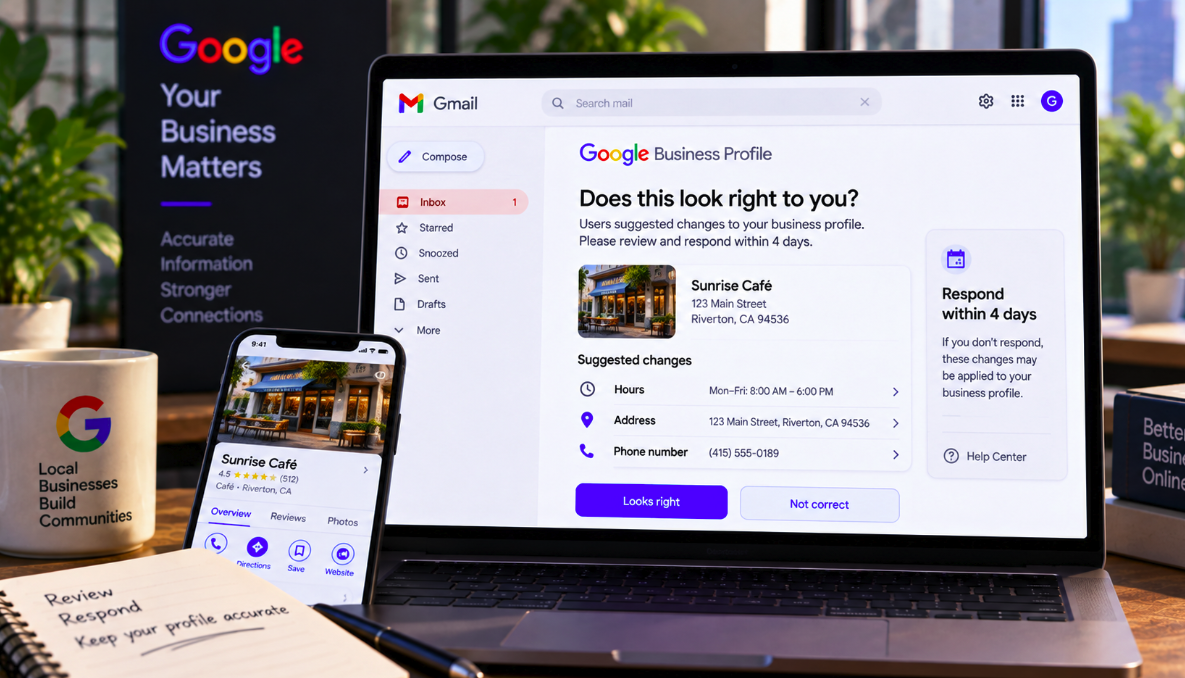
Google is giving some business owners a much clearer deadline for responding when users suggest changes to their Business Profiles.
A new email notification asks, “Does this look right to you?” and gives the profile owner four days to review a suggested edit, according to Search Engine Roundtable. The email was spotted by Vijay Chauhan and shared by Shreya Shah, adding a more explicit countdown to a process that has long allowed Google Maps and Search users to propose corrections to business information.
For local businesses, the message is straightforward: Google Business Profile is not a static listing that can be configured once and ignored. Customers, Google’s own systems and other data sources can all trigger proposed or applied changes, and Google is now testing or rolling out a notification that makes owner review more time-sensitive.
There is one important limitation in the available evidence. The four-day email does not establish that every unreviewed suggestion will automatically become public on day five. Google’s broader documentation says it evaluates profile updates from multiple sources and may apply some updates before an owner reviews them, but the exact consequence of ignoring this particular four-day email has not been formally documented.
The email turns a passive profile update into a deadline
The new message is notable because of its framing.
Instead of simply notifying a business that information may have changed, Google asks the owner directly whether a suggested edit is correct and provides a four-day window to respond. That makes profile maintenance feel closer to an approval workflow.
For an owner managing one location, four days may be easy to accommodate. For an agency, franchise or enterprise team managing hundreds or thousands of profiles, a short review window creates a much more operational problem.
A suggestion affecting opening hours, an address, a phone number or another customer-facing field can influence whether people visit, call or navigate to the business. Even a small inaccurate edit can therefore create real-world consequences.
Users have long been able to suggest edits to businesses
The underlying ability for Google users to report inaccurate business information is not new.
Google Maps and Search include mechanisms for suggesting edits when information appears incorrect. Those contributions can help Google detect businesses that moved, changed hours, use a different phone number or otherwise no longer match the information shown in the listing.
This crowdsourced layer is useful because business data changes constantly. Owners forget to update holiday hours, locations close, phone numbers change and websites can become outdated.
But crowdsourcing also means verified business owners do not have absolute control over every field indefinitely. Google treats the profile as a representation of the real-world business, not merely as content owned by the account holder.
Google can update profiles from several sources
Google’s official Business Profile documentation explains that profile information can be updated using multiple sources.
Those sources can include reports from Google users, licensed third-party content and information Google finds elsewhere online. Google may also use signals from the business owner and other sources to determine which information it believes is accurate.
That makes the new four-day email easier to understand. The owner is not being asked whether another user has permission to edit the listing directly. Google is asking the owner to contribute evidence to a decision Google ultimately controls.
Business verification gives the owner powerful management capabilities, but it does not prevent Google from correcting information it believes is wrong.
Some Google updates can appear before the owner reviews them
Another important detail in Google’s documentation is that owner approval is not always a prerequisite for a profile update.
Google says some changes based on other sources can be applied before the business reviews them. Owners may then see updated fields highlighted in their profile and can edit the information if it is incorrect.
That means businesses should not interpret the new email as evidence that Google will always wait four days before changing anything.
The workflow can vary depending on the type of information, Google’s confidence and the signals available to its systems.
The safest operational approach is therefore to review the notification promptly rather than trying to predict what happens after the deadline.
Four days can be significant for opening hours
Not every Business Profile field carries the same risk.
A minor descriptive change may have limited immediate effect. Incorrect opening hours can send customers to a locked door.
That is particularly important for restaurants, retailers, medical practices and service businesses where customers make decisions based on whether Google says a location is open now.
If a user suggests that a store closes at 6 p.m. instead of 9 p.m., an inaccurate update could discourage evening visits. The opposite error could be worse: Google could send customers to the business after it has closed.
Businesses with frequently changing schedules should therefore treat user-suggested hour edits as operational data, not just SEO metadata.
Phone numbers and addresses deserve the same urgency
A wrong phone number can redirect leads away from the business. A wrong address can disrupt navigation and local discovery. A category change can alter which searches Google considers relevant to the profile.
These fields sit directly between online discovery and offline revenue.
That makes the four-day review window especially important for organizations where the person receiving Google notifications is not the person who knows whether the information is correct.
An agency may need confirmation from a client. A franchise marketing team may need to contact a store manager. A healthcare organization may need approval from an operations team.
Four days can disappear quickly when profile governance involves several people.
Multi-location brands need a defined review process
The new email format is a useful reason for larger organizations to examine who receives Business Profile notifications and who is responsible for acting on them.
A shared inbox that nobody monitors daily is a weak control for hundreds of customer-facing locations.
Multi-location businesses should know which team owns profile accuracy, how suggested changes are validated against internal records and how urgent fields such as hours, addresses and phone numbers are escalated.
The process should also preserve a record of changes. If a listing suddenly displays incorrect information, knowing when a suggestion appeared and how the organization responded can make troubleshooting much faster.
User suggestions are signals, not guaranteed corrections
Businesses should also avoid treating every suggested edit as malicious or every user report as accurate.
Many suggestions are legitimate attempts to correct stale information. Others can be mistaken, based on temporary circumstances or submitted without enough context.
Google says Business Profile edits are reviewed for quality before publication. Its systems can combine owner information, user feedback and other sources rather than accepting a single report as unquestioned truth.
That is why the email asks whether the suggestion “looks right.” The business owner is one important source of evidence in a larger verification process.
The correct response should be based on the real-world state of the business, not simply a preference to preserve the existing listing.
The four-day deadline does not prove automatic approval
The most tempting interpretation of the new email is that silence equals consent after four days.
The currently available reporting does not prove that.
Search Engine Roundtable shows the email giving owners four days to tell Google whether the proposed change looks correct, but there is no cited Google documentation stating that every suggestion automatically publishes if the owner fails to respond within that window.
Google may already have enough independent evidence to apply an update before the deadline, may apply it later, or may reject it through its own quality systems.
Until Google documents the exact lifecycle of these notifications, the four days should be treated as a review deadline rather than a guaranteed automatic-publication timer.
Local SEO monitoring should include profile fields, not only rankings
Many local SEO dashboards focus heavily on rankings, reviews and traffic. Business Profile data integrity deserves equal attention.
A company can rank well and still lose customers because its displayed phone number is wrong. It can have strong reviews and still create a poor customer experience because holiday hours were not corrected. It can maintain an optimized landing page while Maps points visitors to an outdated address.
Profile accuracy is therefore part of conversion optimization as much as search visibility.
The new Google email reinforces that point by putting a clock on at least some suggested changes.
Businesses should verify information beyond Google
Because Google can use information found elsewhere online, profile governance should extend beyond the Business Profile itself.
If a company website lists one set of hours while Google Business Profile lists another, the contradiction can create uncertainty for both users and automated systems. The same applies to addresses, phone numbers and other core business details.
Keeping authoritative first-party pages accurate gives Google another reliable source against which user suggestions can be evaluated.
For multi-location brands, location pages should therefore be maintained as operational records rather than neglected SEO templates.
Consistency does not guarantee that Google will reject an incorrect user suggestion, but it reduces ambiguity around what the correct information should be.
Notification hygiene is becoming part of local SEO
The practical lesson from the new email is surprisingly mundane: somebody needs to read the inbox.
Google Business Profile notifications can contain information with immediate consequences for how customers find and contact a business. If those messages are routed to a former employee, an unmonitored agency account or a mailbox flooded with automated alerts, a four-day review period may effectively pass unnoticed.
Businesses should confirm that current owners and managers have appropriate access and that important Google notifications reach people who can act on them.
That is not glamorous SEO work, but it can prevent a highly visible listing from drifting away from reality.
Google is making profile accuracy a more active negotiation
The “Does this look right to you?” email captures how Google Business Profile increasingly operates.
The listing is not solely a document written by the business. It is a continuously reconciled representation assembled from owner input, user reports, licensed information and signals Google finds across the web.
The business owner remains an important authority, but Google is actively asking that authority to respond when competing information appears.
A four-day review window makes that relationship more explicit.
For local businesses, the response should not be panic about crowdsourced edits. It should be better operational discipline: monitor profile notifications, validate suggested changes quickly, keep first-party information accurate and correct Google when its systems get the facts wrong.
The new email is a small interface change, but it carries a clear message. Google Business Profiles need active stewardship, because the information customers see can be challenged even after the listing has been verified.