
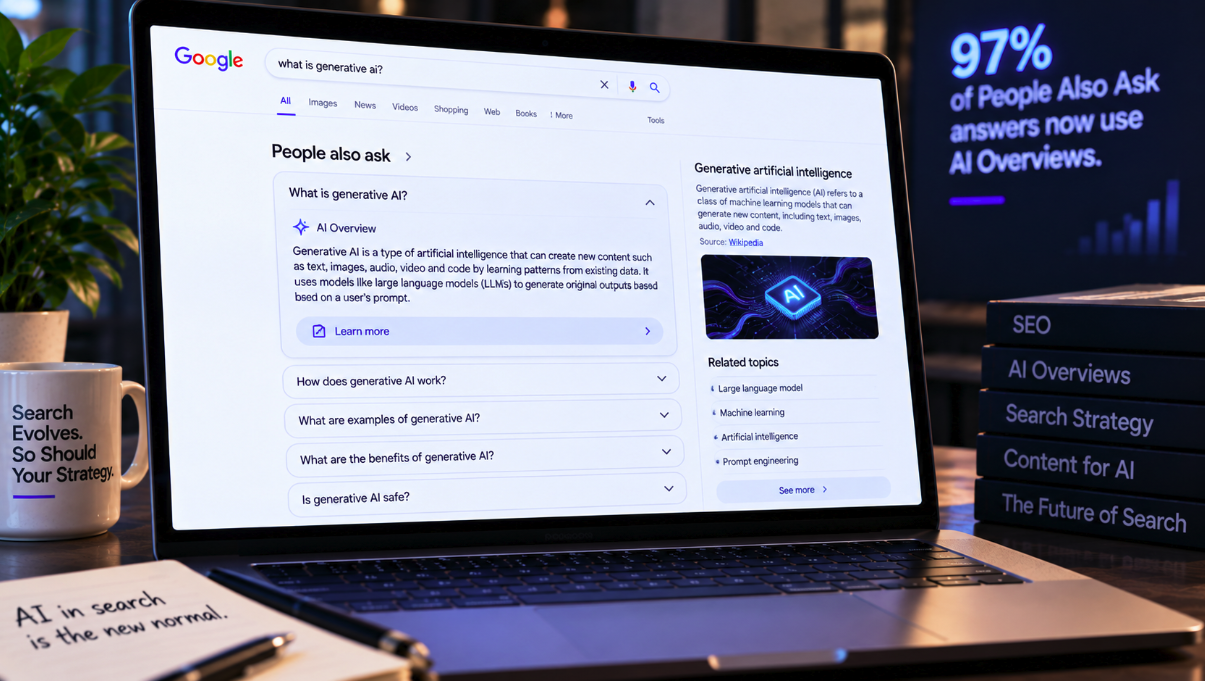
People Also Ask used to be one of Google’s clearest bridges between a question and a publisher’s answer. A user expanded a related question, Google extracted a passage from a webpage, and the source received prominent attribution inside the box.
That model appears to be disappearing at remarkable speed.
According to new data from AlsoAsked, 97% of the English-language People Also Ask answers it measured during the first week of September were generated as AI Overviews. The share was 86% in August.
The underlying dataset is large: 19.2 million live English-language PAA questions collected during 2026. Search Engine Roundtable reported the figures on September 9 after speaking with AlsoAsked founder Mark Williams-Cook, who said the September reading had reached 97% but not yet 100%.
The Search Engine Roundtable report captures a transformation that is easy to underestimate. Google has not merely added AI Overviews above conventional search results. It appears to be replacing the answer mechanism inside one of its longest-running question-discovery features.
The result is a People Also Ask box that increasingly still supplies the questions while Google’s generative systems supply the answers.
AlsoAsked measured 97% AI-generated PAA answers in early September
AlsoAsked’s latest chart covers 19.2 million English-language People Also Ask questions collected from January 1 through September 7, 2026.
For the first seven days of September, 97% of the measured answers were classified as AI-generated through AI Overviews.
August had already reached 86%.
The progression becomes more striking when compared with earlier months. The reported 2026 series is 22% in January, 24% in February, 14% in March, 11% in April, 40% in May, 64% in June, 61% in July, 86% in August and 97% during September 1–7.
That is not a smooth rollout.
AI-generated answers actually declined from February through April and dipped again from June to July before accelerating sharply. The direction since July is dramatic, but the historical reversals are a reason not to treat 100% as inevitable until it is actually measured.
Fourteen months ago, AI answered only about one in eight PAA questions
The speed of the longer-term change is even clearer against AlsoAsked’s earlier research.
In July 2025, Search Engine Roundtable reported that AlsoAsked found 12.6% of People Also Ask answers were AI-generated, while 87.4% were classified as website-cited answers.
Roughly 14 months later, the measured AI share is 97%.
That represents a fundamental reversal in the dominant answer format.
The old PAA experience largely took an answer from a webpage and displayed an attributed extract. The new experience increasingly allows Google to synthesize the response through its AI systems.
For publishers, those are not equivalent surfaces.
People Also Ask is becoming a generative-search interface
PAA has traditionally occupied an unusual position in Google Search.
It is both a discovery mechanism and an answer mechanism. Google predicts related questions, then lets users expand them without issuing an entirely new search.
Historically, expanding a question generally produced a featured-snippet-style answer extracted from a webpage.
Google’s own Visual Elements Gallery still describes the Related Questions group — its documentation name for People Also Ask — as showing a featured snippet when a user expands a question.
The latest observed data suggests the live interface has moved much further toward generative answers than that description implies.
Google has not published a Search Central announcement saying that 97% of PAA answers are now AI Overviews. The percentage comes from AlsoAsked’s external measurement, not an official Google disclosure.
97% does not mean 97% of all Google searches
The scope of the statistic matters.
AlsoAsked measured English-language People Also Ask answers in its own dataset. It did not find that 97% of all Google searches contain an AI Overview.
It also does not establish that 97% of PAA answers in every country and language are AI-generated.
Google has rolled out AI search experiences unevenly across markets and languages, and this particular measurement is explicitly English-language.
The September figure is also based on only the first seven days of the month, whereas the earlier monthly points cover longer periods.
The dataset is large, but the latest time bucket is short.
The methodology deserves caution despite the large sample
Nineteen million questions sounds definitive, but sample size is only one component of measurement quality.
Public reporting around the AlsoAsked chart does not provide a detailed research paper explaining how the live PAA questions were sampled, how query distributions changed over time or precisely how each answer was classified at scale.
AlsoAsked’s core product is built around collecting live People Also Ask data, which gives the company unusually direct visibility into the feature. That makes the trend worth taking seriously.
It does not eliminate the need for methodological caution.
The 97% figure should therefore be described as AlsoAsked’s measurement of its English-language PAA dataset, not as a Google-certified statistic.
A second dataset points in the same direction
Search Engine Roundtable also highlighted data from Allintitle’s Also Ask Miner.
That dataset reportedly showed People Also Ask answers reaching 100% AI-generated beginning in August 2026.
The directional agreement is notable: two independent SEO data providers are seeing AI-generated answers dominate PAA.
But the percentages should not be combined.
The tools can use different query sets, collection systems and classification methods. AlsoAsked says 97%; Allintitle reportedly sees 100% in its own data.
The defensible conclusion is that AI-generated PAA answers have become overwhelmingly prevalent in the measured datasets, not that one exact percentage universally describes Google Search.
An AI-generated PAA answer does not necessarily mean there are no publisher links
Another distinction is critical for publishers.
AlsoAsked’s classification contrasts AI-generated answers with the older website-cited answer format. That establishes a change in how the response itself is produced.
It does not establish that AI-generated answers contain no links to supporting websites.
Google’s documentation for AI features says AI Overviews surface relevant supporting links and use web content from Google’s Search index to help construct responses.
Publishers can therefore still appear as sources inside generative answers even when Google is no longer extracting one publisher’s paragraph as the answer itself.
The competitive model has changed from winning the answer box to being selected as a supporting source for a synthesized answer.
The old PAA optimization model is losing its foundation
For years, a familiar SEO tactic was to find People Also Ask questions, turn them into headings and place a concise answer directly underneath.
That approach was partly designed to make a passage easy for Google to extract into a featured snippet or PAA answer.
The latest data weakens that specific rationale.
If Google synthesizes 97% of the measured answers instead of simply extracting a passage, formatting a 40-word paragraph to fit the old answer box is no longer the whole objective.
That does not mean question-oriented content has become useless.
Quite the opposite: questions remain valuable signals of user intent. What changes is what publishers are optimizing for.
The goal increasingly becomes providing information strong enough to be retrieved, understood and cited by a generative system rather than merely producing a passage with the right snippet shape.
Google says AI Search still relies on the Search index
The shift does not make conventional SEO irrelevant.
Google’s current guide to generative AI Search optimization says AI features remain grounded in the company’s core Search ranking and quality systems.
Google describes retrieval-augmented generation as one of the mechanisms used to retrieve relevant, current pages from its Search index before producing an AI response.
To be eligible as a supporting link in AI Overviews or AI Mode, a page must be indexed and eligible to appear in Google Search with a snippet.
Google says there is no special AI schema or machine-readable file required.
The fundamentals — crawlability, indexability, useful content and relevance — therefore still determine whether a page can enter the retrieval pipeline.
Do not respond by publishing one page for every PAA question
The 97% statistic could encourage exactly the wrong content strategy.
If People Also Ask exposes hundreds of related questions and AI systems use those questions to construct answers, publishers may be tempted to programmatically generate a separate page for every variation.
Google explicitly warns against that approach.
Its 2026 generative AI optimization guidance says creating separate content for every possible variation of related or fan-out queries primarily to manipulate Search or generative responses can violate Google’s scaled content abuse policy.
Google also says its systems can understand relevance even when a page does not contain an exact textual match for every possible query.
The better use of PAA data is therefore editorial.
Questions can reveal which subtopics users care about, where explanations are missing and how one topic branches into another. They do not automatically justify one URL per question.
PAA remains valuable as a map of user curiosity
Even if the answer layer becomes entirely generative, the questions themselves remain useful.
People Also Ask reveals how Google connects an initial query to follow-up information needs.
A search for a broad topic can expose questions about definitions, comparisons, costs, problems, alternatives and next steps. Expanding questions can reveal additional branches.
That makes PAA a useful research surface for understanding topic structure and search journeys.
The difference is that publishers should increasingly treat the questions as research inputs rather than viewing every PAA box as a featured-snippet acquisition opportunity.
The change could alter how PAA traffic should be valued
Under the traditional model, a publisher whose passage was extracted into PAA could receive visible attribution directly beside the answer.
Under an AI Overview model, Google can combine information from multiple sources into one response and present supporting links according to its generative interface.
That makes the relationship between visibility and clicks less straightforward.
The 97% figure itself does not measure click-through rate, publisher traffic or revenue. No traffic-loss percentage can be inferred from it.
It does, however, show that anyone evaluating PAA performance using assumptions from the featured-snippet era may now be measuring a materially different search product.
AI visibility inside Google is finally becoming easier to measure separately
The timing is notable because Google has also changed its reporting infrastructure.
In June, Google announced dedicated generative AI performance reports in Search Console. As of August 31, Google says those insights have rolled out to websites worldwide.
The reports provide dedicated visibility into impressions from generative AI features such as AI Overviews and AI Mode while keeping that activity included in overall Search performance.
That gives publishers more direct data for evaluating whether their own visibility is moving toward generative surfaces.
It should not be assumed, however, that the report isolates People Also Ask AI answers as a separate category unless Google explicitly documents that segmentation.
A third-party 97% PAA average cannot tell a publisher what happened to its own pages.
Google has not announced the transformation — but the interface is changing anyway
Perhaps the most interesting aspect of the PAA shift is how quietly it has happened.
There has been no major Google announcement declaring that People Also Ask is becoming an AI Overview product.
Instead, external measurement shows the proportion of AI-generated answers moving from roughly one in eight in mid-2025 to almost every measured answer in early September 2026.
That fits a broader pattern in Google Search: generative AI is becoming less of a standalone box and more of an underlying answer layer across the search experience.
AI Overviews can expand into deeper conversational experiences. AI Mode can fan out into multiple related searches. And now PAA appears increasingly capable of answering follow-up questions through the same generative paradigm.
People Also Ask may survive — while the old answer box disappears
The 97% figure does not suggest People Also Ask itself is going away.
It suggests the feature is changing roles.
The questions still help users explore a topic. What is disappearing, at least across AlsoAsked’s English-language sample, is the assumption that expanding one of those questions will reveal a traditional answer extracted from a single webpage.
In August, AI Overviews powered 86% of the measured answers. During the first week of September, the figure reached 97%.
Whether that becomes 100% next week, next month or never is not yet known. The 2026 series has already reversed direction more than once, and Google has not announced a target.
But the larger transition is difficult to miss.
People Also Ask was once a network of questions leading to featured snippets.
It is rapidly becoming a network of questions leading to AI-generated answers — and for publishers, that means winning the question is no longer the same thing as owning the answer.