
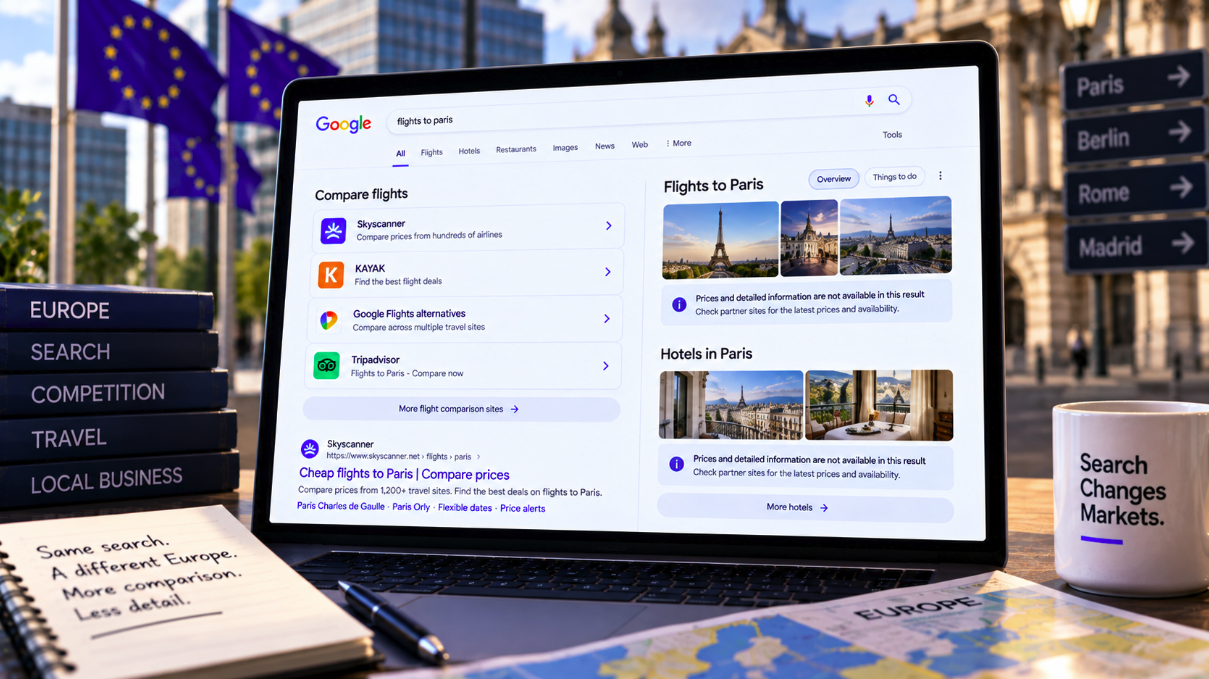
Google Search is becoming a materially different product in Europe, and the latest redesign could shift visibility away from hotels, airlines, restaurants and other direct suppliers toward the comparison platforms that sit between them and customers.
Google is revamping European search results to give vertical search services more prominent placement while reducing the information shown inside some of its familiar travel and local result formats, according to Reuters reporting published September 8.
The changes are part of Google’s continuing response to the European Union’s Digital Markets Act, or DMA, and follow a €460 million fine imposed in July over concerns that Google favored its own specialized services.
For search marketers, the important point is not simply that Europe has another regional Search variation. The new design changes who receives prominent space on commercially valuable results pages and how much information Google can expose before a user clicks.
Comparison services are moving higher in the European search journey
Reuters reports that Google’s restructured format gives greater visibility to vertical search services, or VSS providers.
These are specialized intermediaries and comparison platforms operating in categories such as hotels, flights, restaurants and shopping. Rather than sending a user directly from Google to a hotel, airline or restaurant, a vertical search service can provide its own comparison layer between the search engine and the supplier.
Under the new format described by Reuters, one VSS receives a prominent position followed by two additional comparison services.
That creates a new competitive layer inside the SERP.
A hotel is no longer competing only with other hotels for Google visibility. It can also be competing for the click with booking and comparison platforms that aggregate many hotels — including potentially the same property the user could have reached directly.
Google’s travel and local carousels are losing prices and other details
The second change moves in the opposite direction.
While comparison services gain space, Reuters reports that traditional Google carousels covering categories such as hotels, flights and restaurants are being stripped of real-time prices and other useful details.
That matters because rich information can shorten the path between a search and a decision.
A traveler who can see a hotel price directly in Google can evaluate an option before visiting another site. A diner who sees detailed restaurant information can make a faster local decision. Removing information adds another step to the journey.
Google argues that this produces a lower-quality experience for European users. Comparison services and European regulators have taken a different view of Google’s role, arguing that rich Google-owned formats can give the company an unfair advantage over competing specialized search providers.
The redesign is the latest attempt to reconcile those competing interpretations of what a neutral search results page should look like.
This is not merely another regional feature availability update
Google Search already behaves differently by country, language and regulatory region, and Europe has accumulated a growing list of DMA-specific product changes since 2024.
The September development is nevertheless distinct from documentation that simply tells users whether a Search feature is available in a particular region.
This is a competitive redesign of the results page itself.
The order, prominence and information density of commercial search modules are being altered in response to EU competition rules. That means European SEO teams need to evaluate not only whether a feature exists, but how the available screen space is being redistributed between Google, intermediaries and direct businesses.
The DMA has already changed more than 20 Google Search features
The latest move sits on top of a much longer compliance process.
Google said in a November 2024 DMA update that it had already made more than 20 changes to Search in Europe. Those included dedicated units and formats intended to increase the prominence of comparison sites in categories such as flights, hotels and shopping.
Google also removed or reduced features it had previously used to present travel and local information directly in the SERP.
The company has consistently argued that these changes benefit large intermediaries at the expense of direct suppliers. Its public position is that airlines, hotels, retailers and restaurants can lose free direct traffic when users are routed through aggregators instead.
That is Google’s interpretation of the DMA’s market effects, not a neutral finding about every European query.
Google says direct hotel booking clicks have fallen as much as 30%
One of Google’s most repeated statistics is that some European hotels have reported free direct booking clicks falling by as much as 30% following earlier DMA changes.
Reuters cites the same concern in its coverage of the new redesign.
The number needs careful framing.
It does not mean every hotel in Europe lost 30% of its Google traffic, nor does it prove that the DMA caused a uniform 30% decline across the sector. Google has presented it as a reported upper-end impact from affected businesses.
Still, the mechanism behind the concern is easy to understand.
If Google places more intermediary links between the searcher and the supplier, some users who previously clicked directly to a hotel can instead click to a comparison platform. The hotel may ultimately receive the booking through that intermediary, but the commercial relationship and acquisition cost can be different.
A previous Google test found removing hotel features hurt hotels more than intermediaries
Google has previously tested a more radical version of the stripped-down European SERP.
In late 2024, the company temporarily removed several hotel-search features for users in Germany, Belgium and Estonia. The experiment removed the hotel map and associated rich results, replacing them with a simpler list of links closer to the old “ten blue links” model.
Google later published results from that test.
According to the company, users were less satisfied, needed more searches and took longer to find hotels. Overall traffic to both hotels and intermediary sites declined, but Google said hotels lost more than 10% of traffic while intermediary traffic remained largely flat.
Google ended the experiment.
Those findings were produced and reported by Google itself, so they should not be treated as independent evidence that every reduction in rich search features will have the same effect. They do, however, show why the company is warning that the new 2026 redesign may involve trade-offs.
The European Commission sees a competition problem where Google sees a product-quality problem
The disagreement is fundamentally about the role of a dominant general search engine.
Google argues that rich modules — maps, prices, ratings, flight information and direct business links — make Search more useful. From that perspective, removing details forces users to make additional clicks and can divert traffic toward intermediaries that charge suppliers commissions.
The European competition framework focuses on a different risk: a dominant platform can potentially use its control of the general search results page to favor its own specialized services over rival comparison providers.
The DMA is designed to constrain that gatekeeper power.
Reuters reports that the latest Search changes follow the July €460 million fine connected to Google’s treatment of competing vertical services.
The result is an unusual product-design problem in which a search feature can be evaluated simultaneously for user utility and competitive neutrality — and the two goals do not necessarily produce the same interface.
Local businesses may lose information density even when they keep visibility
For local SEO, the issue is not simply whether a business disappears from Google.
A restaurant, hotel or other local company can remain present while the result around it becomes less informative.
That distinction matters.
Rich result modules allow a business to communicate price, ratings, availability, location and other decision-making details before the user visits a website. If those elements are reduced, the business may retain an impression but lose some of the SERP’s ability to convert that impression into a direct action.
At the same time, comparison platforms can gain more visually prominent routes into the same customer journey.
European local-search reporting may therefore need to distinguish between raw presence and the quality of that presence.
Comparison sites become a more important SEO distribution channel
The redesign also changes the strategic value of third-party platforms.
If Google is required to surface more comparison services, visibility inside those services can become a second-order SEO problem.
A hotel may need to rank well in Google, but it may also need accurate inventory, competitive information and strong representation on the vertical platforms Google places above or beside direct supplier links.
The same logic can apply to restaurants, flights and shopping.
This does not mean every business should abandon direct SEO in favor of intermediaries. Direct visibility remains valuable precisely because it avoids another layer between the customer and supplier.
It does mean European search strategy increasingly includes both the Google SERP and the platforms Google is being required to expose more prominently.
Organic rankings can stay unchanged while click distribution changes
This is an important measurement problem for SEO teams.
A website can hold the same conventional organic position before and after a SERP redesign while receiving fewer clicks because new modules have appeared above it or because users are diverted into comparison experiences.
Conversely, a comparison service can gain traffic without improving its traditional blue-link ranking if Google grants its category a new dedicated unit.
Rank tracking alone will not capture that change.
Teams operating in Europe need to monitor the actual composition of results pages, Search Console click-through rates, branded versus non-branded traffic and direct-booking behavior alongside conventional rankings.
A stable position does not imply a stable search journey.
Google is simultaneously making AI travel search richer
The contrast with Google’s AI products is particularly striking.
Only days before Reuters reported the European SERP changes, Google announced new travel capabilities for AI Mode.
In an August 27 product update, Google said AI Mode can use real-time data to compare flights and hotels and is adding features such as flight-price tracking and hotel booking assistance.
That does not mean every AI Mode feature is available identically across Europe, nor does it override DMA requirements.
It does illustrate how Search can diverge by surface.
The conventional European SERP can become less information-dense in response to competition regulation at the same time that AI Mode becomes more capable of synthesizing travel options and prices.
For marketers, “Google Search visibility” is therefore becoming too broad a category to describe one consistent interface.
The change could increase the value of brand demand
When generic discovery becomes more intermediated, direct brand demand can become strategically more valuable.
A user searching broadly for “hotels in Paris” may encounter comparison services before individual properties. A user searching for a specific hotel by name has a clearer destination in mind.
That does not guarantee the branded search will bypass every intermediary module, but strong brand recognition can reduce dependence on generic category discovery.
For hotels, restaurants and other local businesses, this reinforces the relationship between SEO and broader brand marketing.
The less control a supplier has over the generic results-page architecture, the more valuable it can be for consumers to seek that supplier directly.
Europe is becoming its own search market
SEO has always been geographically variable. Search results differ according to language, location and local competition.
The DMA adds another dimension: regulation can now create structurally different SERPs for European users.
A travel SEO strategy tested in the United States may not map cleanly to France, Germany, Italy or Spain if Google is required to present comparison services differently there. Screenshots from one market can misrepresent another. Click-through benchmarks can diverge even when the same domains rank.
This makes country-level SERP observation more important, particularly for multinational travel and local businesses.
It also makes historical comparisons harder because the page itself is changing around the rankings.
The winners and losers cannot be determined from the redesign alone
It is tempting to describe comparison sites as automatic winners and local businesses as automatic losers.
The likely direction of visibility is clear: comparison services are receiving more prominent SERP real estate, while direct business-oriented rich formats are losing some information.
Actual commercial outcomes are more complicated.
Users can change behavior. Businesses can gain bookings through intermediaries even while losing direct clicks. Some comparison sites may benefit more than others. A less useful results page can also cause users to reformulate searches or abandon journeys, as Google says happened in its earlier hotel test.
The new interface therefore changes incentives and pathways; it does not by itself prove a fixed traffic or revenue outcome for every participant.
Google’s European SERP is becoming a regulatory product
The larger significance of the September redesign is that European search results are no longer shaped only by relevance systems, user behavior and Google’s product decisions.
They are also being shaped directly by competition law.
The DMA is influencing which categories receive dedicated space, how intermediaries are displayed and how much information Google can show inside its own travel and local experiences.
Google says the result will be lower quality and greater friction. European regulators are trying to prevent a gatekeeper from using its search dominance to privilege its own specialized services. Comparison providers have pushed for greater access to the search page. Direct suppliers worry about being moved farther from customers.
For SEO teams, the debate has an immediate practical consequence.
The European SERP is redistributing attention.
And in search, changing who gets the space above the click can matter just as much as changing who ranks number one.