
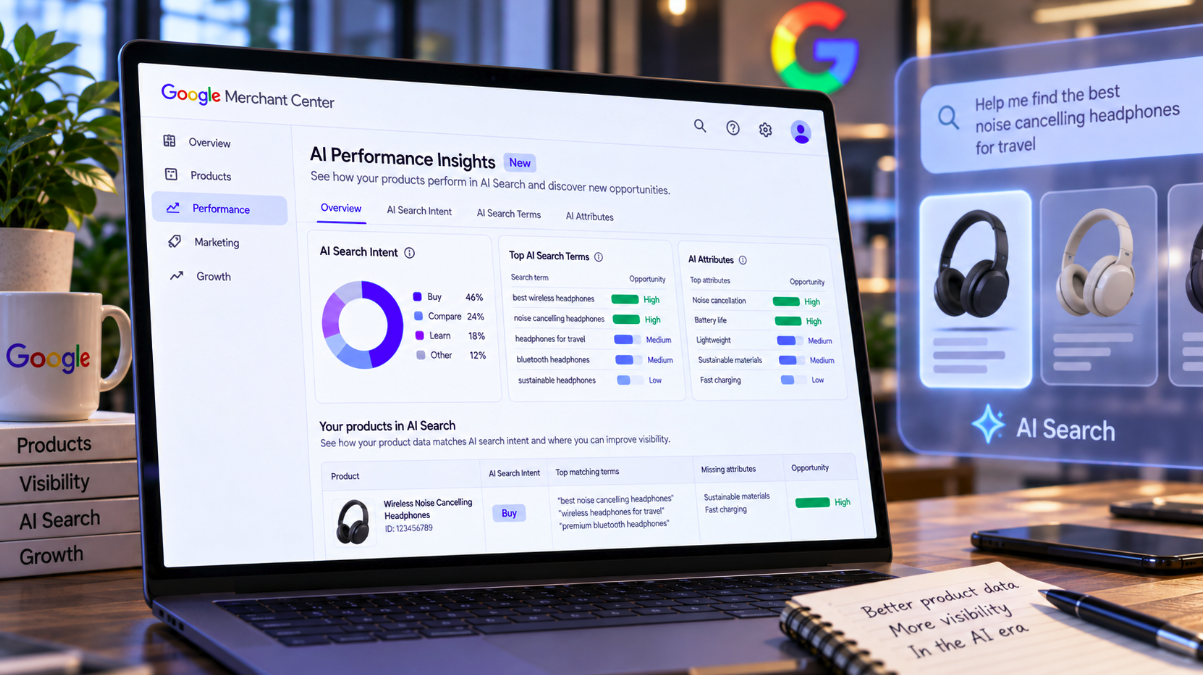
Google is giving ecommerce teams a much clearer view into a question that has been difficult to answer since shopping moved into generative search: why does one product appear in an AI shopping response while another does not?
Merchant Center’s AI Performance Insights now exposes three increasingly actionable layers of that problem: shopper intent, the terms appearing in conversational product searches and the structured attributes shoppers care about.
The expanded interface includes sections described as AI Search Intent, AI Search Terms and AI Attributes, according to a September 9 report from Search Engine Roundtable. More importantly, Google’s own current Merchant Center documentation confirms the underlying functionality: merchants can inspect top search intents, popular product terms and popular attributes alongside share of voice, query frequency and the number of products currently showing.
This changes Merchant Center from a place that merely reports AI visibility into something closer to an optimization diagnostic.
It does not tell merchants a secret AI ranking formula. Google does not say that adding a particular phrase or attribute guarantees inclusion in AI Mode or AI Overviews. But the report can now show the gap between what shoppers are expressing in conversational searches and what a merchant has supplied in its product data.
Merchant Center is moving beyond keyword reporting
Traditional ecommerce search optimization has long revolved around keywords: identify what shoppers type, make sure product titles and descriptions communicate the relevant concepts, and supply accurate structured product information.
Conversational search complicates that model.
A shopper might no longer search simply for “running shoes.” They might ask for shoes with maximum cushioning for long-distance travel, compare materials, request something suitable for a particular use case and add budget or fit constraints in the same conversation.
Google says AI Performance Insights is designed specifically around this shift from short keyword searches toward longer, more complex shopping journeys.
The report focuses on conversational queries with shopping intent in Google’s generative AI experiences, including AI Mode and AI Overviews. Instead of reducing every query to a string of words, Merchant Center attempts to expose the shopping stage, underlying intent, product concepts and attributes associated with that demand.
For ecommerce SEO, that is a meaningful change in what can be measured.
AI Search Intent shows why the shopper is searching
The intent layer is the broadest part of the report.
Google classifies conversational shopping activity into three core stages: Discovery, Evaluation and Ready to buy.
Discovery represents shoppers exploring general options. Evaluation covers people comparing products or investigating specifications. Ready to buy represents queries closer to a transaction.
Merchant Center then provides share-of-voice information for these stages and breaks activity into search types such as searching by category, researching specifications or looking for reviews.
This matters because two merchants can sell nearly identical products while being visible at very different points in the shopping journey.
A brand might appear frequently when users search directly for a product category but rarely when users ask AI Mode to compare specifications. Another could have strong visibility for evaluation queries but little presence during early discovery.
That is more informative than a single aggregate “AI visibility” number.
AI Search Terms exposes the language shoppers actually prioritize
The terms section moves from intent into language.
Google describes these as top terms within a product category that shoppers actively prioritize in conversational queries. Its examples include concepts such as “maximum cushioning” and “arch support.”
For each opportunity, Merchant Center can show frequency, share of voice and how many of the merchant’s products currently appear.
This creates a practical diagnostic.
Imagine that “maximum cushioning” is a high-frequency concept for a shoe category, but only a small number of a retailer’s relevant products appear for it. If those products genuinely provide that benefit and the product data fails to communicate it, the merchant has identified a concrete information gap.
Google recommends incorporating relevant popular terms into the titles and descriptions of appropriate products.
The word “relevant” is crucial.
This should not be interpreted as permission to paste every popular AI search phrase into every product title. Product data still needs to accurately describe the item. Adding unsupported features or mechanically stuffing conversational phrases would make the feed less reliable, not more useful.
AI Attributes turns missing product specifications into visibility opportunities
The attributes layer may be even more useful for retailers with large catalogs.
Merchant Center identifies popular structured specifications shoppers are looking for, such as size, color and material, and highlights where those attributes may be missing from the merchant’s product data.
This connects AI-search demand directly to feed completeness.
A retailer may already have a perfectly crawlable product page with a good title and description, yet still omit a structured material, size or other specification that helps Google understand whether the product satisfies a conversational request.
The report makes those omissions visible in the context of actual AI shopping demand.
That is different from a generic feed-quality warning. Instead of saying only “this field is incomplete,” Merchant Center can help merchants see whether a missing attribute corresponds to something shoppers are actively asking about.
Product data is becoming the language AI shopping systems use to understand inventory
The larger implication is that ecommerce optimization for generative search is increasingly a data-quality problem.
AI systems can interpret natural language, but retailers still benefit from supplying precise structured facts about what they sell.
Google’s Merchant Center ecosystem already supports detailed product attributes covering identity, availability, pricing, variants and specifications. Google has also introduced separate optional conversational product attributes such as question-and-answer data and document links to help AI systems understand additional product nuance.
Those conversational attributes are distinct from the Popular Attributes reporting inside AI Performance Insights. They should not be conflated.
Together, however, the direction is clear: merchants are being asked to give Google richer, more explicit machine-readable information as shopping experiences become more conversational.
The report includes competitive share of voice
AI Performance Insights does not evaluate a merchant in isolation.
Google calculates a merchant’s share of voice based on its AI impressions relative to impressions generated by a defined set of competitors for related queries. Merchant Center also displays the average share captured by those competitors.
This can help distinguish between a category-wide change and a merchant-specific visibility problem.
If conversational demand rises while a merchant’s share remains weak relative to competitors, there may be a meaningful optimization opportunity. If an entire competitive set changes together, the interpretation could be different.
But this metric comes with an important limitation: merchants cannot manually choose the competitor set used by the report. Google defines the available competitors inside Merchant Center.
That makes the metric useful for benchmarking, but less controllable than a traditional SEO competitor comparison where an analyst chooses exactly which domains to track.
A 100% share of voice can be misleading
Google’s troubleshooting documentation contains a particularly important warning for anyone reporting these numbers to executives or clients.
If Merchant Center does not have sufficient competitor data for an account, share of voice can display 100%.
That does not mean the merchant has captured every relevant AI shopping impression in its market. It can simply mean there is no usable competitor set for the calculation.
Likewise, Google says a share-of-voice value of zero can indicate insufficient impressions, while a dash indicates that there is no impression data.
Those edge cases make screenshots without context dangerous.
AI share of voice should be interpreted with the report’s data conditions attached, not presented as an absolute measure of market dominance.
This is organic AI reporting, not paid Shopping attribution
Another boundary is equally important.
Google says the current AI Performance Insights data is limited to organic AI traffic, such as free-listing visibility. Paid advertising traffic is not included.
That makes the report particularly relevant to ecommerce SEO and product-feed optimization, even though Merchant Center is deeply integrated with Google Ads.
A merchant should not use these numbers to infer the performance of Shopping campaigns or Performance Max advertising.
The report is describing product and brand visibility in conversational AI shopping experiences, not paid media performance.
There is no single all-category AI Search report
The data also has to be viewed within a product category.
Merchant Center allows filtering by category, time period, country and traffic scope, but Google notes that there is no report combining every category into one universal view.
That is sensible analytically because conversational intent for running shoes can be very different from intent for televisions, furniture or skincare.
It does mean large multi-category retailers will need to analyze AI visibility in segments rather than relying on one company-wide score.
Historical data is updated daily with a lag of a few days, according to Google, so the system is useful for trend monitoring rather than real-time query surveillance.
Availability is still limited
Merchant Center’s AI reporting should not yet be described as universally available.
Google’s current English documentation says AI Performance Insights is available for English-language queries for eligible accounts in Australia, Canada, India, New Zealand and the United States.
Rollout documentation has changed during 2026 as Google expanded the feature, and some localized help pages still reflect earlier pilot availability.
Merchants outside the supported query and market scope may therefore not see the same report.
That limitation matters particularly for multinational retailers evaluating whether the feature can become a global reporting standard.
The report reveals opportunities, not AI ranking factors
The temptation will be to turn AI Search Terms and AI Attributes into a new checklist of generative-search ranking factors.
The evidence does not support that conclusion.
Google says the report can help merchants optimize product data and recommends supplying relevant popular terms and missing attributes. It does not say that any individual term, attribute or score directly causes a product to appear in an AI answer.
AI shopping visibility can depend on the query, product relevance, availability, data quality, Google's retrieval systems and other signals not exposed in the dashboard.
The safest use of the report is therefore diagnostic.
If shoppers frequently express a need that a product genuinely satisfies but the merchant has failed to describe that capability, fixing the data is a low-regret improvement. It makes the catalog more complete whether or not a particular AI impression follows.
Ecommerce GEO is becoming product-feed optimization
Much of the early conversation around generative engine optimization has focused on editorial content: write clear answers, establish authority and create pages that AI systems can retrieve and cite.
Commerce works differently.
For products, structured data feeds are central to how platforms understand inventory. The Merchant Center update makes that increasingly explicit by connecting conversational search demand with the terms and attributes inside product data.
That means ecommerce teams may need to rethink the boundary between SEO, merchandising and feed management.
A missing material attribute is no longer merely a catalog-quality issue. If shoppers repeatedly ask AI systems for products made from that material, it can become a search-visibility issue as well.
A product description is no longer optimized only around a conventional keyword. It needs to accurately communicate the properties, use cases and benefits people express in natural-language shopping conversations.
And the people managing Merchant Center may increasingly need to work alongside SEO teams rather than only paid-media specialists.
Merchant Center is beginning to show the demand side of AI shopping
The most important part of this update is not that Google added three more cards to a dashboard.
It is that merchants are beginning to see what sits between a conversational shopping prompt and product visibility.
AI Search Intent shows the stage and context of demand. AI Search Terms exposes the concepts shoppers prioritize. AI Attributes identifies structured product information that may be missing when those needs are expressed.
None of those metrics guarantees visibility, and none should be treated as a direct ranking factor.
But together they give ecommerce teams something they have largely lacked in generative search: feedback.
Instead of guessing what AI shoppers might be asking for, eligible merchants can increasingly see the language, intent and specifications Google associates with conversational product discovery — and then decide whether their product data accurately answers those needs.