
Search has traditionally ended at a result. Even when Google, ChatGPT or another AI system summarizes the answer, the user usually remains responsible for the next step: open the website, compare the options, fill in the form, make the reservation or complete the purchase.
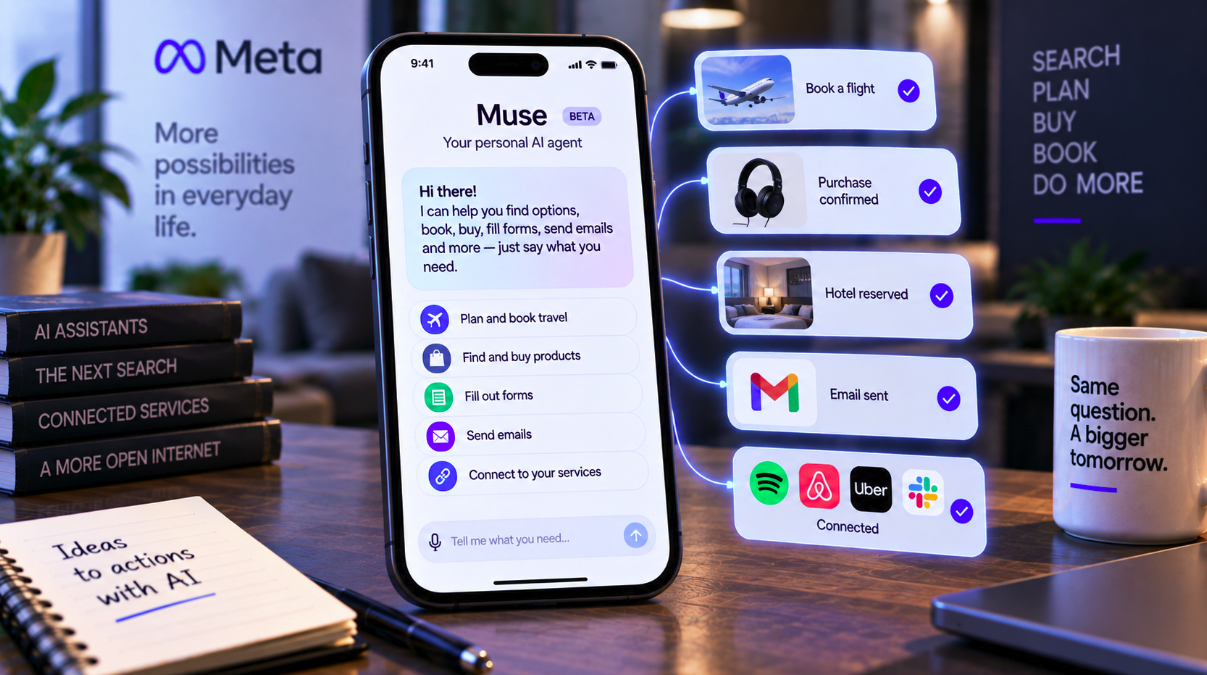
Meta’s new Muse agent pushes that boundary much further. In an announcement published September 8, Meta introduced a personal AI agent that can browse the web, work across connected services, fill forms, send emails, book travel, make purchases and even negotiate on a user’s behalf. Muse is rolling out in the United States through iOS, Android and muse.ai, and Meta says people can also communicate with it directly inside WhatsApp.
The immediate story is another escalation in the race toward agentic AI. For search marketers, however, Muse creates a more consequential question: what happens when visibility is no longer about being the answer or earning the click, but about being the option an agent chooses to act on?
Meta has not publicly documented a general ranking system explaining how Muse selects merchants, hotels, products, airlines or other recommendations. Until it does, any attempt to reverse-engineer a “Muse ranking formula” would be speculation. But the product direction is clear enough to make the measurement problem urgent.
Muse is designed to do the work after the query
Meta describes Muse as a personal agent rather than a conventional chatbot. The distinction is action.
A user can ask it to handle a task, and Muse can open its browser, navigate websites and interact with external services. Meta’s examples include sending email, arranging travel, completing forms, purchasing products and negotiating.
For longer-running goals, Meta says Muse can continue working after the user closes the application, then return when circumstances change or when it needs approval.
That changes the shape of a digital journey. Instead of search query → result → website → conversion, the path can become request → agent research → agent decision → confirmation → transaction.
The website may still participate in that process, but the human may never browse it in the traditional sense.
The next search interface may be an execution layer
AI search has already compressed the discovery funnel by answering questions directly. Agents can compress the transactional funnel as well.
Imagine asking Muse to find a hotel near a conference venue within a fixed budget, with free cancellation and strong recent reviews. A normal search engine returns choices. An answer engine may summarize the best choices. An agent can potentially evaluate the choices, select one, fill in traveler information and reach the point where payment approval is required.
For the hotel, appearing in the agent’s consideration set becomes commercially important even if no human ever sees a conventional search result.
This is why agentic AI could force marketers to separate three concepts that are often grouped under “AI visibility”: being mentioned, being recommended and being selected for action.
Meta has not explained how Muse chooses among competing options
The most important missing information for GEO and ecommerce teams is selection methodology.
Meta’s launch announcement describes what Muse can do and how users control its access, but it does not publish a general framework for how the agent ranks competing merchants, products, travel options or sources.
We do not yet know how much weight Muse gives to price, brand familiarity, product feeds, reviews, availability, delivery terms, structured data, merchant reputation, previous user preferences or other possible signals across different tasks.
Those factors may also vary by domain. Choosing a flight is a different optimization problem from choosing headphones, hiring a service provider or negotiating a bill.
Until Meta publishes more detail or independent testing accumulates, the correct GEO question is not “How do we rank number one in Muse?” It is “What evidence makes our brand eligible, understandable and competitive when Muse performs this task?”
Action visibility may matter more than citation visibility
Current AI visibility tools frequently count mentions and citations. Those metrics are useful because they reveal whether a brand enters an AI-generated answer and which websites provide supporting evidence.
An agent adds another layer.
A brand could be cited during research but never selected. Another company might receive fewer visible citations while consistently being chosen because it has better availability, clearer product data, lower friction or terms that match the user’s constraints.
If Muse and similar agents become meaningful commerce channels, marketers will eventually need metrics closer to agent consideration share, recommendation share and action share.
Those are not established Muse metrics today. They are the logical measurement problem created when an AI system can execute a decision rather than merely describe one.
The website becomes infrastructure for an agent as well as a destination for a person
Agentic browsing also changes how companies should think about web usability.
Traditional conversion optimization assumes a human visitor navigating menus, reading copy and clicking buttons. An agent may instead need to identify prices, understand variants, check cancellation terms, determine availability and complete forms programmatically through a browser or connected service.
A visually attractive page that hides important commercial information behind ambiguous interactions can be frustrating for humans and difficult for agents. Clear product data, stable page structure and explicit policies become useful not only for SEO and accessibility but for machine-mediated transactions.
This does not mean every site should redesign itself for Muse specifically. It means the web increasingly has two active audiences: people and software acting for people.
Merchant eligibility could become a new competitive moat
In traditional search, a business can lose a ranking and still receive traffic through ads, direct navigation, marketplaces or other channels.
Agentic commerce introduces a different risk. If an agent cannot reliably understand a merchant’s inventory, complete its checkout or verify its terms, the merchant may be excluded before the user ever sees it.
That makes operational compatibility a visibility issue.
Availability data, payment flows, authentication, shipping information and cancellation policies are no longer merely back-office concerns when software agents participate in the purchase process. They can influence whether the transaction is technically possible.
The most successful agentic-commerce optimization may therefore require collaboration between SEO, ecommerce, product, engineering and operations rather than a new content checklist.
Muse’s dedicated virtual machine is central to the design
Meta says Muse runs inside Muse Secure VM, a dedicated virtual machine in the cloud with its own browser. The VM stores the information and credentials associated with services the user connects, while keeping each person’s environment separated from other Muse instances.
According to Meta, a separate Sentinel agent operates alongside Muse and must approve what Muse sends to the internet. The company says Sentinel can require user permission when appropriate.
Meta also says Muse cannot see stored passwords or payment methods. Credentials are placed into secure storage so the agent can use them without reading the underlying secret directly.
These are Meta’s security claims about its architecture, not an independent guarantee that the system is immune to agentic-security failures.
Sensitive actions require confirmation
Meta says Muse checks with the user before sensitive actions such as sending an email or making a purchase. Users can see an audit trail showing what the agent has done and what it plans to do.
Permission controls are also granular by connected service. Meta says a user can decide whether Muse may only read email or may also send messages on the user’s behalf, and connections can be changed or removed later.
This human-approval layer is important because the cost of an AI error changes dramatically when the model can act. A wrong restaurant recommendation is inconvenient. A wrong reservation, purchase or email can create a financial or reputational consequence.
The agentic search market therefore has to solve not only relevance but controlled execution.
Payments turn recommendation quality into financial infrastructure
Meta is launching Muse with checkout support through Link by Stripe. The company says Link generates a one-time-use card for agent purchases so the user’s real card details remain hidden, and Muse purchases can receive Link protections on eligible transactions.
Meta says Shop Pay support is coming later, along with 1Password integration that will allow Muse to use credentials a person already has stored.
These integrations matter because they remove one of the biggest barriers between recommendation and conversion. If the agent can research an item but cannot complete payment, it remains primarily an assistant. Once payment is integrated, the agent becomes a transactional intermediary.
For brands, the intermediary can influence which merchant receives the sale.
WhatsApp gives Muse an unusually familiar distribution surface
Muse is not limited to a dedicated AI application. Meta says users can talk to it directly through WhatsApp, using the same conversational pattern they already use to message another person.
That distribution could be significant because agentic interfaces often face a behavior problem: users need to learn when and how to delegate tasks to them. Putting the agent into an existing messaging environment lowers that interface barrier.
It also makes the potential funnel less visible to marketers. A consumer may initiate a commercial journey inside a private conversation rather than through a public search box or retailer app.
Traditional analytics will struggle to describe that journey unless agent platforms and merchants eventually expose attribution mechanisms.
Personal memory could make rankings more individual
Meta says Muse remembers information that matters to the user and can make proactive suggestions based on details mentioned previously. Its example includes remembering friends’ dietary restrictions when helping plan a dinner.
For commerce, persistent preferences could make agent selection more personalized than a conventional SERP.
A user who consistently prefers a particular airline, sustainable materials, free returns or a specific hotel chain may receive a different shortlist from someone making the same broad request with different history.
This would make the idea of one universal “Muse ranking” even less useful. Visibility could depend partly on matching an individual’s accumulated constraints rather than winning one globally ordered result.
Reuters reports that security and reliability remain live issues
The launch arrives with significant caveats. Reuters reported on September 8 that internal testing had uncovered security flaws, reliability problems and user frustrations, including cases involving private data and inconsistent behavior.
Reuters also reported that Meta delayed Muse from an earlier planned launch while working on security and that the company says the product has now met minimum safety standards.
Those concerns are not peripheral to the product category. Agents have a larger potential blast radius than chatbots because they interact with external systems and can perform consequential operations.
As capabilities increase, confirmation controls, isolation, auditability and reliable interpretation of user intent become part of the core product rather than optional safety features.
GEO may need to become operational optimization
The emerging GEO industry has largely focused on making brands visible in AI-generated answers. That work includes improving machine-readable content, building authoritative third-party evidence and monitoring mentions and citations across models.
Muse suggests that the next stage may be more operational.
A brand can publish excellent content and still lose an agentic transaction if its inventory is unavailable, its pricing is unclear, its checkout cannot be completed, its cancellation terms do not match the user’s request or stronger alternatives satisfy the task more precisely.
That moves optimization closer to the business itself. Content explains the offering, but operational data determines whether the offering can actually fulfill the user’s goal.
The next zero-click search may still generate a transaction
For years, publishers and marketers have worried about zero-click search: Google answers the question on the results page, so the website does not receive the visit.
Agentic systems create a different form of zero-click behavior. The user may never visit the merchant website, yet a commercial action can still occur.
That changes what “traffic loss” means. A business could receive fewer human sessions while still generating transactions through agents, provided attribution and merchant infrastructure support the flow.
Conversely, a website can continue receiving traditional organic traffic while losing share in agent-mediated decisions that analytics cannot yet see clearly.
Clicks alone will become an increasingly incomplete measure if this behavior scales.
Brands need to study decisions, not just answers
Meta’s Muse launch does not give marketers enough information to optimize specifically for its selection system. There is no public universal list of ranking factors for merchants, products or sources, and the product is only beginning its U.S. rollout.
The useful response is therefore experimental rather than prescriptive. Brands can begin testing real customer tasks: ask agents to find products under constraints, plan trips, compare services or solve the problems the company claims to solve. Then record which brands enter the shortlist, which sources support the reasoning and where the agent encounters friction before action.
Over time, that can reveal whether visibility failures come from information, reputation, product fit, availability or transaction design.
The important unit of analysis is no longer only the answer. It is the entire decision path.
Search is moving from information retrieval toward delegated intent
Muse is still an early product, and Meta’s claims about security, usefulness and scale will need to be tested in real-world use. Its recommendation mechanisms also remain insufficiently documented for confident GEO prescriptions.
But the strategic direction is difficult to ignore.
Search engines helped people find websites. Answer engines increasingly synthesize those websites. Personal agents aim to take the user’s intent and complete the work.
That progression changes what it means for a brand to be visible. The winning result may not be the page ranked first, the source cited most often or even the product the AI describes most enthusiastically. It may be the option the agent can confidently select, transact with and complete on the user’s behalf.
Meta Muse therefore turns a familiar search-marketing question into a much larger one. The next search result may not be a result at all. It may be an action — and the competitive battle will be over which brand gets chosen when the software is the customer’s delegate.