
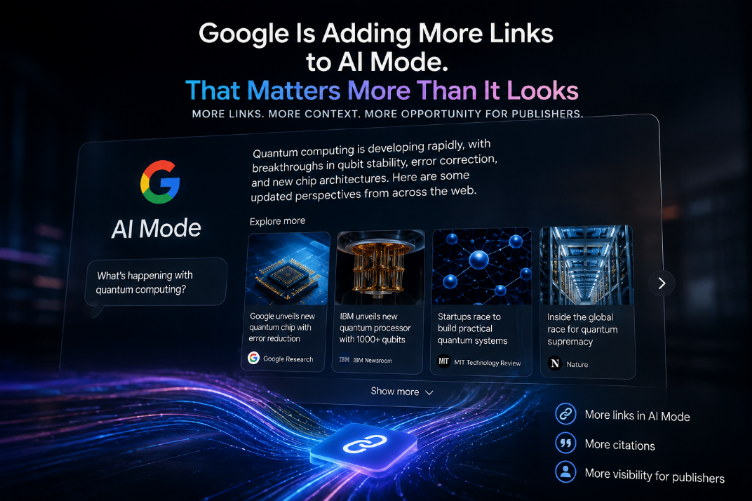
Google is putting more links inside AI Mode, and the change is easy to dismiss as a small interface update. It is not. For publishers, marketers and anyone trying to understand how visibility works when search engines generate answers instead of simply ranking pages, the new link carousels offer a useful glimpse of the emerging rules of AI search.
Google is rolling out link carousels for developing topics in AI Mode, extending a format that had already appeared in AI Overviews. When users ask about a trending or evolving subject, AI Mode can now place a horizontal group of relevant articles and webpages prominently within the generated response. The format can also surface content from a user's Preferred Sources, giving selected publishers an additional route into the AI-generated search experience.
On the surface, this is about clickability. A visible card containing a headline, source, date and image is much easier to notice than a discreet citation attached to generated text. But the more important development is structural: Google is acknowledging that an AI answer cannot always be the final destination, particularly when information is changing quickly and original reporting matters.
AI visibility is becoming a placement problem
Traditional SEO trained publishers to think in rankings: position one, page one, impressions, clicks and click-through rate. Generative search complicates that model. A publisher can contribute information to an AI-generated answer without receiving anything resembling a traditional search result, while another source may receive a prominent citation, link card or carousel placement.
That means AI visibility is not simply a question of whether a model has encountered a page. The commercially meaningful question is whether the source is represented in the interface in a way that a user can recognize and act on. Google's carousel makes that distinction unusually clear. Being part of the information environment and being visibly credited inside the answer are two different outcomes.
This is why citation visibility is becoming an important layer of search strategy. Publishers increasingly need to understand not only whether their pages rank, but whether their reporting, explanations and data are selected as supporting sources for generated answers. In an AI-first interface, the citation can become the new search result.
Developing stories expose a weakness in answer engines
The choice to emphasize developing topics is significant. Generative systems are naturally good at synthesizing established information, but breaking and evolving stories create a different problem. Facts change, new reporting appears, perspectives diverge and the authority of the underlying source becomes much more important.
A static synthetic answer can quickly become incomplete. Links give users a route to the reporting underneath it. They also allow Google to present multiple perspectives without forcing the generated response to absorb every update or flatten every disagreement into one authoritative-sounding summary.
Google has explicitly framed its recent AI Search changes around connecting users with original coverage, relevant websites and a range of perspectives. Earlier in 2026, the company announced additional link treatments in AI Mode and AI Overviews, features highlighting news subscriptions, Preferred Sources and other mechanisms intended to make publishers easier to discover. The new developing-topic carousel fits that broader direction rather than standing alone.
For publishers, originality may become more valuable — but differently
There is an important opportunity here for publishers that produce information other sites subsequently repeat. If AI systems increasingly need identifiable sources for fast-moving topics, original reporting, proprietary data, first-hand expertise and clearly attributable analysis become useful not only for conventional rankings but also for citation selection.
This does not mean publishers should expect AI search to restore the traffic patterns of the pre-generative web. Search Engine Land, reporting on the rollout, makes the same practical point: more clickable links can improve the opportunity to receive traffic from AI Mode, but that does not imply a return to historical search click volumes. AI interfaces can satisfy part of the user's intent before a click ever happens.
The strategic response therefore cannot be to measure success only through sessions. Publishers will increasingly need to consider a broader visibility layer: how frequently they appear as cited sources, which topics trigger those citations, how prominently their brand is displayed, whether competitors are cited instead and which content formats repeatedly earn placement inside AI answers.
The measurement gap is becoming harder to ignore
There is a problem, however. The interface is evolving faster than publisher analytics. Google does not currently give publishers the kind of granular AI Mode click reporting that would make these placements easy to evaluate independently in Search Console. That leaves an awkward gap between what users can see in the product and what publishers can reliably measure behind the scenes.
This matters because a carousel can create several kinds of value. It can generate a click, expose a brand, reinforce authority or influence a later search or direct visit. Those outcomes are not equivalent, and conventional search reporting was not designed to separate them. As AI search grows, measurement will need to distinguish ranking visibility from citation visibility and citation visibility from actual referral traffic.
Until platforms provide better reporting, publishers and SEO teams will have to build their own observation frameworks. That can include tracking representative prompts, recording cited domains, monitoring the persistence and position of citations, comparing AI visibility against conventional rankings and correlating major visibility changes with referral and branded-search trends. It is imperfect, but treating AI answers as an unmeasurable black box is increasingly untenable.
Preferred Sources add another dimension
The inclusion of Preferred Sources makes the update even more interesting. Google has been expanding tools that allow users to signal which publishers and creators they want to see more prominently. In August, Google said users could prioritize favorite publishers across Search and AI results, building on earlier work around Preferred Sources and publisher visibility.
This introduces a layer that classic SEO rarely emphasized: explicit audience preference. A publisher's ability to earn direct loyalty may influence how visible it becomes inside personalized AI search experiences. In other words, brand strength and distribution strategy can feed back into search visibility rather than sitting outside it.
For publishers, that reinforces an old lesson in a new environment. Depending entirely on an algorithmic intermediary is risky. Building a recognizable editorial identity, direct readership, subscriptions and habitual use can become valuable even inside the intermediary's own AI interface.
Links are becoming a design decision, not a default
The larger shift is that links can no longer be treated as the automatic unit of search. In classic Google, the result page was fundamentally a list of destinations. In AI Mode, the primary object is the generated response, and links are components Google can choose to insert, emphasize, group or suppress depending on the query and interface.
That makes every change in link presentation strategically important. A carousel is not merely decoration. It determines which publishers remain visible when the answer itself occupies the center of the experience. It also reveals where Google believes external sources add enough value that users should be encouraged to leave the generated answer and explore the web.
The practical lesson for publishers is not to chase a new carousel with another narrow optimization trick. It is to recognize that search visibility is splitting into multiple layers. Rankings still matter. Links still matter. But citations, source selection, brand recognition and prominence inside generated interfaces are becoming distinct competitive surfaces.
Google adding more links to AI Mode is therefore encouraging, but the significance goes beyond the possibility of a few extra clicks. It is evidence that the relationship between AI answers and the open web is still being negotiated in the product itself. For publishers, the next phase of SEO will be partly about ranking pages and increasingly about earning a visible, attributable place inside the answer.