
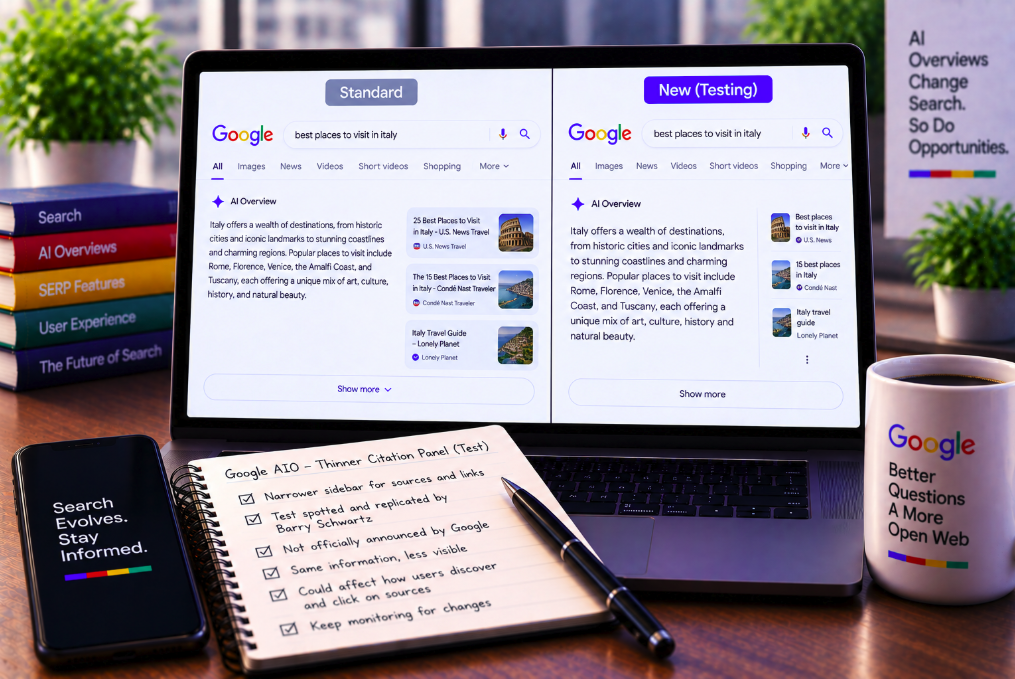
Google is testing a noticeably narrower citation panel on the right side of some AI Overviews, compressing the visual space given to the sources and links that support the generated answer.
The experiment was first spotted by Khushal Bherwani and then independently replicated by Barry Schwartz, who published side-by-side screenshots in a September 8 Search Engine Roundtable report. Compared with the familiar layout, the experimental source column is visibly thinner.
Google has not announced the design change in the sources reviewed for this article, and there is no evidence that it represents a broad rollout. There is also no published click-through data showing whether the narrower panel actually causes fewer users to visit cited websites.
That caveat matters because visual prominence and traffic impact are not the same thing. The test makes citations look less substantial on the page, but only controlled engagement data could establish whether searchers click them less often.
The source panel is visibly narrower
Schwartz's comparison shows the basic change clearly. The AI-generated answer continues to occupy the main content area, while the citation cards remain in a right-hand column. In the test, however, that column takes up substantially less horizontal space.
The narrower design gives the answer itself more visual dominance and leaves less room for the source cards.
This can affect how much source information is visible at a glance, including titles, publisher names, thumbnails and other card elements depending on the specific result.
The experiment is a layout change, not evidence that Google is removing citations from AI Overviews.
Barry Schwartz was able to replicate the test
The fact that Schwartz reproduced the interface makes the observation stronger than a single isolated screenshot.
Search experiments can be personalized, account-specific, geography-specific or limited to a small percentage of traffic. Independent replication confirms that the design was genuinely being served to more than the original observer.
It still does not establish the size of the experiment or whether Google intends to ship it permanently.
Google routinely tests Search interfaces before deciding whether to expand, modify or abandon them.
Google has not announced this specific citation redesign
No official Google post reviewed for this article describes a September rollout of a thinner AI Overview source panel.
That means the safest terminology is “test” rather than “update” or “new design.”
Search marketers frequently encounter experimental SERP layouts that disappear after days or weeks. Treating every screenshot as a product launch can create false expectations for publishers and clients.
Until Google confirms the change or it becomes broadly reproducible, the thinner panel should remain classified as an observed experiment.
There is no evidence yet that the test reduces clicks
Search Engine Roundtable raises the obvious question: if citations become less noticeable, could fewer people click them?
That is a reasonable UX hypothesis, but it has not been demonstrated.
Click behavior depends on more than panel width. Card ordering, title wording, thumbnails, source familiarity, answer completeness, device size and the user's motivation to explore can all influence whether a citation receives traffic.
Without an A/B test result or comparable click data, “less visible” should not be translated automatically into “lower CTR.”
The test matters because citations are the bridge back to publishers
AI Overviews can answer a substantial portion of a user's question directly on the search results page.
For publishers, the citation layer is therefore one of the main mechanisms that can turn inclusion in a generated answer into a website visit.
Google's official documentation for AI features in Search says AI Overviews provide a jumping-off point for people to explore links and discover more information.
If the generated answer becomes increasingly prominent while supporting sources become visually compressed, publishers have a legitimate reason to watch how that balance affects user behavior.
Google says AI features surface relevant supporting links
Google's documentation describes AI Overviews and AI Mode as experiences that identify supporting web pages and display relevant links alongside generated responses.
The systems can use query fan-out, issuing multiple related searches across subtopics and data sources before generating an answer.
Google argues that this approach can expose users to a wider and more diverse set of websites than a classic search for the same complex question.
The thinner-panel experiment does not show that this retrieval process has changed. It changes how the resulting links are presented to users.
Presentation and selection are separate questions
For GEO and SEO measurement, this distinction is essential.
A page can remain selected as a supporting source while receiving less visual prominence. Conversely, a prominent citation can still produce few clicks if the AI answer satisfies the user's need completely.
Ranking, citation selection, citation position, visual treatment and outbound traffic are different layers of the same search experience.
The September test concerns the presentation layer. There is no evidence from the screenshots that Google's underlying source-selection systems changed at the same time.
The narrower design could change the information density of citations
A wide source card has room to communicate more context before the click.
Users may be able to scan a longer headline, recognize a publisher, interpret an image and understand why the source is relevant. A narrower card forces the interface to fit the same concept into less space.
That can potentially change which visual cues receive priority, even if the source list itself remains identical.
The actual implementation needs to be measured rather than inferred from width alone, but card density is an important variable for future AIO click studies.
Publishers should distinguish citation visibility from citation count
Many AI-search tracking tools report how often a domain is cited.
That metric treats two citations as equivalent even when one appears in a large card near the top of the answer and another is compressed into a narrow side panel that requires more effort to notice.
As AI interfaces mature, raw citation counts may become insufficient for evaluating real exposure.
Trackers will increasingly need to record placement, card type, source order, visual prominence and whether a citation is visible without additional interaction.
A citation can exist without delivering meaningful exposure
This is already familiar from traditional search.
A page can rank in Google and technically earn an impression while appearing far enough down the results that very few users engage with it. Position changes the value of the exposure.
AI citations create an analogous problem, but with more complex layouts. A source can be present inside the answer architecture without receiving the same attention as another source shown more prominently.
The thinner panel makes that measurement problem easier to see.
Google's official guidance still emphasizes clickable sources
Google's newer guide to optimizing for generative AI features describes its systems as using Search ranking and retrieval techniques to ground generated responses in relevant web pages.
The documentation specifically frames prominent, clickable links as part of the experience that connects generated information with supporting pages.
Google's position is therefore not that AI answers should replace the web entirely. The company presents source links as an integral part of how its generative Search experiences work.
A test that reduces the visual width of those links is worth scrutinizing precisely because it touches that stated relationship between answer and source.
Google has previously argued that AIO clicks can be higher quality
In its 2025 guidance for site owners, Google said clicks from search results pages with AI Overviews can be higher quality, with visitors more likely to spend time on the destination site.
Google's argument is that users receive more context before clicking and therefore may arrive at a source with stronger intent.
That claim concerns the value of clicks that occur, not whether every interface design produces the same number of clicks.
A citation treatment could theoretically reduce click volume while the remaining visitors remain highly engaged. Those two effects would need to be measured separately.
The publisher question is traffic quantity versus traffic quality
This tension increasingly defines AI search.
A generated answer can reduce the need for some users to visit a website, while the users who do click may be more motivated to explore the source in depth.
For ad-supported publishers, losing raw pageviews can be damaging even if engagement per visit rises. Subscription publishers and lead-generation businesses may care more about conversion quality than total sessions.
The impact of a narrower citation panel therefore cannot be reduced to one universal publisher outcome.
Desktop changes may not translate directly to mobile
A right-side citation panel is inherently a desktop layout concept because desktop screens have enough horizontal space to place answer content and sources beside one another.
Mobile AI Overviews have different space constraints and often need to stack or transform citation elements.
Even if Google adopts the thinner desktop panel broadly, mobile behavior could remain different.
Publishers measuring AIO traffic should segment by device rather than assuming a desktop interface experiment changes every searcher's experience.
The test could be about fitting more answer content on screen
One possible product rationale is simply information density.
A narrower source panel creates additional horizontal space for the AI answer, potentially reducing line wrapping and allowing more generated text to appear before the user scrolls.
That could make the answer easier to scan on certain desktop widths.
Google has not disclosed its reasoning, so this remains a possible UX explanation rather than a confirmed motivation.
It could also be part of broader experimentation with citation design
Google has repeatedly adjusted how AI Overview sources appear, including card treatments, link placements and expandable interfaces.
This is not surprising for a relatively new search format whose answer and attribution layers are still evolving.
Small interface changes can materially affect where users focus their attention, so Google has strong incentives to test multiple arrangements.
For publishers, the instability means a citation format observed today should not be assumed to remain permanent.
Search Console can help measure impact, but not from one screenshot
Google introduced dedicated generative AI performance reports in Search Console in 2026, giving site owners more direct visibility into their presence within AI features.
Those reports create a better foundation for evaluating whether interface changes correspond with changes in impressions, clicks or other visibility patterns.
However, an individual publisher usually cannot know which users were assigned to a specific Google UI experiment unless Google exposes that segmentation.
Site-level trend changes can therefore suggest an effect but may not isolate the thinner citation panel as the cause.
GEO trackers need screenshot-level evidence
Traditional rank tracking can often reduce a search result to a position number.
AI interfaces are harder. The same cited URL can appear in a wide card, narrow card, carousel, inline link, expandable panel or another treatment.
A useful GEO monitoring system should preserve the rendered answer or structured layout metadata alongside the citation itself.
Without that evidence, historical datasets may say a domain's citation rate was unchanged even while its actual visual exposure changed dramatically.
Source order may become more important as the panel shrinks
When less horizontal space is available, users may scan fewer citation details before deciding whether to interact.
That could make the first one or two visible source positions disproportionately important.
Again, there is no click dataset from this experiment proving that effect. It is a measurement hypothesis worth testing if the layout expands.
For AI visibility platforms, reporting citation order alongside presence would make that analysis possible.
Do not change content strategy because of one UI experiment
The thinner panel does not create a new technical requirement for appearing in AI Overviews.
Google's official documentation says pages need to be indexed and eligible to appear in Search with a snippet, while normal SEO fundamentals remain applicable. Google says there is no special schema or separate AI file required for inclusion.
Nothing in the September screenshots indicates that publishers should rewrite content, alter structured data or pursue a new citation-specific optimization technique.
The appropriate response is measurement, not reactive optimization.
The test increases the value of first-party click data
If citation layouts keep changing, publishers need to connect AI visibility with actual website outcomes rather than treating a citation as the end goal.
A source can be cited more often while receiving fewer clicks, or cited less often while attracting more qualified visitors from the citations it does receive.
Search Console, web analytics, conversion data and controlled SERP monitoring together provide a more useful picture than citation share alone.
The question is not simply whether Google used the page as a source. It is whether that visibility generated meaningful human attention.
This remains a test, not a verdict on Google's publisher strategy
The temptation is to interpret the narrower panel as evidence that Google wants to hide publisher links behind increasingly dominant AI answers.
The screenshots alone cannot establish that intent.
Google may be testing visual density, readability, source-card usability or several variables simultaneously. The experiment could disappear without ever reaching most users.
Intent should not be inferred where product behavior can be described directly.
The important question is what happens to citation engagement
Google's thinner AI Overview citation panel is notable because it changes the balance of visual attention between generated answers and the websites that support them.
Barry Schwartz was able to reproduce the test, making it a credible Search experiment rather than an isolated rendering glitch. But Google has not announced a rollout, and no data currently shows that the narrower design reduces publisher clicks.
That makes the correct response empirical. Publishers should watch AI Overview impressions and clicks, GEO platforms should track citation placement and visual treatment, and analysts should resist converting “narrower” into “lower CTR” without evidence.
The future of AI search will not be determined only by which sources models select. It will also depend on how visibly those sources are presented after selection. This experiment is a reminder that in generative search, citation presence is only the first half of the distribution question.