
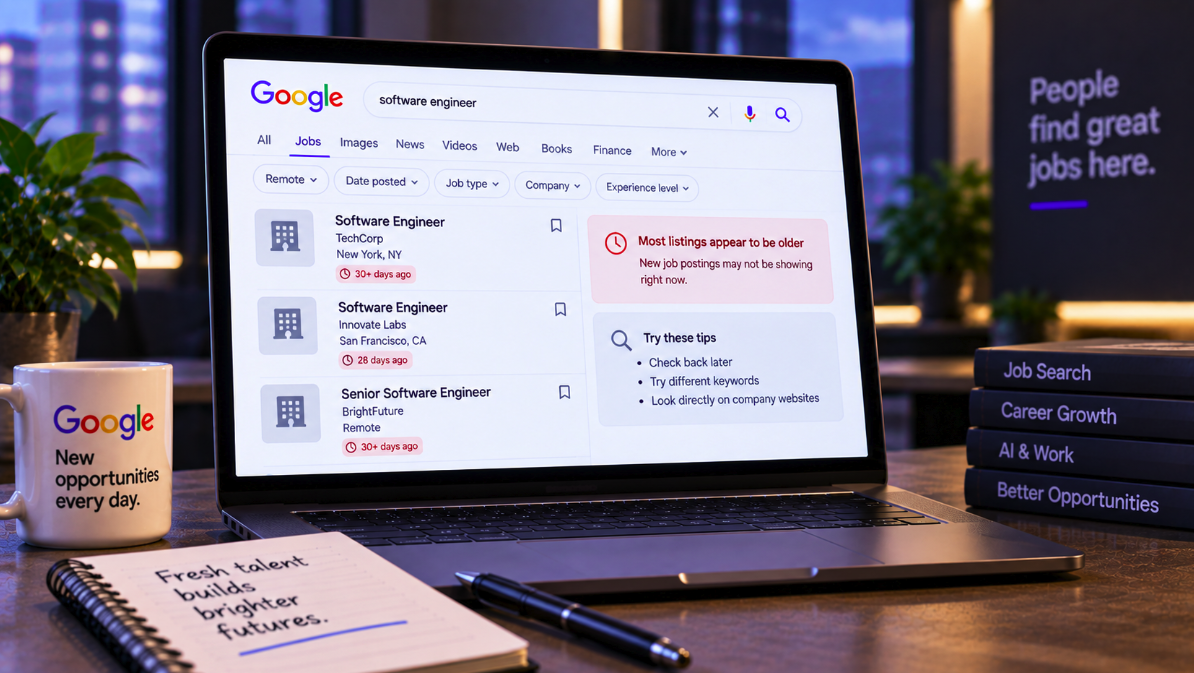
Google’s job-search experience appears to be suffering from a freshness problem for at least some users, with recent vacancies becoming unusually difficult to find while older listings continue to populate results. The pattern has prompted speculation about a Google Jobs bug, but Google has not publicly confirmed an incident or explained what might be causing it.
Search Engine Roundtable reported the issue on September 4 after users described several days in which saved Google Jobs searches stopped producing the normal stream of new openings. In one test cited by the publication, filtering New York City jobs to the previous day returned nothing, while expanding the window to three days produced only a small number of results.
The reports do not establish that every user, location or job category is affected. Search Engine Roundtable noted that the experience appeared better in some searches outside the United States, including London. But the symptoms are significant because freshness is not a cosmetic feature in employment search. A job listing can lose much of its value quickly once applications accumulate or a role closes.
Users say the searches still work, but the new jobs are missing
The unusual part of the reported behavior is that Google Jobs has not simply disappeared or stopped returning results. Users can still run searches, but some say those searches are dominated by older postings.
One complaint highlighted by Search Engine Roundtable came from a person who uses saved Google Jobs queries to find potential leads. The user said the queries continued functioning but had stopped generating new jobs over the preceding days. Another user removed a three-day freshness filter after it returned little or nothing and noticed that many listings that might have been recent no longer displayed the expected age label.
That creates two possible user-facing problems. Fresh jobs may not be entering or surfacing in the experience as expected, or freshness metadata may be failing in a way that makes filtering and presentation unreliable. Without confirmation from Google, it is not possible to determine which layer is responsible.
The timing resembles an earlier Google freshness-filter problem, but that is not proof
Some users connected the Google Jobs behavior with an earlier issue involving date filters in ordinary Google Search and Google News. Search Engine Roundtable had reported a broken recent-results filter in August that Google subsequently fixed.
The resemblance is interesting because both problems involve time-sensitive filtering. But there is no evidence that the earlier search-filter bug and the current job-search complaints share a technical cause. Google Jobs has its own ingestion, structured-data and presentation requirements, and a symptom involving dates can originate in several different parts of the system.
The responsible interpretation is therefore narrow: users are reporting a freshness failure, the behavior appears abnormal, and no confirmed root cause is available.
Freshness is unusually important in job search
An old informational webpage can remain useful for years. An old job advertisement can become actively misleading once the employer has stopped accepting applications. Google’s own documentation reflects that distinction.
In its JobPosting structured-data documentation, Google says expired job postings are not allowed in the jobs experience. Publishers should remove jobs that are no longer open, remove their JobPosting markup or provide an appropriate validThrough value that is already in the past.
Google also warns that expired listings can remain accessible through the jobs experience when expiration information is missing, the page stays live, the application flow points to an expired position or the structured data remains on a page after the role closes. Those are publisher-side freshness problems that Google has documented for years.
The September reports, however, describe something different: users are not merely complaining that one expired listing slipped through. They are describing a broader scarcity of recent postings across searches that previously produced fresh opportunities.
Publishers should not respond by artificially refreshing old jobs
If Google Jobs is currently underrepresenting recent listings, employers and job platforms may be tempted to manipulate posting dates in an effort to regain visibility. Google’s guidance explicitly warns against that approach.
In its job-posting quality guidelines, Google says the posting date must be genuine and that publishers should not disguise an old job as a new one by updating datePosted when the vacancy itself has not changed. Job seekers use freshness as a signal for whether a role is still actively recruiting, how likely they are to receive consideration and whether an application is worth their time.
That means a possible Google-side freshness bug is not a reason to create publisher-side freshness noise. Accurate dates become more important, not less, when the search experience itself appears unstable.
Job sites can still make their own signals as clean as possible
Even if the current problem ultimately proves to be on Google’s side, job publishers should verify that their feeds and pages are not contributing additional ambiguity. Every live vacancy should have accurate JobPosting structured data that matches the visible content of the page. The original posting date should remain truthful, and roles with a known closing date should use validThrough appropriately.
When a position closes, the publisher should stop presenting it as an active vacancy. Google recommends removing the page with a 404 or 410 response, removing the job structured data, or setting validThrough in the past, depending on the site’s content strategy.
Google also supports a faster notification mechanism specifically for this type of content. The Indexing API can be used to tell Google that a page containing JobPosting markup has been added, updated or removed. Google recommends the API for job-posting URLs because it can prompt Googlebot to crawl the page sooner than relying only on sitemap changes.
None of those actions guarantees that a listing will appear in Google Jobs or fixes a Google-side bug. They simply reduce the number of publisher-controlled variables when diagnosing missing or stale results.
Recruiters should separate ingestion from visibility
A fresh vacancy not appearing in Google Jobs can fail at several stages. Google may not have crawled the page yet. It may have crawled the page but not processed the updated structured data. The job may be understood correctly but not selected for a particular query. A freshness filter or user-interface layer may also fail to surface it even though Google has the underlying listing.
That distinction matters for troubleshooting. If Googlebot has not revisited the URL, the problem looks different from a situation where the page has been crawled and indexed correctly but remains absent from the jobs interface. Server logs, Search Console, structured-data testing and Indexing API notification status can help publishers establish which parts of the pipeline they can verify.
A sudden simultaneous decline across many otherwise healthy listings should also make teams cautious about assuming that every employer feed broke at once. When unrelated users and publishers report the same freshness pattern, a platform-level issue becomes more plausible, although it still needs confirmation.
Job seekers should temporarily widen their search beyond Google
For candidates, the immediate risk is simpler: relying on Google Jobs as the only discovery layer could mean missing newly published openings while the reported issue persists. Direct employer career pages, specialist job boards and other recruitment platforms can provide a useful cross-check.
Searchers can also experiment with broader date ranges and inspect the source listing itself rather than relying entirely on the age displayed in Google’s interface. If a result lacks a clear freshness label, the employer’s page may provide the original posting date or indicate whether applications are still open.
The reports are not evidence that every listing currently shown by Google is stale. They suggest that the normal flow and presentation of recent jobs may be incomplete for some searches.
A jobs freshness bug would be more than a minor search-interface glitch
Freshness failures have unusually direct consequences in employment search. Candidates can spend time evaluating positions that are already old while missing roles posted hours earlier. Employers can lose applicants during the most valuable early period of a vacancy. Recruitment platforms can see referral traffic fall even though their underlying inventory remains current.
That is why Google has historically treated accurate posting and expiration dates as a quality issue. The jobs experience depends on both sides of the system behaving correctly: publishers must provide truthful, current vacancy information, and Google must ingest and surface that information in a timely way.
For now, the key word is “may”
The available evidence supports describing the September 4 situation as a possible Google Jobs bug, not a confirmed outage. Search Engine Roundtable documented multiple complaints and reproduced unusually sparse recent-job results, but Google had not acknowledged the problem at the time of reporting.
That uncertainty should shape how publishers respond. There is no reason to rewrite structured data, manufacture new posting dates or make disruptive SEO changes simply because fresh listings appear to be missing from Google Jobs. First verify the job pages, markup, expiration data and crawl activity. Then monitor whether the broader pattern changes.
If Google confirms a platform issue, publishers will have a clearer explanation. Until then, the strongest signal is the mismatch users are seeing: Google Jobs continues to return vacancies, but for some searches the newest opportunities appear to have gone unusually quiet while older listings remain visible.