
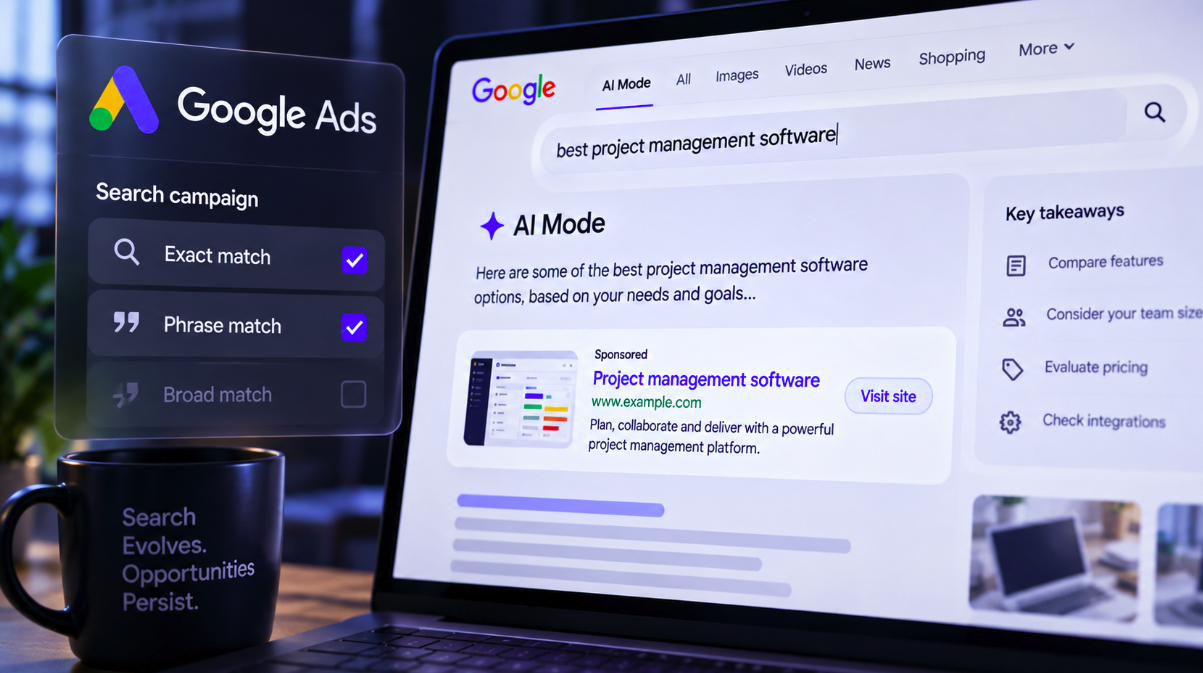
Google is testing a notable expansion of who can advertise inside AI Mode. Standard Search campaigns using exact- and phrase-match keywords can now serve text ads in Google’s conversational search experience in a limited experiment, provided the user expresses sufficiently explicit and direct intent.
The test was confirmed by Google Ads Liaison Ginny Marvin to Search Engine Roundtable on September 4. Until now, the industry had largely associated AI Mode advertising access with Google’s more automated systems, including AI Max, Performance Max and broader AI-driven matching.
The change does not mean every traditional Search campaign can suddenly follow users throughout complex AI Mode conversations. Google is drawing a clear boundary: restrictive keyword match types are eligible when intent is straightforward, while AI Max and Performance Max remain the products designed to interpret more complicated conversational intent and unlock Google’s newest AI-native ad formats.
That distinction makes the experiment more interesting than a simple inventory expansion. Google is beginning to connect the familiar keyword auction with a search interface that was built to move beyond keywords.
Exact and phrase match can now enter AI Mode in a small test
Search Engine Roundtable reported that advertiser Anthony Higman first noticed regular Search campaigns with restrictive match types serving in AI Mode across multiple campaigns and tests.
Marvin then confirmed the behavior directly, calling it a “small experiment.” She clarified that exact- and phrase-match keywords are eligible to serve text ads in AI Mode, but only in cases where the user’s intent is explicit and direct.
That qualification matters. An exact-match keyword does not suddenly become a universal ticket into every conversational query AI Mode can understand. Google is testing whether conventional keyword targeting can still work when an AI Mode interaction contains an obvious commercial intent that maps cleanly to the advertiser’s keyword.
For PPC teams that deliberately retained restrictive match types for control, the experiment potentially opens a new surface without requiring an immediate migration of every campaign to broader targeting.
AI Mode is no longer an entirely separate advertising universe
Google has spent the past year describing AI Mode as a fundamentally different kind of Search experience. Users can ask longer questions, refine their needs conversationally and move through research without repeatedly reformulating short keyword queries.
That evolution initially made highly automated advertising systems the obvious fit. AI Max can use keywords, creative assets and landing pages to identify additional relevant searches beyond an advertiser’s explicit keyword list. Performance Max similarly relies on Google AI across inventory and signals.
Google’s original AI Max announcement framed the product around moving beyond simple query matching toward richer signals of intent. The company has continued expanding that approach throughout 2026.
The new experiment shows that Google does not view conversational Search and traditional keyword Search as completely isolated systems. When the user’s intent is sufficiently clear, an old-fashioned exact or phrase keyword can still be a useful commercial signal inside an AI interface.
Explicit intent is the bridge
The key phrase in Marvin’s explanation is “explicit and direct user intent.”
AI Mode can support a broad spectrum of behavior. A user might spend several turns exploring a complicated problem without expressing any immediate desire to buy. Another might ask a direct question that makes commercial intent unmistakable.
Google appears to be testing restrictive keyword eligibility primarily in the second situation.
That makes conceptual sense. If someone asks AI Mode a direct question closely aligned with an advertiser’s exact keyword, Google does not necessarily need expansive AI matching to understand that the campaign is relevant. The explicit intent already supplies the connection.
The experiment therefore preserves a role for keyword precision even inside an environment built around natural-language reasoning.
This does not make exact match broad match
Advertisers should not interpret the test as evidence that Google has erased the distinction between keyword match types.
Google’s current keyword prioritization documentation still gives special priority to exact-match keywords identical to a search term. Phrase and broad matching remain separate mechanisms with different expansion behavior.
The new test changes the surface on which qualifying text ads may appear, not the fundamental definition of every keyword.
That distinction will be important when advertisers analyze search terms from AI Mode. A campaign receiving impressions there does not automatically mean Google used the same broad semantic expansion that AI Max would have used to reach a complex conversational query.
AI Max still has a much larger role
Google was equally clear about what the experiment does not replace. Marvin said AI Max and Performance Max for Search are designed to capture complex conversational intent and access the company’s latest ad formats, including Highlighted Answers.
Google has been aggressively expanding AI Max. In April, it announced that the product was moving out of beta and that legacy Search capabilities would increasingly transition toward it. The company says AI Max uses search-term matching, text customization and final URL expansion to identify opportunities conventional setups can miss.
More recently, Google has introduced additional testing and planning controls to make AI Max easier for advertisers to evaluate without abandoning important brand and location guardrails.
Traditional exact- and phrase-match campaigns entering AI Mode should therefore be viewed as a narrower path into the surface, not as a substitute for Google’s broader AI advertising strategy.
Google is building multiple ad layers inside AI Search
The test also arrives as Google develops ad experiences that go far beyond standard text placements.
At Google Marketing Live 2026, the company announced new AI Mode advertising formats built with Gemini, including Conversational Discovery ads and Highlighted Answers. Those formats are designed to combine advertiser assets with AI-generated context that helps users evaluate a product or service.
Google has separately tested retail and travel formats that insert sponsored commercial options into AI-assisted research.
The emerging structure therefore has at least two layers. Familiar Search ads can appear when a conversational interaction produces direct intent, while more automated campaigns can participate in complex discovery journeys and AI-native formats.
That gives Google a way to expand AI Mode monetization without forcing every advertiser into the same campaign architecture.
Restrictive match advertisers gain a new reason to watch AI Mode reporting
For performance marketers, the immediate impact may be modest because Google explicitly describes the rollout as a small experiment. It should not be treated as universal availability.
But advertisers using exact and phrase keywords now have another reason to inspect where impressions and clicks are coming from and to watch for changes in search-term behavior.
If AI Mode traffic begins appearing, teams should evaluate it as a distinct context rather than assuming it behaves identically to the conventional Search results page. Conversational users may be at a different point in the decision process, and the surrounding AI response can affect how they interpret the sponsored result.
Conversion rate, click quality and query intent will matter more than the novelty of receiving an AI Mode impression.
Control and automation are starting to coexist rather than replace each other
Google Ads has spent years moving toward broader matching, automated bidding and AI-driven campaign systems. That trajectory has sometimes created the impression that restrictive keyword targeting is destined to disappear.
This experiment suggests a more nuanced outcome. Google can continue promoting automated systems for incremental reach while allowing tightly controlled campaigns to participate when the system has high confidence that a direct intent matches them.
For advertisers, that creates a possible hybrid strategy. Exact and phrase keywords can continue serving high-confidence demand, while AI Max expands into more ambiguous or conversational opportunities.
The two approaches are not necessarily competitors. They can represent different confidence thresholds inside the same evolving Search ecosystem.
AI Mode monetization is moving closer to the existing Search business
Google has made clear throughout 2026 that advertising will be built directly into its AI search experiences. In its February outlook for digital advertising, the company said it was not merely bringing ads into AI Search but redesigning commercial experiences for a more conversational environment.
The company has also said AI Max is already unlocking searches that advertisers were not reaching through conventional campaign structures.
Allowing standard Search campaigns into AI Mode for direct-intent cases adds another piece to that strategy. It increases the potential pool of eligible advertisers without requiring Google to wait for every business to adopt AI Max or Performance Max.
That could matter particularly for smaller advertisers and sophisticated PPC teams that still rely heavily on exact and phrase match for economics, compliance or control.
The experiment is small, but the boundary it crosses is important
No advertiser should restructure an account solely because of this test. Google has not announced broad general availability, and Marvin’s wording deliberately limits the scope.
But the experiment changes an important assumption about AI Mode.
Traditional Search campaigns are no longer categorically outside Google’s conversational search surface. When the user states an intent directly enough, even exact- and phrase-match keywords can participate.
AI Max remains Google’s preferred route for complex conversational discovery and the newest AI-native formats. Yet the old keyword model has found a path into the new interface.
That may be the clearest indication yet that Google does not plan to replace traditional Search advertising with a separate AI ad system. It is increasingly weaving the two together.