
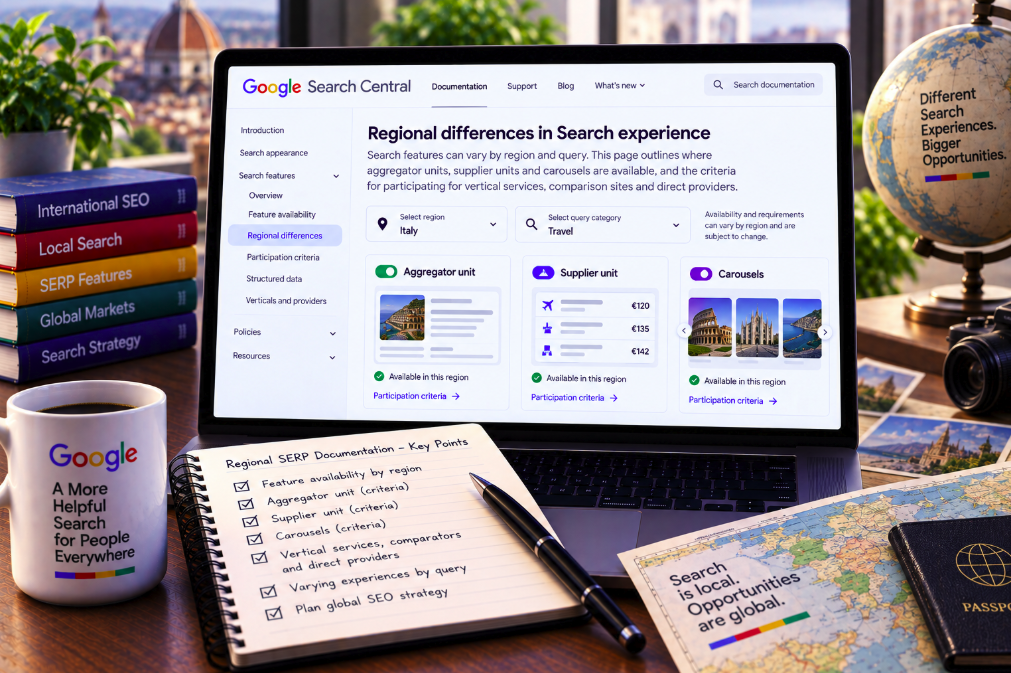
Google has published a new Search Central reference that makes an increasingly important fact about modern search explicit: the opportunities available on a results page can change depending on where the user is and what they are searching for.
The new regional Search experience documentation, added on September 8, maps specific features to regions and query categories. It covers aggregator units, supplier units, ecosystem carousels, job-site features, places-site features, South African badges and refinement chips, and structured-data carousels.
Google's Search documentation changelog says the purpose is to help publishers, businesses and aggregators understand which regional features are available, what the eligibility criteria are and how organizations can participate.
Search Engine Roundtable highlighted the new resource on the same day, noting that Google now breaks the information down by feature, region and query type. The change is more than documentation housekeeping. It gives international SEO teams a clearer way to identify SERP opportunities that may exist in one market but not another.
Google now lets businesses filter Search opportunities by region and query
The new page is designed as a practical lookup tool rather than a generic description of Search.
Users can select where their company is based and the query types relevant to their business, then see which specialized Search experiences apply.
That is useful because Google's regional Search features do not follow one universal template. The European Economic Area, Türkiye and South Africa currently have different combinations of features and vertical coverage.
For international SEO, this means a visibility strategy built around the U.S. SERP can miss surfaces that matter in Europe or other regulated markets.
The EEA has the broadest set of documented ecosystem units
Google's table lists aggregator units in the European Economic Area for hotel, flight, ground-transportation and product queries.
The EEA also has supplier units for those same broad query families, ecosystem carousels for weather, sports, finance and translation queries, and dedicated Job sites features for job searches.
Structured-data carousels are available in the EEA for hotels, local businesses, things to do, products, ground transportation, flights and vacation rentals.
These are different mechanisms with different eligibility rules, so being eligible for one does not automatically make a site eligible for the others.
Aggregator units create a dedicated surface for vertical search services
Google's aggregator-unit documentation describes the feature as a multi-provider unit designed for Vertical Search Services, or VSSs.
Potential participants include online travel agencies, comparison-shopping services, metasearch engines and directories.
For an eligible query such as a hotel search, one participating provider's results can be expanded by default inside the unit. Users can select another aggregator when alternatives are available.
Clicks within the unit lead directly to the selected aggregator's website, making the feature a distinct organic distribution opportunity rather than simply another label applied to a standard blue link.
The top-ranked aggregator is expanded by default
The design creates competition at two levels.
First, eligible aggregators compete for visibility as providers within the unit. Second, the selected aggregator supplies the individual results that users can explore.
Google says the top-ranked provider's results are expanded by default, while users can choose another participating provider.
That makes provider ranking itself strategically important. Participation creates eligibility for the surface; it does not guarantee the most prominent default state.
Aggregator participation can require feeds or real-time APIs
This is not a feature that every ordinary website can activate with a meta tag.
Google says eligible aggregators need relevant content, must meet quality requirements, comply with Search content policies and express interest through the appropriate process.
Depending on the vertical, participants may also need to provide structured data through direct feed integrations or real-time APIs.
Flight and long-distance transportation experiences, for example, can depend on real-time partner APIs, while lodging and other entity-oriented experiences use relevant feed systems.
Supplier units are designed for direct providers
Google has separately documented the supplier unit, which is intended for businesses that provide the product or service directly.
Examples include individual hotels, airlines, brick-and-mortar businesses and service providers.
The supplier unit appears alongside the aggregator unit and is intended to provide direct providers with their own visibility opportunity.
Google explicitly says the supplier unit appears only when the aggregator unit appears, so it is not an independent SERP feature that can surface in every relevant search.
Direct suppliers do not need a special feed just to be eligible
The supplier requirements differ significantly from the aggregator requirements.
Google says direct providers do not need to submit additional data beyond what is accessible through ordinary web crawling in order to be eligible for the supplier unit.
Feeds can enhance supplier results where available, but they are not described as a basic participation requirement.
This makes conventional technical SEO fundamentals—crawlability, indexable pages and clear entity information—especially important for direct businesses seeking visibility in the surface.
The documentation clarifies who is an aggregator and who is a supplier
That distinction has practical consequences for companies operating hybrid business models.
An online travel agency comparing inventory from many hotels is participating as an aggregator. An individual hotel selling its own rooms is a direct supplier.
A marketplace or directory may need the aggregator pathway, while the businesses represented inside it can qualify through supplier visibility.
International search teams should therefore classify their role before deciding which integration or eligibility documentation applies.
Ecosystem carousels cover data-heavy informational queries
Not every regional feature is commercial.
Google's ecosystem carousel is available in EEA countries for weather, sports, finance and translation queries.
The feature is designed for questions that benefit from data visualization or interactive information, such as stock charts, weather information or sports scores.
When a user clicks a tile, Google says the searcher is taken directly to the participating website.
Google says carousel ordering follows Search ranking principles
The ecosystem-carousel documentation says website order is determined by Google's Search ranking algorithms.
Google describes those algorithms as applying non-discriminatory ranking principles intended to surface the most relevant results for the user's location and language.
Eligibility therefore does not mean equal placement or guaranteed traffic.
The surface still contains a ranking layer, making relevance and overall Search quality important after a provider becomes eligible.
Job aggregators get dedicated EEA features
Google has also published documentation for Job sites features in the EEA.
The experience includes a dedicated aggregator carousel that can show job sites relevant to the user's query and a refinement chip that lets searchers focus on aggregator text results.
Google says publishers do not need to add special markup to qualify for the aggregator carousel or refinement chip.
Eligible businesses serving users in the EEA can express interest through Google's participation process.
Türkiye has a different set of regional features
The new reference makes clear that European-style Search changes should not automatically be generalized to every nearby market.
For Türkiye, Google lists Places sites features for hotel and local-business queries. These include a dedicated carousel and refinement mechanism pointing users toward aggregator sites.
Türkiye is also included in Google's beta structured-data carousel program for hotels, local businesses and vacation rentals.
The set of supported query types is therefore narrower and structurally different from the EEA list.
South Africa has its own badges and refinement chips
Google documents a separate Search treatment for South African businesses.
A South Africa badge and refinement chip can be available for travel, products, car hire, food delivery and ground-transportation queries.
Structured-data carousels are also supported in South Africa across a broader set of verticals including hotels, things to do, flights, products, food delivery, car hire, vacation rentals and ground transportation.
This reinforces the core message of the documentation: regional SERPs cannot be understood through one global feature checklist.
Structured-data carousels remain a beta feature
Google's structured-data carousel documentation labels the feature as beta.
The carousel can present entities from one website in a horizontally scrollable result, sometimes described as a host carousel.
Unlike some of the other regional surfaces, this feature requires supported structured-data markup for eligibility.
Google warns that requirements can change while the beta develops, so implementations should be maintained against the current documentation rather than treated as permanent specifications.
The query type matters as much as the country
A business being located in an eligible region is not sufficient by itself.
Google's new table maps features to query categories because a hotel search, finance query and job search can trigger entirely different ecosystem opportunities even for users in the same country.
This means regional SEO auditing needs two dimensions: market and intent.
A team should ask not only “What Search features exist in Germany?” but “What Search features exist in Germany for the hotel, flight, product or job queries that matter to us?”
The documentation turns SERP localization into an operational task
International SEO has traditionally focused on language targeting, hreflang, local content, country domains and localized keyword demand.
The new documentation adds another layer: feature eligibility.
Two correctly localized sites can compete in different ways if one qualifies for a specialized regional unit and the other does not.
For vertical businesses, technical integration with feeds, APIs or structured data can therefore become part of international Search distribution rather than merely an optional enhancement.
This is especially important for travel and comparison businesses
Hotels, flights, ground transportation and products appear repeatedly across Google's EEA documentation.
These categories are also central to the relationship between Google, direct suppliers and vertical comparison services.
An OTA needs to understand aggregator eligibility and data integration, while an individual hotel needs to understand the supplier path. A comparison-shopping service has different participation requirements again.
Grouping all of those businesses under one generic “SEO” workflow would miss how the new surfaces actually operate.
Google is documenting changes shaped by Europe's regulatory environment
Search Engine Roundtable notes that the new page launched alongside Google's documentation about changes to Search under Europe's Digital Markets Act environment.
The EEA-specific units are designed in part to create explicit visibility opportunities for ecosystem participants such as vertical search services, comparison services and direct suppliers.
That regulatory context helps explain why the European results page can diverge materially from Google's U.S. experience.
For multinational businesses, regulation is now a direct input into SERP design and therefore into organic-discovery strategy.
The new page is documentation, not proof every feature launched on September 8
Google's changelog says the regional-differences documentation itself was added on September 8.
That does not mean every feature listed on the page was first launched that day.
Some of the underlying experiences have been developing through earlier Search changes, beta programs and regulatory adjustments.
The September update should therefore be understood primarily as a new consolidated map of availability and participation rather than one simultaneous global product launch.
Eligibility still does not guarantee appearance
Meeting the technical and business requirements for a feature means a site can participate; it does not mean the feature will appear for every relevant query.
Google repeatedly frames these experiences around what is helpful and relevant for the specific search.
Ranking systems still determine which providers and results receive prominence, and some units only appear under particular conditions.
International SEO forecasts should therefore model eligibility as an opportunity set, not as guaranteed impressions.
Feeds are becoming part of organic Search operations
For aggregators, some of the most important work may sit outside traditional page optimization.
Google's documentation references lodging feeds, transport APIs, flight partner integrations and product-data systems as ways to populate specialized units.
That means Search visibility can depend on the freshness and quality of machine-readable inventory data as well as crawlable webpages.
SEO teams in travel, commerce and local marketplaces increasingly need to work with feed engineering and product-data teams rather than treating Search as a purely content-layer discipline.
Google's local VSS documentation extends the same architecture
Google's Actions Center documentation for Local Vertical Search Services describes a related aggregator-and-supplier model for local queries such as dining, services and things to do.
Google says the Local VSS aggregator unit lets participating vertical services compete to show query-relevant results, with the top-ranked provider displayed by default.
A standardized point-of-interest feed can provide business names, addresses, phone numbers, categories, photos and other metadata to power the partner's own unit.
Google explicitly says data submitted through that POI feed is used to populate the partner's unit rather than enrich Google's own services or competing units.
Regional SERP monitoring should become part of international SEO
A global rank tracker that checks one location can miss the most important part of the story.
A query may show a specialized aggregator surface in an EEA country, a different carousel in Türkiye and neither experience in the United States.
The conventional organic rankings could be similar while the actual visibility and click opportunities differ significantly.
Teams operating across markets should therefore capture rendered SERP features by country and query class, not just a numerical ranking position.
Competitor analysis also needs regional context
A competitor that appears dominant in one market may simply be participating in a feature that does not exist in another.
For example, an aggregator's prominence in an EEA hotel query could come partly from its eligibility and ranking within an aggregator unit, while a direct hotel brand competes through a supplier surface.
Comparing those businesses solely through traditional blue-link rankings would understate the actual distribution landscape.
Competitive intelligence should identify which SERP ecosystems each competitor can enter and which integrations enable that presence.
Publishers should build a regional feature inventory
The new Google page makes this relatively straightforward.
For each target country or regulatory region, teams can document the important query families, relevant Search features, eligibility requirements, required feeds or markup and the internal owner responsible for implementation.
The resulting matrix becomes a practical roadmap for international organic visibility.
It also prevents teams from spending engineering resources on a Search feature that is unavailable for their users or vertical.
The documentation is a useful transparency improvement
Google Search has become structurally more complex as rich results, AI features, vertical units and regulatory requirements have accumulated.
A centralized page that states where specialized experiences are available reduces some of the guesswork for publishers and businesses.
It does not make Search uniform, and it does not reveal every ranking factor or guarantee participation.
What it does provide is a clearer map of the surfaces that exist and the pathways organizations can use to become eligible.
International SEO now means optimizing for different Search architectures
The biggest takeaway from Google's September 8 documentation is that localization is no longer only about translating content or selecting the right regional URL.
The Search results page itself can be a different product in different markets.
An aggregator may need a feed integration to compete inside an EEA unit. A direct supplier may rely on crawlable website information for an adjacent surface. A publisher in weather or finance may have an ecosystem-carousel opportunity, while a business in South Africa or Türkiye faces another set of features entirely.
Google has now made those differences easier to discover. For global SEO teams, the next step is to stop treating one country's SERP as the template for every market and start mapping visibility opportunities region by region, query by query and business model by business model.