
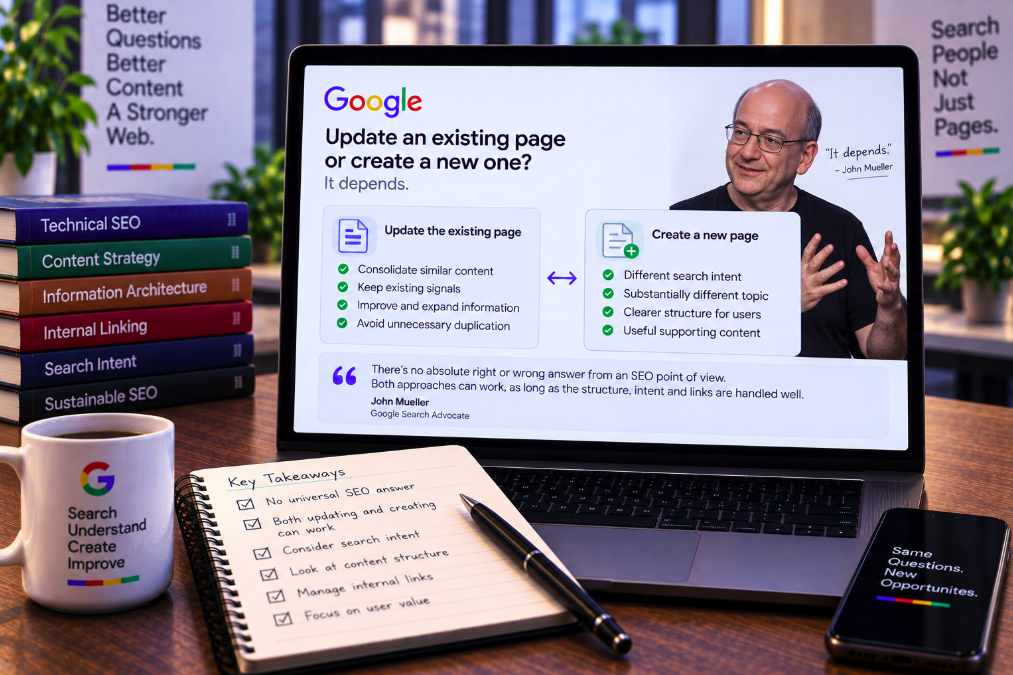
One of the most common content-architecture questions in SEO sounds as if it should have a definitive answer: when an existing page needs more depth but one part of the topic could stand on its own, should you expand the original page or publish a new supporting article?
Google's John Mueller has offered the answer many experienced SEOs eventually arrive at themselves: there is no universal rule. In a LinkedIn exchange reported by Search Engine Roundtable on September 9, a practitioner described an existing article that needed expansion while also containing a sub-intent substantial enough to potentially justify its own page.
Mueller's response was deliberately non-prescriptive: sometimes there is no absolute right answer, but you can choose one and make it the right answer through execution.
That comment should not be turned into a new Google ranking rule. Google did not announce that consolidated pages rank better, that supporting articles rank better or that either architecture receives a special algorithmic advantage. The useful lesson is more practical: both structures can work when they make sense for users, clearly represent search intent and are connected coherently within the site.
The original question was about a genuine sub-intent
The distinction in the LinkedIn question matters. The practitioner was not asking whether to create two nearly identical pages targeting slightly different keyword variations. The issue was whether a meaningful sub-intent should remain inside a broader article or become a separate supporting resource.
That is an information-architecture decision rather than a simple keyword decision. A broad article can often accommodate several closely related questions without becoming confusing. But a subtopic can reach a point where it serves a different reader need, requires substantially more explanation or deserves its own search destination.
Mueller did not define a threshold at which that transition occurs. His answer suggests there may not be one threshold that applies to every website and topic.
The right architecture depends on what the content is trying to accomplish and whether the site can execute the chosen structure clearly.
“It depends” is not an absence of SEO strategy
SEO practitioners often find conditional answers frustrating because they want a rule that can be applied consistently across hundreds or thousands of URLs. Yet content architecture involves tradeoffs that cannot always be reduced to one variable.
A consolidated page can concentrate information, links and user engagement around one URL. A separate supporting page can provide greater depth, target a genuinely distinct intent and create a cleaner reading experience for people who only need that subtopic.
Neither advantage automatically wins in every situation. Consolidation can become bloated. Splitting can become fragmentation. A large page can satisfy several related intents efficiently, while a cluster of separate pages can create a strong navigational structure. The same cluster can also create redundant pages competing for nearly identical searches.
The strategic work is deciding which failure mode is more likely for the content in front of you.
Start with intent, not word count
A useful first question is whether the proposed new page solves a meaningfully different user problem. Word count is a poor proxy for that distinction.
A subtopic can require 1,500 words and still belong naturally inside the parent page because users need that explanation to complete the same task. Another subtopic might require only 500 words but represent a different decision, audience or stage of the journey and therefore deserve its own URL.
Consider a broad guide to choosing a home heat pump. A section explaining how heat pumps work may be necessary context within the main guide. A detailed page about calculating heat-pump size for a particular property could serve a sufficiently distinct task to justify a supporting resource.
The test is not “can we write enough words for another page?” It is “would a user reasonably seek this information as a destination of its own?”
Search results can reveal whether Google sees a separate intent
The SERP can provide evidence for the decision, although it should not be treated as a perfect oracle. Search the parent topic and the proposed subtopic separately and compare the results.
If substantially different pages and site types rank for the two queries, that can indicate different intent. If the same URLs consistently rank for both, Google may be able to satisfy the searches with one broader page.
Look beyond exact ranking positions. Compare page formats, titles, the questions being answered and the depth of treatment. A subquery that returns calculators, tools or detailed tutorials while the parent query returns broad guides may deserve its own experience even if the keywords share many words.
SERP evidence is particularly useful when combined with first-party query data rather than used in isolation.
Search Console can show whether one page already serves both needs
Before splitting an established article, inspect the queries and landing-page performance associated with it. An existing URL may already rank for the proposed sub-intent and receive meaningful impressions or clicks from it.
If the page performs well for both the broad topic and the narrower question, expanding the relevant section may be the lower-risk option. The URL already has a history, internal links and search visibility associated with the subject.
If the sub-intent appears frequently but the existing page performs poorly for those queries, a deeper analysis is warranted. The problem could be insufficient coverage, poor placement, weak relevance or simply stronger competing pages built specifically for that intent.
A separate page is one possible solution, but the data should identify the problem before architecture is changed to solve it.
Consolidation works when the intents are tightly connected
Updating an existing page is often the cleaner choice when the new material directly helps the same reader complete the same task. The content becomes more comprehensive without forcing users to navigate elsewhere for necessary context.
Consolidation also avoids creating multiple URLs that say substantially the same thing. When two pages overlap heavily, search engines and users may struggle to understand why both exist.
A well-expanded page can establish a clear hierarchy with headings, concise navigation and sections that answer related questions without turning into a disorganized encyclopedia. Existing internal and external links continue pointing to the same destination rather than being divided across multiple URLs.
But consolidation should not be pursued merely because “bigger pages rank better.” Mueller's comment provides no support for that claim, and page length by itself does not resolve intent.
A new page works when the sub-intent deserves independence
A supporting page becomes attractive when the subtopic has enough conceptual independence that a user could reasonably enter the site through it, understand it without reading the parent article and leave with a complete answer to a distinct problem.
That independence can come from different audience needs, a different stage of a process, a different content format or substantially greater depth. A broad beginner guide and a technical implementation tutorial can belong to the same topic while serving different intents.
Separating them can improve clarity. The parent page remains focused, while the supporting page can use its title, introduction, examples and structure to address the narrower need directly.
The important condition is that the new URL adds real value rather than repackaging a section of the original article into a second page with a slightly different keyword.
Internal linking makes the two-page option coherent
The original question explicitly proposed connecting the parent and supporting article, and that relationship is essential when content is split.
The parent page should link to the deeper resource where a reader naturally needs more detail. The supporting page should provide enough context to explain its relationship to the broader topic and link back when that helps navigation.
Internal links do more than move ranking signals around. They explain site structure to users and search engines. A deliberate parent-support relationship is easier to understand than two isolated pages that happen to contain similar terminology.
Anchor text should describe the destination naturally. There is no need to repeat an exact-match keyword mechanically every time the pages connect.
The real danger is creating accidental internal competition
“Keyword cannibalization” is often used too broadly, but the underlying problem is real when a site publishes several pages that satisfy essentially the same intent without a clear reason for each to exist.
Two URLs ranking for related queries is not automatically harmful. Large sites frequently have several useful pages on one subject because those pages serve different needs.
The problem appears when the pages are interchangeable. If an editor cannot explain in one sentence why a user should choose Page A instead of Page B, the distinction may not be strong enough.
In that case, consolidation can create a clearer destination. If the difference is obvious and useful, separate pages may be entirely appropriate.
Content architecture should survive without the target keyword
One useful editorial test is to describe each proposed page without mentioning its SEO keyword. What job does the page perform for the reader?
If both descriptions are effectively identical, splitting the content may be artificial. If one page is an overview while another is a troubleshooting guide, comparison, calculator, case study or implementation tutorial, the architecture has a stronger conceptual basis.
This approach prevents keyword tools from dictating a site structure that makes little sense to humans. Two phrases can have different wording while representing the same need, and two similar phrases can conceal very different tasks.
Search intent is ultimately about the job behind the query, not the lexical distance between keywords.
Updating an existing URL can preserve continuity
Established pages often have assets that a new URL does not: external links, internal prominence, historical engagement and a known place within the site's architecture. Updating that page can preserve continuity while improving its usefulness.
This is especially compelling when the article is outdated or incomplete but still broadly aligned with the intended topic. A thoughtful refresh can correct obsolete information, add missing sections, improve examples and strengthen the page without creating another destination.
However, preserving an old URL should not become a reason to force unrelated content into it. Existing authority is valuable only if the page remains coherent for the user.
The best update improves the page's purpose rather than merely increasing its size.
Creating a new URL creates a maintenance obligation
Every new page is another asset that needs to remain accurate, internally linked and useful over time. That cost is easy to ignore during content planning.
A site that splits every subtopic into a separate article can quickly accumulate thin, overlapping or outdated pages. The architecture may look impressive in a spreadsheet while becoming difficult to maintain in practice.
This is one reason consolidation can be the stronger choice for smaller teams. A comprehensive page that is regularly maintained may provide more value than a large cluster of supporting articles that gradually decay.
Conversely, a team with genuine expertise and a durable editorial process may be able to support a deeper cluster effectively. The right architecture depends partly on operational capacity.
The decision can be reversible
Content architecture is not always a permanent commitment. A team can expand an existing article and later discover that one section has developed enough search demand and editorial depth to deserve its own page.
It can then create the supporting resource, shorten the parent section and link to the new destination. Similarly, two weak or overlapping pages can later be consolidated into a stronger resource with appropriate redirects and internal-link updates.
That reversibility supports Mueller's broader point. Teams do not need perfect foresight before publishing. They need a defensible structure, clean implementation and enough measurement to recognize when the structure should change.
SEO strategy is often iterative rather than a one-time architectural verdict.
Measure whether the chosen architecture actually works
Once the decision is made, evaluation should focus on outcomes rather than proving the original theory correct. Track query coverage, impressions, clicks and conversions for the relevant intent. Watch whether users engage with the supporting links and whether the new structure improves navigation.
If a new page is created, check whether it develops its own distinct query footprint or simply duplicates the parent's visibility. If an existing page is expanded, monitor whether the additional section begins attracting the intended searches without weakening the page's overall focus.
Qualitative signals matter too. Does the content read naturally? Can users find the answer quickly? Does the site architecture make sense when viewed without an SEO tool?
The purpose of measurement is not to find a universal rule after the fact. It is to determine whether the specific choice works for the specific site.
Mueller's comment is not a new ranking-factor disclosure
Short comments from Google representatives are frequently converted into prescriptive SEO headlines. That would be a mistake here.
Mueller did not say Google has a ranking signal that rewards publishers for splitting subtopics into separate URLs. He did not say consolidation is preferred. He did not announce a content-cluster factor or a new internal-linking requirement.
His statement was contextual advice in response to a practitioner facing two defensible content structures. Search Engine Roundtable also notes that the comment is consistent with Mueller's longstanding tendency to reject the idea of a perfect universal SEO formula.
In earlier discussions, Mueller has similarly argued that search does not have one absolute truth about which page must rank for a query and that different sites can succeed through different approaches. The September comment is better understood as continuity with that philosophy than as new algorithm information.
SEO teams need decision frameworks, not universal rules
The absence of one Google-approved answer does not mean every choice is equally good. It means the team needs its own evidence-based decision framework.
Ask whether the sub-intent is independently useful, whether the SERPs differ, whether first-party query data shows separate demand, whether a standalone page can provide distinct value, whether the parent will remain coherent and whether the site can maintain both resources properly.
Then make the architecture explicit. If the content stays consolidated, organize the expanded section clearly. If it becomes a new page, differentiate its purpose and connect it naturally to the parent.
What matters is not choosing the option that sounds most “SEO.” It is creating a structure in which each URL has a comprehensible reason to exist.
“Make it the right answer” means execution matters after the decision
The most useful part of Mueller's comment is the second half. Choosing an architecture is only the beginning. A theoretically sensible content cluster can fail if the pages are redundant, poorly linked or neglected. A consolidated guide can fail if it becomes unwieldy and buries important information.
The team makes the decision work through execution: clear scope, strong writing, useful navigation, descriptive internal links, accurate information and ongoing maintenance.
That is why “expand or create a new page?” has no universal SEO answer. The two structures are not isolated ranking tricks. They are different ways of organizing information, and either can support search performance when it matches the user's intent and the site's ability to deliver it well.
For content teams, that is a more useful principle than another binary rule: stop searching for a hidden Google preference where none has been announced. Define the user problem, choose the architecture that explains it most clearly, connect the information properly and measure whether the result works.