
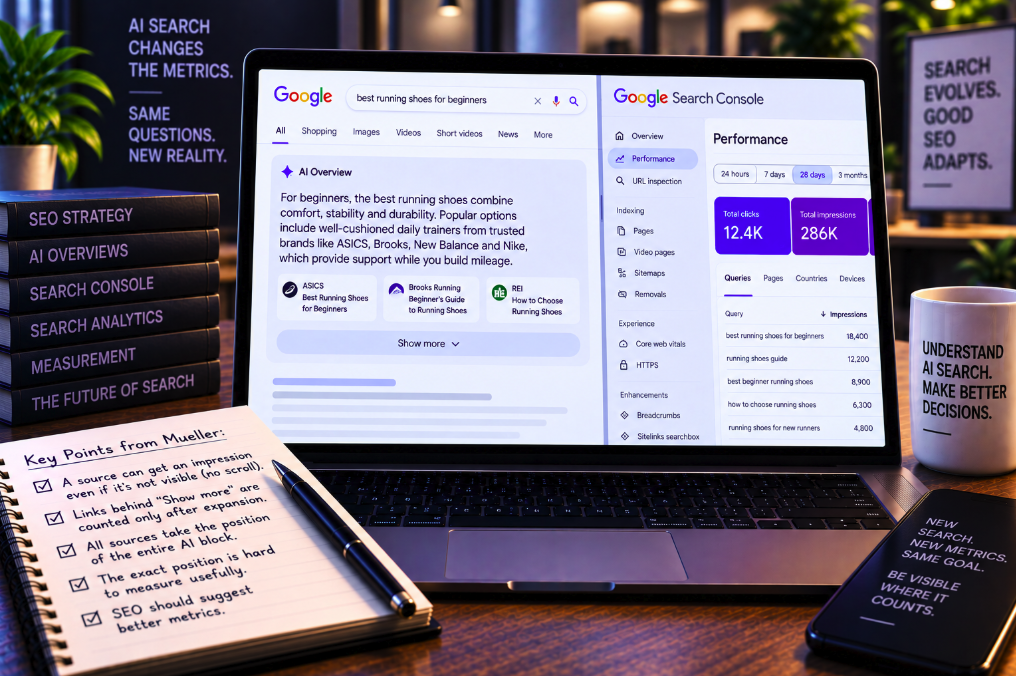
Google Search Console can record an impression for a source inside an AI Overview even when the user never scrolls far enough to see that source on screen. At the same time, Search Console cannot tell the site owner where the source appeared inside the AI-generated block, because every link in an AI Overview inherits the position assigned to the block as a whole.
Those reporting mechanics were clarified in a Reddit discussion involving Google’s John Mueller and subsequently examined by Search Engine Journal on September 13. Mueller said the community explanation was “pretty much it” and acknowledged that position is difficult to report in a way that is genuinely useful for modern search.
The exchange exposes a central problem with measuring AI visibility through Search Console. The familiar metrics—impressions and position—still exist, but their meaning becomes much less intuitive when a search result is an expandable, multi-source AI answer rather than a single blue link.
An impression can mean “potentially seen,” not actually viewed
Google’s Search Console documentation for impressions, clicks and position defines an impression as a link that a user has seen or potentially seen in Search, Discover or News.
For the standard set of search results, Google generally counts the impression when the item is loaded on the current results page even if the user does not scroll it into the visible browser viewport. In other words, Search Console is not universally measuring whether the user’s eyes had an opportunity to land on the specific link.
AI Overviews follow those standard impression rules. If an AI Overview renders and a source link is part of the currently exposed result set, the source can receive an impression even if the user stops reading higher on the page and never scrolls down far enough for the link to become visible.
This is why an AI citation impression should not be interpreted literally as “one person saw my citation.” A more accurate interpretation is that Google considered the source exposed within the served search result under its impression-counting rules.
“Show more” works differently
Expandable content creates the opposite situation. Google’s standard rules generally require the user to perform the action that reveals a link before the link can receive an impression.
For AI Overview sources hidden behind a “Show more” control, the impression therefore is not counted merely because the hidden source exists in the underlying answer. The user has to expand the section so that the additional result set becomes available.
The distinction is important because it creates two different kinds of measurement error if marketers treat impression counts as literal viewability. Sources in the initially loaded result set can look more visible than they were because no viewport exposure is required. Sources behind an expansion can look less present because their inclusion is not recorded until a user opens that section.
Search Console is applying a consistent legacy rule, but the user experience around that rule has become more complex.
Every AI Overview source receives the position of the entire block
Position is even more problematic. Google’s documentation says an AI Overview occupies a single position in the search results and all links within it are assigned that same position.
Suppose an AI Overview occupies position one. One publisher might be the first prominent source shown alongside the opening answer, while another may appear much farther down inside the generated response. Search Console does not express that internal difference through the position metric. Both links inherit the AI Overview’s position.
This follows the way Google has historically measured compound search features such as carousels and knowledge panels. The containing feature occupies a position, while its internal elements share that value rather than receiving their own conventional rank.
For AI Overviews, however, the limitation is particularly consequential because one generated answer can contain numerous source links with very different visual prominence.
A “position 1” AI citation is not necessarily the first citation
This means SEOs should be extremely cautious when interpreting average position in AI search. A source reported at position one may not be the first source the user sees inside the AI Overview. It may not even enter the user’s viewport under the standard impression rules.
The metric describes where the AI Overview block sat relative to other search features, not the source’s ranking among the citations contained within that block.
That distinction breaks one of the most familiar assumptions in SEO analytics. With traditional organic listings, improving from position eight to position two usually communicates a meaningful change in visual prominence. Inside an AI Overview, multiple domains can all be reported at the same block position while occupying very different places in the interface.
Search Console therefore cannot currently answer a question many GEO teams care about: “Was my site the primary visible source, or one of the less prominent citations inside the answer?”
Mueller says position is hard to make useful
In the Reddit thread, Mueller acknowledged the problem directly. He said Google had tried to document the mechanics as clearly as possible, but that position for these features is difficult to track in a way that is useful.
Google is therefore handling AI features as blocks, as it does with many other complex search elements. Mueller also noted that position is not separated out in the dedicated Generative AI performance report.
He then broadened the point beyond AI Overviews. Modern results pages contain many interactive formats, making the old concept of positions one through ten increasingly difficult to map onto what users actually experience.
Mueller invited SEOs to suggest what kind of position tracking would be more useful and said he would be happy to discuss those ideas with the Search Console team.
The dedicated AI report still centers on impressions
Google’s Generative AI Performance report provides a dedicated view of how sites appear in AI features including AI Overviews and AI Mode. Google made the report globally available on August 31, 2026 after an earlier staged rollout.
The report allows site owners to analyze generative-AI impressions by page, country, date and device. It is useful for identifying which URLs are appearing in these experiences and how that exposure changes over time.
But the report does not create an entirely new measurement system for generative search. The underlying impression logic still comes from Search Console’s existing definitions, and the data is a filtered view of performance already represented in the broader Search reporting rather than an additional traffic pool that should be added to Web performance totals.
That makes the report useful for segmentation while leaving the harder question of source prominence unresolved.
AI Mode introduces another layer of interaction
Google also applies standard impression rules to AI Mode. But AI Mode is even more interactive than an AI Overview because users can continue asking follow-up questions and explore new subtopics within the same experience.
Google treats a follow-up question in AI Mode as a new query for reporting purposes. Impression, position and click data associated with the new response are assigned to that follow-up query.
Position in AI Mode follows Google’s normal search-result methodology, with carousels and image blocks using the rules established for those individual elements.
The broader implication is that a single conversational research session can create multiple reported query events and multiple source exposures, even though the user experiences them as one continuous interaction.
CTR can become harder to interpret too
If impressions no longer correspond neatly to actual viewport exposure, click-through rate inherits the ambiguity. CTR is simply clicks divided by impressions.
A source can receive an impression when the AI Overview is loaded even if the user never scrolls to the citation. That impression enters the denominator without a realistic opportunity for the user to click the source.
At the same time, sources hidden behind “Show more” do not enter the denominator until the expansion occurs. Those impressions therefore represent a more active form of user exploration than an automatically loaded source higher in the result set.
Comparing CTR between two AI citations can consequently mix different levels of exposure. A lower CTR does not necessarily mean one source was less persuasive; it may have been technically counted as available while being less visually reachable.
The missing metric is actual source prominence
What Search Console does not currently provide is a measure closer to how publishers intuitively understand AI visibility: whether the citation was actually visible, how prominently it was displayed and where it appeared relative to other sources.
A more useful system could potentially distinguish loaded impressions from viewport-visible impressions. It could report whether a source was visible before an expansion, whether it appeared in a prominent source card or inline citation, and where it ranked within a group of sources.
There are obvious implementation challenges. AI interfaces are dynamic, device layouts differ, answers can expand, carousels can scroll horizontally and citations may appear in several forms. A single numeric rank could create a false sense of precision.
That complexity is essentially Mueller’s point: the old position model does not translate cleanly to the new interface. But the inability to reduce AI visibility to one simple rank does not eliminate the need for better measures of actual exposure.
Search Console’s “position” is increasingly a property of the interface
For years, SEOs treated position as a property of a URL: a page ranked third for a query. Modern Search increasingly makes position a property of a larger interface component.
An AI Overview can occupy one position while containing multiple publishers. A carousel can occupy one position while holding many cards. A knowledge panel can contain numerous links while functioning as a single result element for ranking purposes.
The URL is still reported, but the position value may describe the container around it rather than the URL’s actual visual prominence.
That makes average position less useful as a standalone KPI and more useful as contextual metadata: it tells the site owner approximately where the containing search feature appeared, not precisely where the source sat within the feature.
Publishers should not equate AI impressions with citation views
For practical reporting, the safest language is to describe Search Console’s generative-AI number as “AI search impressions” rather than “citation views.”
The former reflects what Google actually measures. The latter implies a level of user visibility the data cannot guarantee.
Teams should also avoid telling stakeholders that an average position of one means their source was the top AI citation. It means the containing feature occupied that position under Google’s methodology.
Clicks remain the clearest direct evidence that a user interacted with an external source, but even clicks reveal only part of AI search’s influence. A user can consume a brand’s information inside an AI answer without visiting the site, while a citation can contribute authority or awareness without generating an immediate session.
AI search needs metrics designed for AI search
The exchange with Mueller is notable because Google is not pretending the legacy framework maps perfectly onto generative interfaces. Search Console’s rules are internally documented and consistent with how compound search features have long been handled, but consistency is not the same thing as analytical usefulness.
An AI Overview citation can receive an impression without entering the user’s viewport. A citation behind “Show more” is not counted until the user expands the answer. Every source can inherit the same block-level position regardless of where it actually appears inside the generated response.
Those rules make sense from the perspective of Search Console’s existing measurement architecture. They are much harder to translate into questions publishers actually want answered: Did users see us? How prominent were we? Were we the primary source? Did our visibility improve relative to competing citations?
Mueller’s invitation for better ideas is therefore more than a casual request for feedback. It reflects a larger transition in search analytics. As Google’s result pages become conversational and compositional, the industry may need to stop forcing AI visibility into the vocabulary of ten blue links and define a new set of metrics around actual exposure, prominence and interaction.