
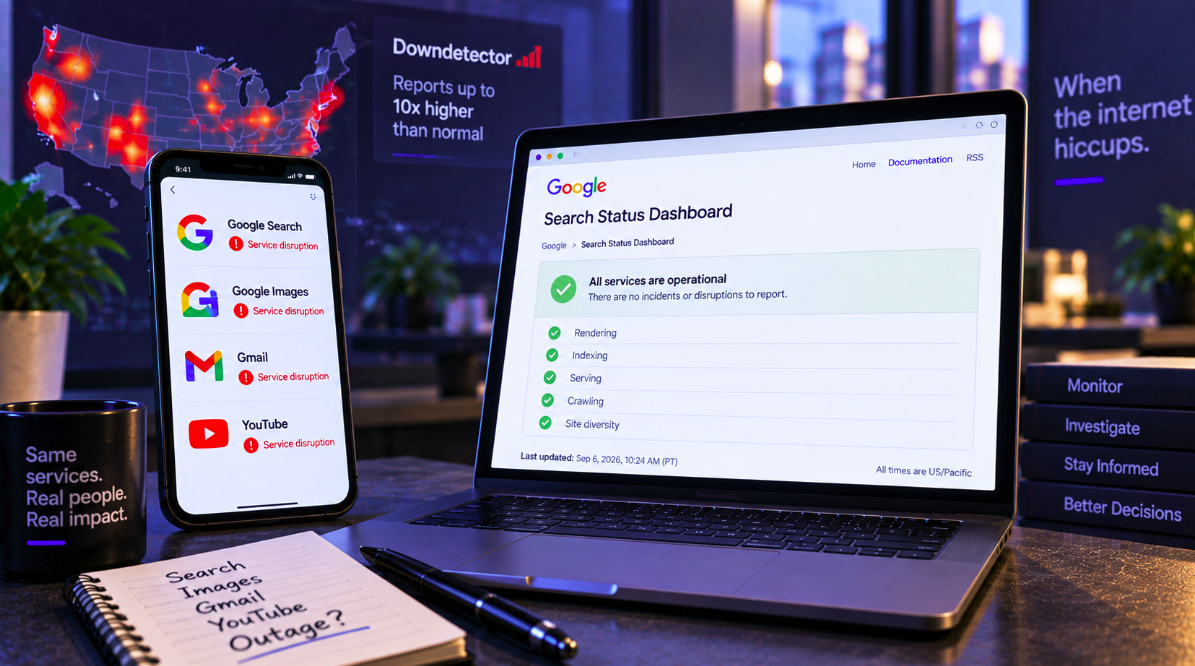
Google users in the United States reported widespread problems across Search, Images, Gmail and YouTube on Sunday, September 6, creating an unusual split between what people were experiencing and what Google’s official service dashboards were showing. While user reports surged and several products appeared degraded, Google’s Search Status Dashboard continued to report no incident.
According to the Houston Chronicle, reports began accumulating early Sunday morning and climbed sharply as the morning progressed. Downdetector volumes reportedly reached roughly ten times their normal level at the peak, with users describing failures or degraded performance involving Google.com, Gmail, YouTube and related services.
By around 10:30 a.m. U.S. Central time, ordinary Google web searches were again returning results for the Chronicle, but Google Images continued to show problems. The cause of the disruption was not known at the time of reporting.
Google’s Search dashboard showed no incident
The most striking part of the episode was the absence of a corresponding incident on Google’s official search-health page. The Google Search Status Dashboard displayed “No incidents” on September 6, including no reported disruption for Crawling, Indexing, Ranking or Serving.
That does not necessarily mean users were mistaken about the outage. Status dashboards and public outage reports measure different things, and an incident can affect only a subset of users, regions, interfaces or infrastructure without immediately meeting the criteria for an official dashboard entry.
It is also important not to overread the Search dashboard’s scope. Google’s Search Status Dashboard is specifically designed to report problems with systems that are part of Google Search. It is not a universal status page for every Google consumer service. A YouTube playback problem, for example, would not necessarily be expected to appear as a Google Search incident.
The reports extended beyond Search
The Houston Chronicle described problems across several Google products. Some users had trouble accessing Google.com and Gmail through browsers and applications. YouTube thumbnails reportedly loaded inconsistently, while some users encountered video playback problems on streaming devices. YouTube TV users also reported buffering and visual glitches.
The breadth of those reports is notable because it can point to a shared dependency rather than an isolated defect in a single product, although no confirmed root cause was available. A networking, authentication, routing or infrastructure problem can sometimes surface as different symptoms across services that share underlying systems. Without a technical explanation from Google, however, any specific diagnosis would be speculation.
Google Search itself appeared to recover during the morning. Image search was slower to normalize in the Chronicle’s testing, illustrating another common characteristic of large distributed-service incidents: recovery does not always happen simultaneously across every interface or product component.
Downdetector is useful evidence, but not an official incident log
Downdetector can identify abrupt increases in user complaints by comparing incoming reports with the normal baseline for a service. A surge to many times the expected level is therefore a meaningful signal that a large number of people are experiencing something unusual at roughly the same time.
But crowdsourced outage monitoring and an operator’s status dashboard answer different questions. Downdetector records what users report experiencing. An official status page reflects what the provider has identified, classified and chosen to publish under that dashboard’s scope and incident criteria.
Those two sources can disagree temporarily. User reports can rise before an engineering team confirms the problem. A regional or partial failure may create a substantial complaint spike without becoming a global service incident. Conversely, an official dashboard can identify an infrastructure issue before most users notice it.
For publishers and SEO teams, that means neither signal should be used in isolation when diagnosing a sudden traffic anomaly.
The Search Status Dashboard has a narrower purpose than many users assume
Google’s search dashboard tracks four broad categories: crawling, indexing, ranking and serving. Those categories are particularly useful to publishers because they help distinguish a problem on the website from a problem in Google’s own search systems.
If Google confirms a serving incident, for example, an abrupt decline in search traffic may have little to do with a site’s rankings or technical configuration. An indexing incident can affect how newly published or updated pages enter the search index. Crawling and ranking incidents create different diagnostic implications.
On September 6, however, all four categories remained clear on the dashboard during the checked snapshot. That makes the reported user-facing disruption an important reminder that not every search-access problem will necessarily be represented there, particularly while an event is developing.
Gmail’s official dashboard also showed no incident in the checked snapshot
Google maintains a separate status system for Workspace products such as Gmail. During research for this article, the Google Workspace Status Dashboard also showed no incident for September 6, including no Gmail disruption in the visible status history.
Again, that does not invalidate individual or regional reports. It shows only that Google had not posted an incident to that dashboard at the observed time. The difference between a user-reported outage and a formally declared service incident is central to interpreting events like this one.
For SEO teams, an external outage can look like a site problem
A temporary Google Search serving issue can produce symptoms that resemble an SEO failure. Organic sessions can fall suddenly. Rank-tracking tools may fail to retrieve results or record unusual SERPs. Search Console data may later show an abnormal period. Users may report that they cannot find pages that ranked normally hours earlier.
The wrong reaction is to start changing the website immediately. If many unrelated Google services are failing at the same time, the probability that a site-specific canonical tag, robots rule or algorithmic penalty caused the traffic decline becomes much lower.
A better incident workflow is to compare several independent signals: the site’s own uptime, server logs, analytics, Google Search Console, official Google status pages and reputable third-party outage monitors. Social reports can add context, but they should be treated as observations rather than a root-cause diagnosis.
Partial recovery can make monitoring harder
The reported difference between ordinary Search and Images is especially useful operationally. When one interface recovers before another, a simple “Google is up” or “Google is down” label becomes inadequate.
Modern platforms consist of many components, delivery paths and regional systems. A search results page can load while image retrieval remains degraded. A website may work in one browser or network while another path fails. A service can also recover gradually as traffic is rerouted or affected systems return to normal.
That is why checking a single query once is not enough to establish that an outage has ended. For organizations that depend heavily on search visibility, repeated tests across key interfaces and regions can provide a more reliable picture.
No public cause means the cause should remain unknown
At the time of the Houston Chronicle report and NetContentSEO’s dashboard check, there was no confirmed explanation for the disruption. That is an important boundary for coverage. A simultaneous problem across several Google products invites theories about shared infrastructure, but without a statement or post-incident report from Google, those theories remain speculative.
The responsible conclusion is therefore narrower: users reported an unusual concentration of failures across multiple Google services; Downdetector activity rose sharply; ordinary web search later appeared to recover while Images still showed difficulties; and the official Google Search Status Dashboard did not record an incident during the observed period.
The dashboard gap is itself useful information
For SEO professionals, the September 6 episode is less about proving that one monitoring source was right and another was wrong than understanding what each source can tell you. A status dashboard is authoritative about the incidents Google has formally posted. It is not necessarily a complete real-time record of every problem every user can experience.
Likewise, crowdsourced outage data is valuable for detecting widespread symptoms, but it cannot identify the technical cause. The strongest diagnosis comes from combining provider status, user reports, independent monitoring and first-party site data.
Google Search appearing unavailable to some users while its official Search Status Dashboard showed “No incidents” may look contradictory. In a distributed system serving billions of requests, it does not have to be. The discrepancy is a reminder that service health is often more granular than a single green or red status indicator—and that during an emerging outage, the users can sometimes see the symptoms before a dashboard tells the story.