
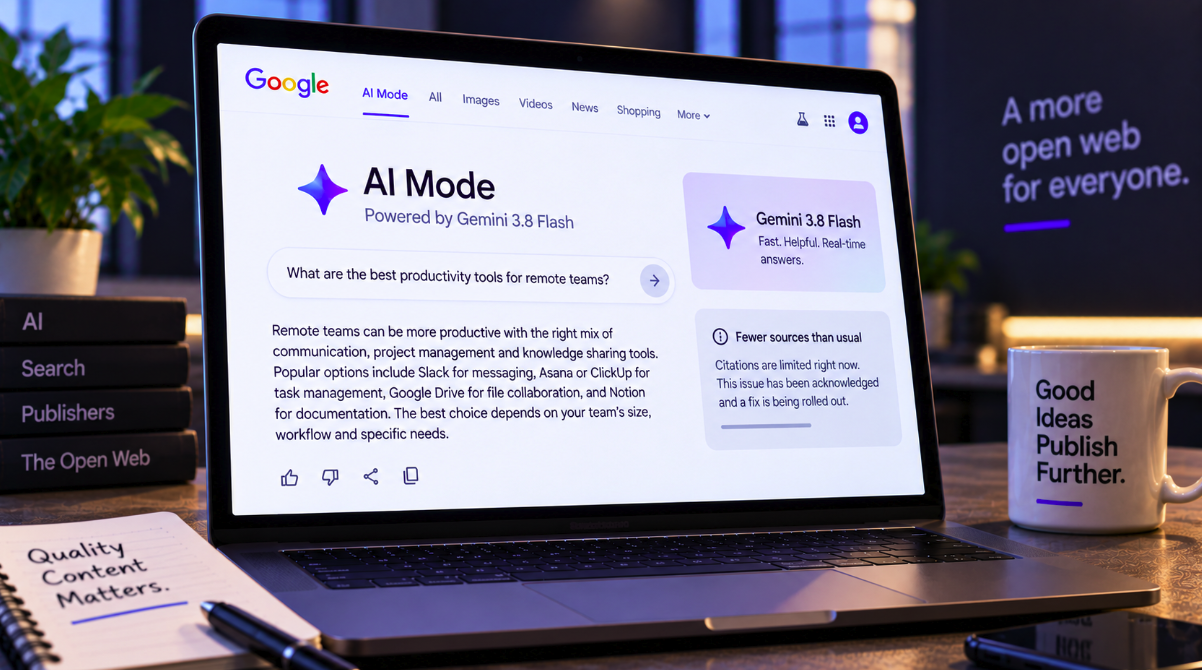
Google’s rollout of Gemini 3.8 Flash into AI Mode briefly created exactly the kind of failure publishers fear from generative search: the AI could answer questions while providing almost none of the links that let users inspect the sources behind those answers.
The behavior appeared shortly after the new model became available in Google Search’s AI Mode. Search marketers testing Gemini 3.8 Flash found that queries which produced source links under AI Mode’s default model could return answers with few or no citations when the new Flash model was selected. Google subsequently confirmed that this was not the intended behavior and said a fix was coming. By the following morning, observers reported that links were appearing again.
The episode, documented by Search Engine Roundtable, appears to have been a short-lived product bug rather than a deliberate change in Google’s approach to publisher links. But its brief existence is still important. It demonstrates how dependent publisher visibility in AI search can be on the behavior of a particular model and the integration layer around it.
Gemini 3.8 Flash had only just arrived in AI Mode
Google introduced Gemini 3.8 Flash on September 2, describing it as its most intelligent workhorse model and highlighting improvements over Gemini 3.7 Flash in software engineering, agentic tasks and complex multi-step reasoning.
On the same day, Google Search executives announced that the model had landed in Search. Search Engine Roundtable reported that Google AI Pro and Ultra subscribers could select Gemini 3.8 Flash inside AI Mode globally through the model picker.
That meant users could compare the new model directly with the existing AI Mode experience. The comparison quickly exposed an unexpected difference that had little to do with reasoning benchmarks: the new model appeared much less willing, or less able, to surface source links.
Testers saw answers with almost no citations
Search marketer Gagan Ghotra shared multiple examples of top-of-funnel queries in AI Mode where Gemini 3.8 Flash returned responses without links or citations. Glenn Gabe then compared the new model with AI Mode’s default model and reported seeing the same discrepancy.
The contrast mattered more than an isolated citation-free answer would have. Generative search systems do not necessarily cite the same number of sources for every question, and some responses may legitimately contain fewer links than others. But when the same product surface changes model and citation behavior changes dramatically across repeated tests, the model rollout becomes a plausible explanation.
That is exactly what Google later confirmed at a product level, although it did not publish a technical root cause.
Google said the behavior was not intended
Robby Stein, Google’s Vice President of Product for Search, responded publicly after the issue was flagged. He said the behavior was not working as intended and that Google would roll out a fix soon.
That acknowledgement is the most important fact in interpreting the incident. The lack of links should not be treated as evidence that Google intentionally decided Gemini 3.8 Flash should answer without crediting or directing users to publishers. Google characterized the behavior as something that needed to be corrected.
Search Engine Roundtable subsequently added another update saying the problem appeared to be resolved the following morning. Gabe reported that Gemini 3.8 Flash was once again providing links after the early rollout had produced barely any.
The incident was therefore brief. Its implications are not.
AI search visibility can change when the model changes
Traditional search publishers are accustomed to ranking changes caused by algorithm updates, indexing issues and SERP redesigns. AI search adds another variable: the model generating the answer.
A new model can be better at reasoning while behaving differently around retrieval, source selection, citation placement or the decision to include a link at all. Even when the underlying web index and publisher pages remain unchanged, the user-facing distribution of citations can shift because the answer-generation system has changed.
The Gemini 3.8 Flash incident is an unusually clean example because the model transition was visible to users. Testers could switch between experiences and compare the resulting answers. When Google fixed the issue, the citation behavior changed again without publishers needing to modify their pages.
For anyone measuring AI visibility, that is a warning against treating citation loss as automatically site-specific.
A publisher can lose links without losing indexation
Nothing in the reported incident suggests that affected publishers were suddenly removed from Google’s web index. The problem was the output layer: AI Mode could generate a response without surfacing the expected links.
That distinction matters because publishers diagnosing a sudden decline in AI citations might otherwise start changing content, structured data, internal links or technical SEO settings even though the actual problem sits inside the AI product.
In conventional search, an indexed page can still fail to rank. In AI search, an indexed and retrieved page can potentially contribute to an answer without receiving a visible citation, depending on how the system constructs and presents the response. External observers cannot always determine which stage failed simply by looking at the final answer.
That makes model-level monitoring increasingly important.
Publisher links are part of the product contract around AI search
Google has consistently framed AI-powered Search as a way to combine generative answers with access to the wider web. At Google I/O 2026, the company described AI Mode as part of its effort to bring together the strengths of a search engine and AI, with Gemini models powering increasingly capable research and agentic experiences.
Links matter in that architecture for more than referral traffic. They let users verify claims, inspect original reporting, compare sources and continue researching beyond the generated synthesis. They also provide a visible connection between an AI-generated answer and the websites whose information may have contributed to it.
For publishers, that visible connection has direct economic importance. A citation can create a path to a subscription, advertising impression, ecommerce transaction or brand relationship. An answer that consumes information while removing the outbound path changes the value exchange substantially.
That is why a temporary citation bug can trigger concern even when it is fixed quickly.
The bug also shows why citation counts are a fragile KPI
AI visibility tools increasingly track how often brands and domains are mentioned or cited across Google AI Mode, AI Overviews, ChatGPT, Gemini, Perplexity and other systems. Those metrics are useful, but the Gemini 3.8 Flash incident shows how easily a platform-side change can distort them.
Imagine a publisher monitoring daily AI Mode citation counts. A sudden collapse on September 3 could have looked like a content-quality problem, competitive loss or algorithmic demotion. In reality, Google itself acknowledged that the product was not behaving as intended.
A robust monitoring system therefore needs annotations for model releases, product incidents and interface changes. Without that context, teams can mistake platform volatility for publisher performance.
The same principle applies to experiments. When a search platform offers multiple selectable models, citation benchmarks should record which model generated each response. Combining all AI Mode observations into one undifferentiated visibility score can hide meaningful differences.
Model quality and publisher attribution are separate dimensions
Google’s announcement for Gemini 3.8 Flash focuses heavily on intelligence: stronger coding, reasoning, autonomous workflows and long-horizon tasks. Those improvements can coexist with a regression in a different part of the product.
That is a broader lesson for AI search development. A model can score better on reasoning benchmarks while producing a worse search experience if retrieval, grounding, citation or link presentation fails. Search is not merely a language-model benchmark wrapped in a text box. It is an information system with expectations around freshness, provenance and access to sources.
Google’s rapid acknowledgement suggests the company recognized that distinction. The fix was not about making Gemini 3.8 Flash more intelligent in the abstract; it was about restoring a search behavior that the product was expected to provide.
Publishers should avoid reacting to one-day citation collapses in isolation
The incident also offers a practical lesson for SEO and editorial teams. When AI citations fall suddenly, first determine whether the change is isolated to one domain or visible across unrelated publishers and queries.
Check whether the platform has just introduced a new model. Compare the same prompts across available model variants when possible. Verify whether ordinary web indexing and rankings remain stable. Look for independent reports from other publishers and search professionals before making structural site changes.
If citation behavior recovers without any publisher-side intervention, that is strong evidence that the website itself was not the primary cause.
This does not mean publishers should ignore persistent AI visibility declines. It means short-lived anomalies deserve diagnosis before optimization.
The speed of the fix is encouraging, but the dependency remains
Google appears to have corrected the Gemini 3.8 Flash citation problem quickly after it was reported. That is a positive outcome for users and publishers, and it sharply limits the duration of the incident.
But the episode exposes a structural reality of AI-mediated search. Publishers can follow technical guidelines, maintain crawlable pages, publish original reporting and remain fully indexed, yet a model or presentation regression can still interrupt the links users see.
That dependency is not unique to Google. Every answer engine sits between the source and the user, making decisions about retrieval, synthesis and attribution. As more discovery happens through generated answers, changes in those systems can affect publisher distribution as directly as changes in traditional ranking algorithms.
The important story is not that Google removed links on purpose
The headline needs the context that followed the rollout. Gemini 3.8 Flash temporarily produced far fewer links in AI Mode, Google confirmed that the behavior was not intended, and observers reported that the issue was corrected the next morning.
There is no evidence here of a permanent policy to stop linking to publishers. Framing the incident that way would ignore Google’s own acknowledgement and the subsequent fix.
The more useful takeaway is operational. AI search introduces a new class of visibility failure in which the web page can remain healthy while the answer layer stops exposing its sources correctly. Publishers measuring AI referrals and citations need to monitor not only their own sites but also the models and product surfaces distributing their content.
Google shipped a more capable AI Mode model and, for a short period, one important search behavior regressed. The links came back. The lesson remains: in AI search, publisher visibility can be changed by a model release overnight—and restored just as quickly without the publisher touching a single page.