
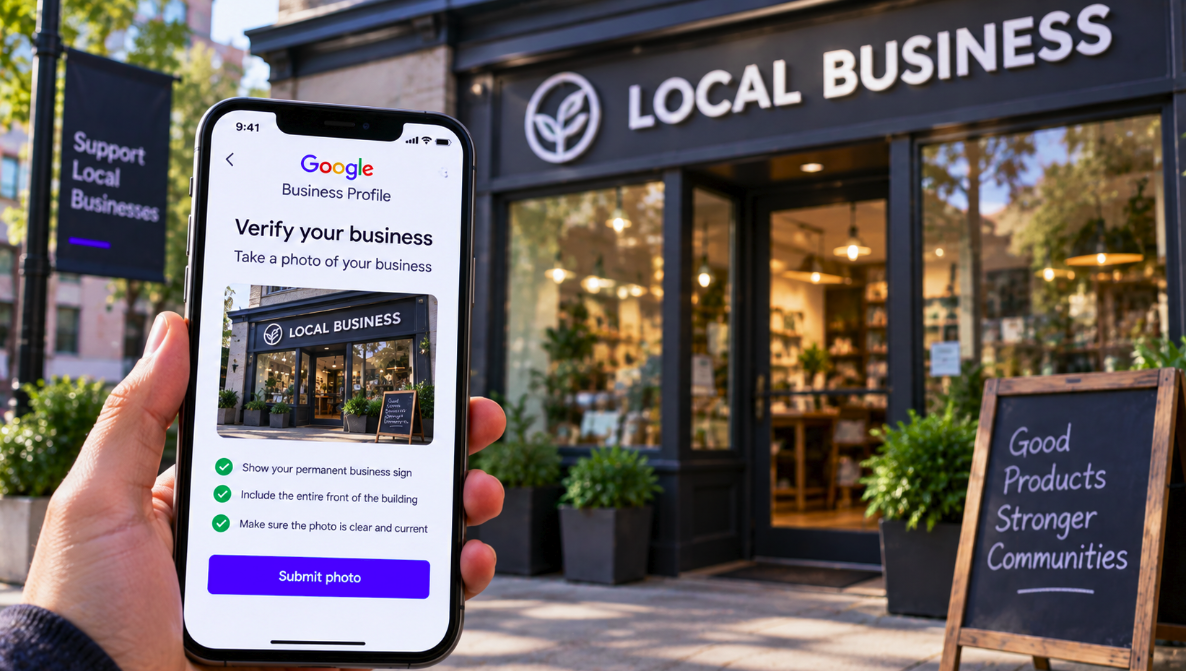
Google appears to be testing a simpler way for some storefront businesses to verify their Google Business Profiles: submit one photo showing the business’s permanent sign and the entire storefront in a single frame.
The new option was spotted by local-search specialist Ben Fisher and reported by Search Engine Roundtable on September 4. The interface reportedly presents “Submit a business photo” as a verification choice, potentially reducing a process that can otherwise require a live or recorded video, phone or text confirmation, email, or postal verification depending on what Google offers to a particular business.
Google’s public Business Profile documentation had not been updated with the single-photo method when checked for this article. That makes the safest interpretation that Google is testing or selectively rolling out the workflow rather than formally replacing its existing verification systems.
The photo has to show more than a generic storefront
The reported requirements make clear that this is not simply an invitation to upload any exterior image. Fisher’s follow-up, cited by Search Engine Roundtable, says the business name must be printed on a permanent fixture such as a signboard and the entire front of the business must be visible in one frame.
Those requirements make sense in the context of verification. Google needs evidence connecting a claimed Business Profile to a real-world location and business identity. A tight crop of a logo, a temporary paper sign or an interior product shot would provide far less evidence than a photograph showing a permanent business name in the context of the full storefront.
The approach could be particularly useful for conventional brick-and-mortar businesses whose identity is visually obvious from the street: restaurants, retailers, salons, clinics and other customer-facing locations with permanent signage.
The test compresses part of video verification into one image
Google’s current video-verification documentation asks storefront businesses to demonstrate several things. The recording should establish the business’s location by showing nearby signs, street information or recognizable surroundings; prove that the business exists through its storefront and permanent signage; and show evidence that the person submitting the video manages or represents the business.
For the existence requirement, Google specifically says the business name should be clearly printed on a permanent fixture such as a sign, wall or window, and that the name shown in the recording must match the Business Profile.
The new photo workflow appears to reuse part of that logic while dramatically simplifying the capture process. A single image containing both the permanent sign and complete facade can establish two useful pieces of evidence at once: this physical storefront exists, and this is the business name displayed at that location.
What remains unclear is how Google handles the management or ownership component when photo verification is offered. The existing video process asks users to demonstrate access to employee-only areas or business systems. The reported single-photo requirements do not describe an equivalent step, and Google has not publicly documented the workflow in enough detail to know what other account or location signals may be involved.
A faster verification path could remove meaningful friction
Business Profile verification is a necessary anti-abuse measure, but it can be a frustrating step for legitimate businesses. Video verification requires planning, a mobile device, location access and a continuous recording that captures the required evidence. Google says recorded verification videos must be at least 30 seconds long, unedited and uploaded through the Business Profile workflow.
A storefront owner who can instead stand across the pavement, frame the permanent sign and full facade, and submit one clear photo faces a much lower operational burden.
That matters because an unverified profile limits what a business can do with its presence on Google. Google’s photo and video guidance, for example, notes that uploaded media appears on Google only after the Business Profile has been verified.
For agencies and multi-location operators, even small reductions in verification friction can compound across many locations. A process that takes minutes rather than a more involved recording can reduce failed submissions, staff training and repeated attempts.
Not every business can prove itself with a storefront photo
The simplicity of the new method also explains why it is unlikely to work for every business type. Google Business Profile supports service-area businesses and hybrid businesses that may operate from locations customers never visit. A plumber, mobile locksmith or home-based consultant may have no public storefront or permanent exterior sign to photograph.
Google’s video-verification guidance already treats these businesses differently. Service-area operators can be asked to show tools, branded equipment, vehicles, workspaces, business documents or evidence that they control the resources used to provide the service.
The single-photo method therefore looks most naturally suited to businesses whose physical presence is straightforward to verify visually. Google may also be using other signals to decide which profiles are eligible for the option, although no public criteria have been announced.
Permanent signage becomes even more operationally important
The test reinforces something Google has long required from storefront businesses: the business should look like a real, permanent location, not a temporary attempt to establish a Maps presence.
Google’s existing verification guidance says a storefront or hybrid business should have permanent on-site signage. If a business does not have permanent signage at its location, Google directs it toward the service-area-business model instead of treating the address as a normal storefront.
For businesses that are opening a new location, moving or rebranding, that means physical signage is not merely a branding asset. It can become part of the evidence Google uses to establish eligibility and identity.
Businesses should nevertheless avoid changing their physical presentation purely to satisfy a speculative verification tactic. The profile name, signage and real-world business identity should agree naturally. Verification is intended to confirm reality, not create a temporary scene for the camera.
The missing documentation is an important caveat
Search Engine Roundtable described the photo option as something Google Business Profiles “seems to be adding,” and the official help materials surfaced during research still center on the established verification methods, including video recording.
That means businesses should not assume they can choose photo verification simply because another merchant has seen it. Google determines which verification methods are available for individual profiles, and the set of options can vary by business, location and account circumstances.
If “Submit a business photo” appears in the verification interface, the business should follow the instructions displayed there. If it does not appear, manually uploading an ordinary storefront photo elsewhere in the profile should not be assumed to substitute for verification.
Photo quality matters when the image is evidence
Google’s general Business Profile photo guidance provides a useful baseline even though it is not yet documentation for this verification test. Google recommends clear, well-lit photos that represent reality without significant alterations or excessive filters. Supported profile images are JPG or PNG files, with 720-by-720 pixels recommended for ordinary Business Profile media.
For verification, clarity becomes more than an aesthetic concern. The permanent business name needs to be readable, and the full storefront needs to be recognizable in the same frame. Heavy editing, an extreme angle, poor lighting or an obstructed facade could weaken the evidentiary value of the image.
If Google expands the feature, it will be important for the company to publish specific capture requirements rather than forcing businesses to infer them from screenshots and community reports.
The bigger trend is verification that matches the evidence available
Google has gradually moved Business Profile verification away from one universal method toward a menu of methods selected according to the business and risk context. That is logical because the best evidence for a restaurant is different from the best evidence for a mobile service business.
A single storefront photo is a natural extension of that approach. When a business has a clearly branded physical location, asking for a long video may collect more evidence than is necessary in every case. If Google can combine a strong storefront image with account, Maps and other internal signals, the company may be able to verify some legitimate locations with less friction while preserving more demanding methods for cases that need additional proof.
That remains an interpretation rather than a confirmed explanation for the test. Google has not publicly detailed how the photo option is evaluated or what signals accompany it.
Local businesses should follow the interface, not chase the test
For local SEO teams, the immediate advice is simple. Do not redesign verification workflows around a feature that Google has not yet documented as universally available. Instead, check the verification options Google actually presents for each profile.
If the new photo method appears, prepare one clear image that follows the reported requirements: show the business name on a permanent fixture and capture the entire storefront in the same frame. Make sure the visible name matches the real business and Business Profile, and avoid unnecessary editing.
If the option does not appear, continue with the verification method Google provides. Video verification remains fully documented and may still be necessary for many businesses.
The significance of the September test is not that Google has abolished verification friction. It is that the company appears willing to reduce that friction when a single piece of visual evidence may be sufficient. For a straightforward storefront with permanent signage, one well-framed photo could become the fastest path from an unverified listing to a trusted local business presence.