
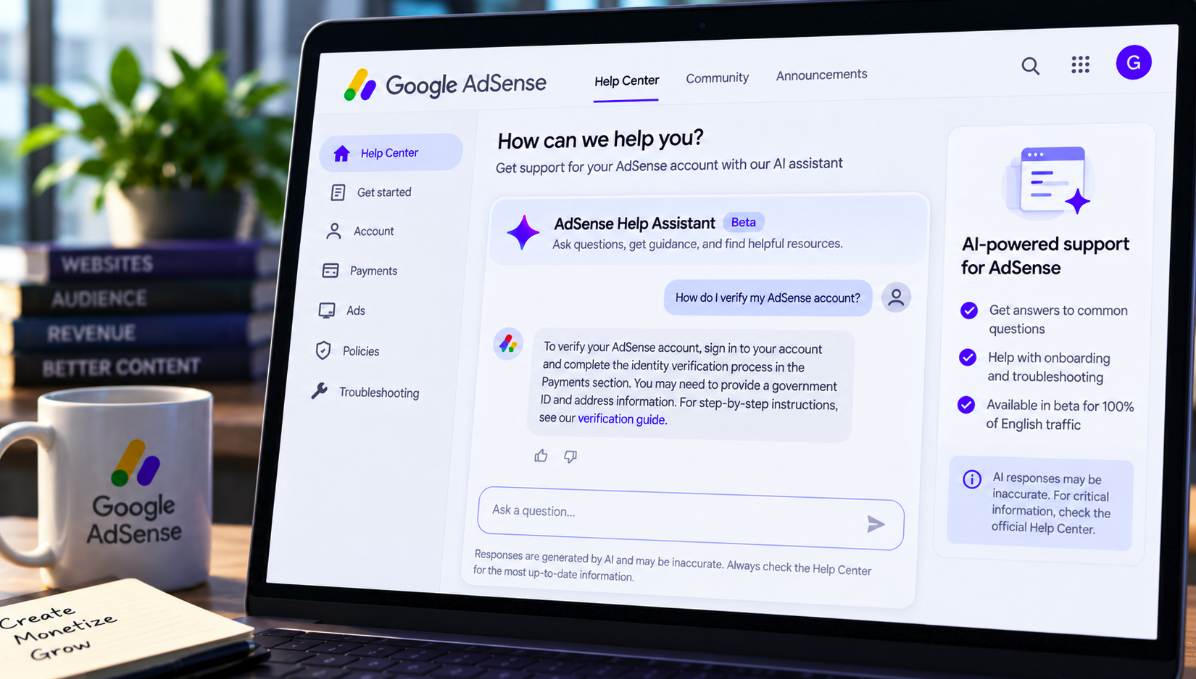
Google has turned a major part of AdSense support into a conversation with AI—and attached an unusually direct warning to the experience.
On September 3, Google announced that its AI-powered “Help guide” had reached 100% of English traffic in the AdSense Help Center while remaining in beta. The conversational assistant is designed to help publishers learn how AdSense works, complete onboarding tasks, troubleshoot problems and navigate the product without relying exclusively on traditional help-page searches.
But Google is explicit about the limitation that comes with that convenience. In its official announcement, the company says the guide’s responses can vary in accuracy and that decisions made based on those responses remain the publisher’s responsibility.
That disclaimer makes the rollout more interesting than another AI chatbot launch. Google is effectively placing generative assistance inside a product support environment where an incorrect answer can affect advertising revenue, account configuration or policy decisions, while telling users not to treat the assistant as infallible authority.
The AdSense Help Center now has a conversational support layer
The Help guide sits inside the AdSense Help Center and allows publishers to ask questions about AdSense and its features in natural language. Google describes it as an AI-powered conversational assistant for education, onboarding, troubleshooting and related support needs.
The company’s more detailed Help guide documentation shows that the experience is built around an ongoing chat rather than a single search box. Users can start a conversation, enter their own question or choose a popular topic, then continue interacting with the guide.
Google also lets users expand a “Sources” section for individual answers. That is an important design choice for a support assistant because it gives publishers a route back to the underlying documentation instead of requiring them to accept a generated response on trust.
Previous conversations can be loaded again, and users can request an updated response to an earlier question. The assistant therefore behaves less like a static FAQ search and more like a persistent support workspace.
Google’s accuracy warning is part of the product, not fine-print speculation
The most important sentence in the announcement is not about AI capability. It is about uncertainty.
Google says that the guide’s responses may occasionally vary in accuracy. It then places responsibility for decisions based on those responses on the publisher.
The wording matters because AdSense support questions are not always low stakes. A publisher may be trying to understand an account restriction, payment issue, invalid traffic concern, policy requirement, ad configuration or verification process. Acting on an inaccurate interpretation can have financial consequences.
Google is therefore drawing a boundary between assistance and authority. The AI can help users navigate information, but the presence of a conversational answer does not transform that answer into a guaranteed policy ruling.
Publishers can inspect sources instead of treating the AI as the source
The ability to view sources is one of the most useful safeguards in the design. For a straightforward onboarding question, a concise AI summary may be enough. For policy-sensitive or account-critical issues, the source link allows the publisher to verify what Google’s actual documentation says.
This is a pattern that should become standard for generative support systems. The assistant is strongest when it reduces the work required to locate and interpret documentation, not when it replaces documentation with an opaque answer.
In practical terms, publishers should treat the guide as a navigation and explanation layer. If the answer concerns revenue-impacting settings, compliance, invalid traffic, account suspension or another consequential decision, opening the cited source is the safer workflow.
The assistant does not eliminate Google’s other support channels
Google’s documentation is equally clear about what happens when the Help guide fails to resolve an issue.
Publishers can still search the AdSense Help Center, ask questions in the Help Community and, depending on their account type, access additional support options. The Help guide is therefore an additional interface over the support ecosystem rather than a complete replacement for human or community assistance.
That distinction will matter as publishers encounter edge cases. Generative systems are particularly useful for synthesizing common documented procedures, but account-specific problems can depend on information the generic assistant may not have or may not be authorized to interpret.
Google is instrumenting the assistant for feedback
The beta includes several feedback mechanisms. Users can rate individual responses as helpful or unhelpful, flag inappropriate responses, submit detailed feedback with a screenshot and rate the overall conversation after closing a session.
Those controls show why Google still labels the product beta even after expanding it to all English Help Center traffic. Broad distribution gives the company a much larger stream of real-world questions, failure cases and feedback with which to improve the system.
The 100% rollout should therefore not be confused with general availability across every AdSense language or market. Google’s announcement specifically refers to English Help Center traffic, and the product documentation continues to label the feature beta.
Support is a natural but sensitive use case for generative AI
Customer support is one of the clearest applications for conversational AI. Traditional help centers force users to translate their problem into the terminology used by the documentation, search through several pages and assemble an answer themselves.
A conversational layer can reverse that process. The user describes the problem in ordinary language, and the system identifies relevant documentation and turns it into a direct response.
For a product as complex as AdSense, that can significantly reduce friction. Publishers do not necessarily know whether a problem belongs under payments, policy, account access, ad serving or optimization before they start searching.
The AI assistant can potentially make that classification on their behalf.
The sensitivity comes from the same capability. A fluent answer can sound definitive even when the underlying model is uncertain, which is why Google’s accuracy disclaimer is not a minor legal detail. It is central to how the tool should be used.
The interface changes the psychology of Google documentation
A list of search results naturally reminds users that they are choosing among documents. A chatbot produces a single coherent response, which can create a stronger impression of authority.
That difference is especially important when the chatbot appears inside Google’s own AdSense Help Center. Users may reasonably assume that a response generated there represents Google’s official position.
The disclaimer pushes against that assumption. The official documentation remains the more authoritative layer, while the Help guide is a generated interpretation designed to help users reach and understand it.
For publishers, this creates a simple hierarchy: use the AI for speed, use the cited documentation for verification, and escalate through established support channels when the issue is account-specific or consequential.
AI is moving from content creation into publisher operations
Much of the discussion around generative AI and advertising has focused on ad creative, campaign automation and content generation. The AdSense Help guide represents a quieter shift: AI is becoming part of the operational interface publishers use to run their businesses.
Instead of generating an ad or optimizing a bid, the model is helping explain why something happened, how a feature works and what a publisher should do next.
That kind of embedded assistance can be more consequential than a standalone chatbot because it appears at the exact moment a user encounters friction inside a complex product ecosystem.
Google has already integrated AI across advertising and publisher products in multiple forms. A conversational support layer extends that strategy into documentation itself.
The real test is whether the assistant reduces support friction without creating new errors
The success of the Help guide will not be measured simply by how many questions it can answer. The more meaningful question is whether publishers reach correct resolutions faster.
If the assistant reliably points users to the right documentation, summarizes procedures accurately and knows when a question requires escalation, it can make a sprawling help center significantly easier to use.
If fluent but inaccurate answers send publishers toward incorrect settings or misunderstandings, the support burden may simply move rather than disappear.
Google’s decision to expose sources, preserve other support options and collect granular feedback suggests the company recognizes that tension.
Google is asking publishers to use AI—and verify it
The September 3 rollout captures the current state of enterprise generative AI in a single product decision. Google believes the technology is useful enough to place in front of 100% of English AdSense Help Center traffic, but not reliable enough to remove an explicit accuracy warning.
That is not necessarily a contradiction. It is a model for using generative AI as an assistive layer rather than an unquestionable authority.
For AdSense publishers, the workflow is straightforward: ask the Help guide, inspect its sources when the answer matters, and use the established support channels when the situation requires more certainty.
Google has made AdSense support conversational. It has not made the conversation automatically correct.