
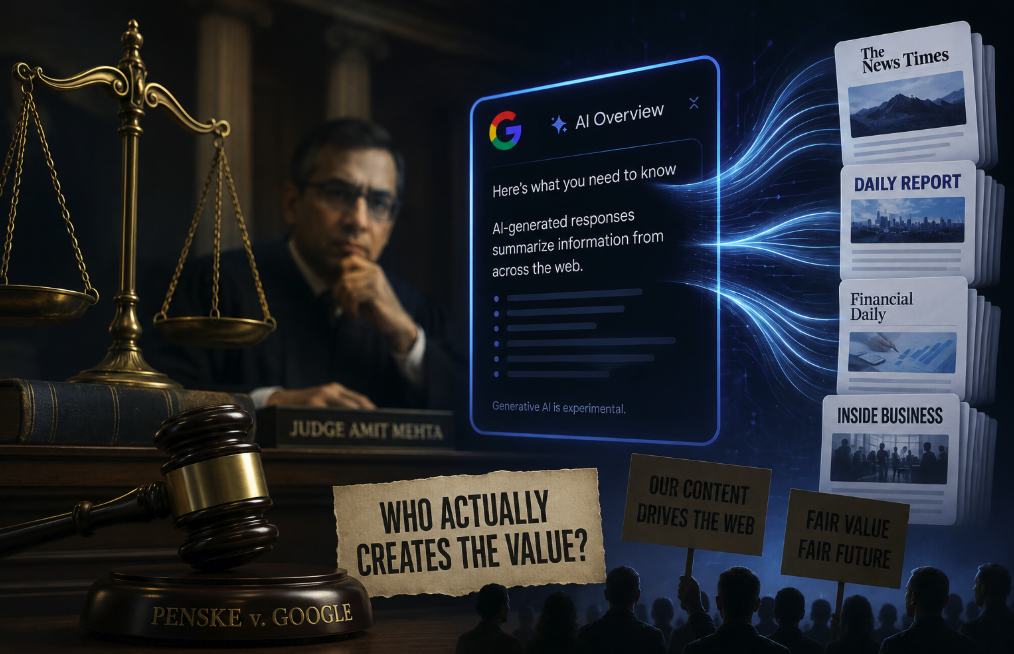
One of the most important questions in artificial intelligence is not whether machines can produce convincing answers. It is who creates the underlying value that makes those answers possible, and who gets to capture the economic benefit once the answer reaches the user.
That question moved from industry debate into a federal courtroom this week. During a hearing in Penske Media Corporation’s antitrust case against Google, U.S. District Judge Amit Mehta pressed on the relationship between Google’s AI-powered search products and the publishers whose reporting and information help supply them. According to accounts of the hearing, Mehta questioned a system in which publishers create content that can support AI answers while Google controls the dominant gateway through which much of that content has historically been discovered.
The case is still at an early and consequential procedural stage. Google is seeking dismissal, and Mehta has not ruled on that motion. His questions are therefore not a judgment that Penske’s claims are correct. But the exchange matters because it crystallizes a problem that has been building since generative AI began moving from a separate chatbot experience into the search results themselves.
The old search bargain is under pressure
For much of the commercial web’s history, publishers and search engines operated under an informal but powerful exchange. Publishers made their pages crawlable and gave search engines access to enormous amounts of information. Search engines organized that information and sent users outward through links. Publishers could then monetize those visits through advertising, subscriptions, ecommerce, affiliate relationships or other business models.
Penske’s lawsuit argues that generative AI has disrupted that exchange. In a February court filing opposing Google’s motion to dismiss, Penske described the historical arrangement as one in which publishers supplied content for Google’s search index and received referral traffic in return. The company alleges that Google now uses its position in search to obtain publisher material for generative AI products that can compete with publishers for users’ attention.
Google disputes that framing. At the August 25 hearing, its attorneys reportedly characterized AI Overviews as a product improvement and described the historical traffic-for-crawling relationship in less contractual terms. Google has also argued in court filings that AI Overviews are part of the evolution of Search rather than a separate product that publishers are entitled to constrain.
The legal question is complicated. The economic question is easier to see: if a search engine can use publisher information to answer the user directly, the publisher can contribute to the value of the search experience without necessarily receiving the visit that once completed the exchange.
Mehta’s questions go to the heart of AI search
Mehta is a particularly significant figure in this dispute because he previously found Google to have illegally maintained a monopoly in general search. At this week’s hearing, according to Search Engine Journal’s account, the judge appeared skeptical of the idea that describing AI Overviews as a product improvement necessarily resolves the antitrust issue. He reportedly emphasized that product improvements are not automatically insulated from antitrust scrutiny.
The most revealing part of the exchange concerned the market for publisher content. Other AI companies have entered licensing agreements and paid substantial sums for access to high-quality material. Mehta reportedly questioned the apparent contrast between those arrangements and Google’s ability to obtain publisher content through its existing search relationship. He also raised concerns about the practical choices available to publishers when participation in Google’s ecosystem remains commercially important.
That does not establish that Google’s conduct is unlawful. It does, however, expose the central structural tension. A publisher may theoretically have choices about how its content is used, but the economic meaning of those choices depends on how feasible it is to withdraw from a search platform with enormous distribution power. An opt-out is less powerful if exercising it also means surrendering access to a major source of discovery.
The value chain has changed
Traditional search mostly helped users locate an answer. Generative search increasingly attempts to become the answer. That sounds like a product-design distinction, but economically it changes where value is captured.
When a user clicks a link, the destination publisher receives an opportunity to monetize the attention. When an AI system synthesizes the relevant information on the search page, the platform can satisfy some portion of the user’s need before that click happens. The publisher’s reporting may still contribute to the result, but the audience relationship remains with the platform.
Recent evidence suggests that this is not merely theoretical. A preregistered field experiment published this month involving 1,100 participants found that removing AI Overviews and AI Mode increased click-through rates to publishers. The researchers concluded that generative AI in search can reshape online attention in ways that carry economic consequences for the publishers supplying the underlying information.
Industry data points in the same direction, although different studies use different methodologies and should not be treated as interchangeable. Axios reported in July that Chartbeat data showed Google Search traffic to publishers down 34% over the preceding year. The causes of publisher traffic declines are broader than any single Google feature, but the direction of travel makes the argument over AI-generated answers economically urgent.
Who creates value, and who captures it?
The internet has always involved intermediaries. Search engines create real value by crawling billions of pages, ranking them, fighting spam and helping people navigate an otherwise unmanageable quantity of information. AI systems can add another layer of value by synthesizing sources and making complex information easier to understand. It would be too simplistic to say that publishers create everything and platforms merely extract it.
But the reverse is equally incomplete. AI-generated answers do not emerge from an informational vacuum. Newsrooms pay reporters. Specialist publications employ editors and researchers. Review sites test products. Financial publishers analyze filings and markets. Local outlets attend meetings. Researchers produce studies. The cost of generating reliable primary information is borne somewhere before an AI system can summarize it.
The sustainability problem appears when the organization paying those costs cannot capture enough of the downstream value to continue producing the information. A search experience can become more useful in the short term by absorbing more of the answer, while simultaneously weakening the economic incentives that produce the sources on which future answers depend.
This is bigger than copyright
Much of the public debate about generative AI and publishing has focused on copyright, training data and licensing. The Penske dispute raises a related but different issue: market power. The question is not only whether content can legally be processed or summarized, but whether the terms governing that use are shaped by genuine negotiation or by the leverage of a dominant distribution platform.
That distinction explains why Mehta’s reported interest in the publisher relationship is significant. In a competitive market, an AI company that needs premium content may have to negotiate access and pay for it. If a company already controls a critical discovery channel, the economics can look very different. The legal system will have to determine whether those differences amount to an antitrust violation in this case; the hearing itself does not answer that question.
For publishers, however, the strategic implications exist regardless of the eventual ruling. Dependence on a platform becomes riskier when that platform evolves from sending audiences to publishers into answering audiences with publisher-derived information. The same infrastructure that once distributed content can become a substitute for visiting it.
The web needs an incentive to produce what AI consumes
This is ultimately an ecosystem problem. AI search needs authoritative, current and original information. The open web remains one of the richest sources of that information precisely because millions of organizations have had reasons to publish it. Some reasons are commercial, others institutional or personal, but sustainable professional publishing usually requires revenue.
If AI interfaces materially reduce referral traffic, the industry will need new mechanisms for aligning the value created upstream with the value captured downstream. Licensing is one possible model. Revenue sharing, stronger attribution, differentiated crawling controls and new forms of paid access could be others. None offers a simple universal solution, and forcing every piece of web content into a licensing framework could create its own barriers to an open internet.
Publishers also cannot assume that regulation or litigation will restore the old search model. They have strong incentives to build direct audience relationships through subscriptions, newsletters, communities, apps and recognizable brands. The less dependent a publication is on an intermediary for every reader relationship, the more negotiating power it retains as discovery shifts toward AI.
Yet diversification does not eliminate the underlying policy question. If AI products become a primary interface to knowledge, society has an interest in ensuring that the systems producing original knowledge remain viable. Better synthesis is not a substitute for the reporting, research and expertise being synthesized.
A courtroom question with consequences for the entire web
Penske v. Google is one lawsuit, and Mehta’s comments at a motion-to-dismiss hearing should not be mistaken for a final ruling. But the case is forcing an unusually direct examination of the economic architecture behind AI search.
The old web made the exchange visible: a search result offered a link, the user chose whether to click, and the publisher received the visit. AI answers make that exchange harder to see because the platform can transform multiple sources into a new interface before the user encounters the original material.
That is why the question of who creates the value is becoming unavoidable. Google creates value by organizing and synthesizing information. Publishers create value by producing much of the information worth organizing and synthesizing. A sustainable AI-search ecosystem will eventually need an economic relationship that recognizes both. If it cannot find one, the risk is not simply fewer clicks for publishers. It is a web with progressively fewer incentives to create the original material that makes intelligent answers valuable in the first place.