
For years, digital publishers and online businesses treated Google traffic as one of the web’s most valuable currencies. Rank well, earn the click and turn that visit into advertising revenue, a subscription, a lead or a sale. The rise of generative search is putting that familiar equation under increasing pressure.
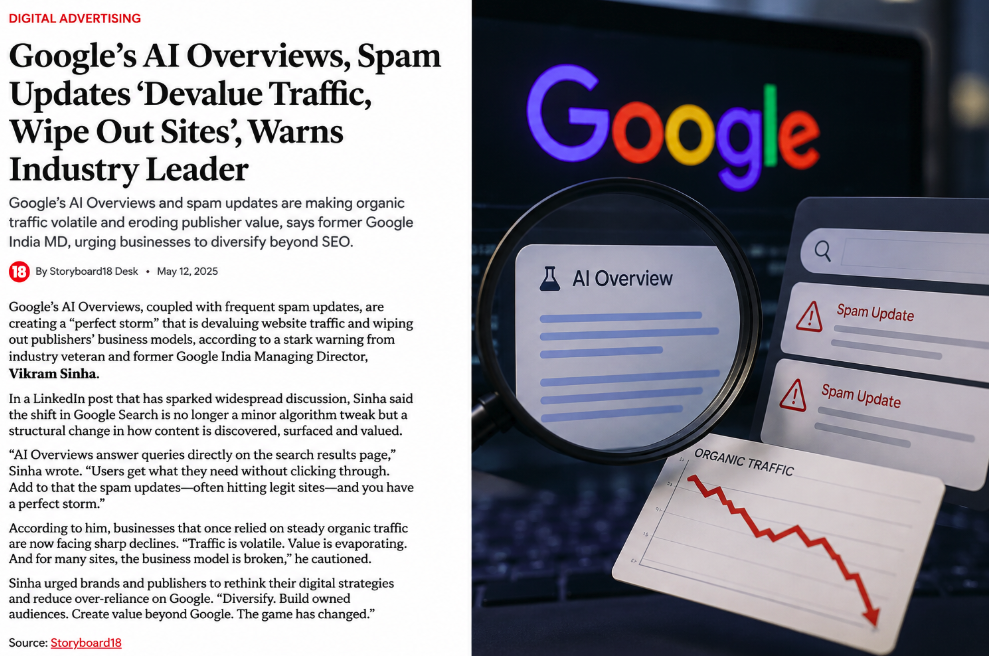
A recent report from Storyboard18 highlights concerns that Google’s AI Overviews and spam-related changes are altering the economics of search traffic. The central issue extends beyond rankings: when an AI-generated answer satisfies a query directly on the results page, a website can remain visible in Google without necessarily receiving the visit that historically made that visibility commercially valuable.
Search visibility no longer guarantees a click
AI Overviews represent a structural change in the search experience. Instead of functioning primarily as a directory that points users toward external pages, Google can increasingly synthesize information and present an answer before the user visits a publisher.
That creates a difficult distinction for website owners between visibility and traffic. Being referenced or surfaced by an AI system may strengthen brand awareness, but it does not automatically produce the page view on which many digital business models still depend.
The result is a new strategic problem for publishers, affiliate businesses and content-driven companies. Traditional SEO was largely built around improving rankings and click-through rates. AI search adds another layer: content can contribute to an answer while the user journey ends on the search page itself.
Algorithm volatility adds another source of pressure
The shift toward AI-generated answers is unfolding alongside continued changes to Google’s ranking and spam-detection systems. Google has rolled out multiple spam updates in 2026, with the updates applying globally and enforcing existing policies against manipulative or low-value practices. Independent SEO reporting has documented significant ranking volatility around some of these changes.
Spam enforcement and AI Overviews are different mechanisms, but for publishers they can combine into the same business concern: organic traffic is becoming harder to treat as a predictable asset. A site can face changes in ranking visibility at the same time that the search interface itself reduces the need for users to click external results.
The economics of organic traffic are changing
This matters because a visit is not merely an analytics metric. For an advertising-supported publisher, traffic creates impressions. For an e-commerce company, it creates opportunities to convert shoppers. For a software company, it can generate leads. For subscription businesses, it feeds the top of the acquisition funnel.
If search engines answer more questions directly, the economic value produced by a high-ranking page may decline even when that page continues to influence the information users see. That does not make search visibility irrelevant, but it changes how businesses should measure its return.
The emerging challenge is therefore not simply “How do we rank?” It is increasingly “How do we turn visibility into a durable relationship with an audience?”
Publishers may need to build beyond Google
The most important strategic response is diversification. Businesses heavily dependent on organic search have a stronger incentive to develop channels they control more directly, including newsletters, communities, direct traffic, apps, subscriptions and recognizable brands that users intentionally seek out.
This does not mean abandoning SEO. Google Search remains a major discovery channel, and appearing in conventional results, AI Overviews and other generative experiences can still carry substantial value. But search traffic is becoming one component of a broader discovery ecosystem rather than an asset publishers can safely assume will behave as it did in the era of ten blue links.
Content strategy may also need to evolve. Commodity information that can be summarized easily is particularly exposed to answer-first interfaces. Original reporting, proprietary data, expert analysis, useful tools, communities and distinctive first-hand material offer users stronger reasons to leave an AI-generated summary and visit the source itself.
From search engine optimization to audience resilience
The larger transformation is about dependency. Google’s move toward AI-generated search results is forcing publishers to confront how much of their business has historically depended on a platform whose interface, algorithms and incentives they do not control.
Spam updates reinforce the same lesson from another direction. Search engines can change how they evaluate websites rapidly, and even legitimate publishers operate inside an ecosystem that is constantly being recalibrated.
The winners in the next phase of search may therefore be companies that treat Google as a powerful distribution partner rather than as the foundation of the entire business. Ranking still matters. Being cited by AI may matter increasingly. But owning the audience relationship — and giving people a reason to visit directly — is becoming more important as the traditional value of an organic click is rewritten.
Source: Storyboard18 — “Google’s AI Overviews, spam updates ‘devalue traffic’”.