
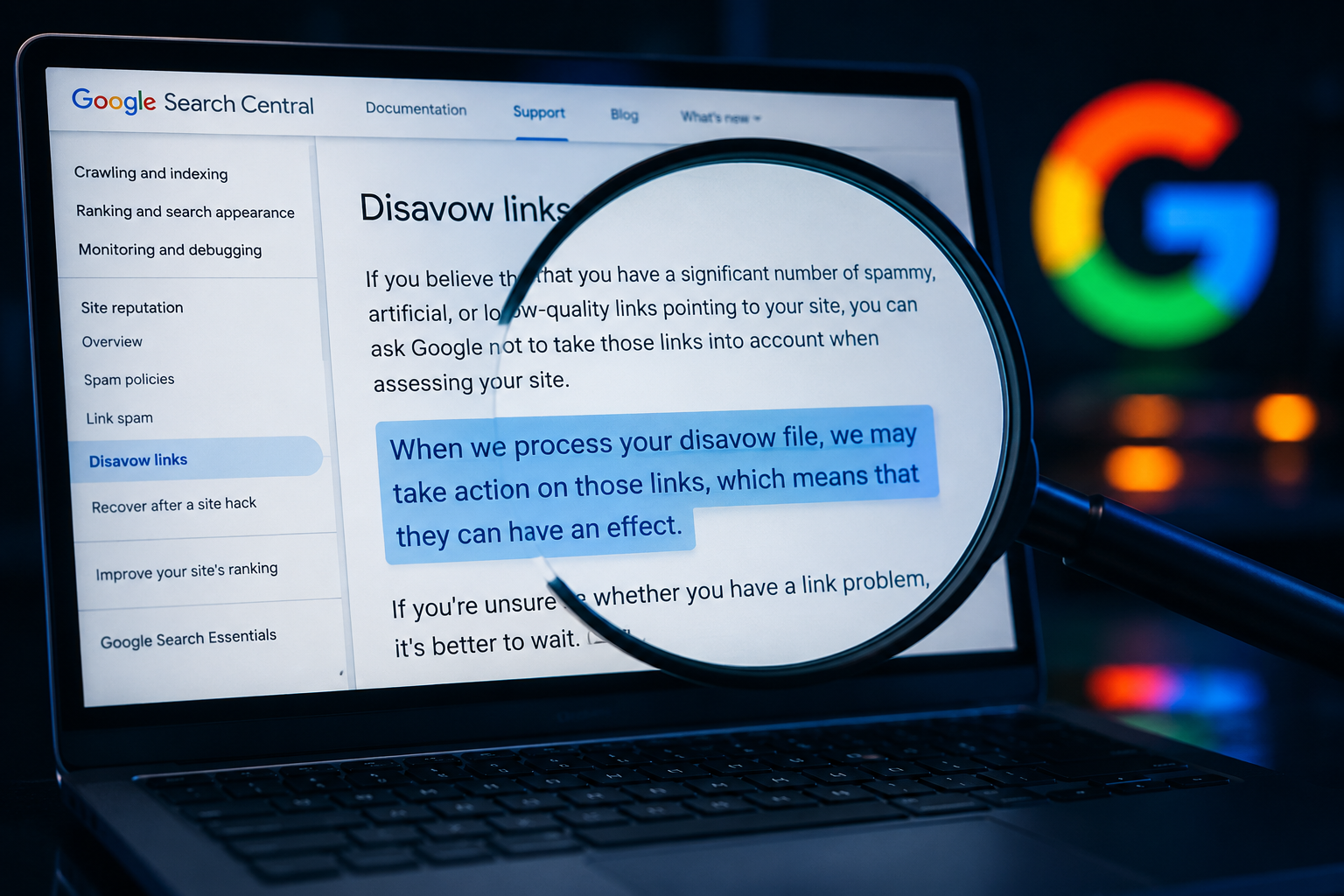
Google’s Disavow Tool is not quite the dead instrument that parts of the SEO industry sometimes describe. The more accurate reading is narrower, but more interesting: Google still treats disavow files as a real signal, while continuing to warn that most site owners should not touch the tool unless they have a serious link problem.
The nuance matters because the public conversation around disavow files has become increasingly absolutist. For years, Google representatives have pushed back against routine “toxic backlink” cleanups, arguing that Google is generally good at ignoring spammy or low-quality links without needing extra instructions from site owners. That position has often been simplified into a stronger claim: that disavowing links is now useless. Google’s own documentation does not support that interpretation.
The key line is still in Google’s own guidance
In its official Search Console help documentation, Google describes the Disavow Tool as an advanced feature that can harm a site’s performance if used incorrectly. The same page says publishers should only disavow backlinks when they believe there are a considerable number of spammy, artificial or low-quality links pointing to the site, and when they are confident those links are causing issues. Crucially, Google also says that by disavowing links, site owners can ask Google not to take those links into account when assessing the site. That phrasing is not decorative; it means the tool is designed to influence how Google evaluates links, even if it is not a guaranteed override.
Google’s original 2012 announcement made the same point in even more operational terms. The company said the tool allows site owners to indicate which links they want to disavow and that Google will typically ignore those links, while also calling the file a “strong suggestion” rather than an absolute command. Google also noted that the effect is not instant because the affected URLs need to be recrawled and reindexed before the disavowal can be reflected in its systems. In other words, the Disavow Tool has always sat in a grey area: meaningful enough to matter, but conditional enough to be dangerous when used casually.
Why this contradicts the “it does nothing” narrative
The latest discussion resurfaced after Search Engine Roundtable covered comments from Google’s John Mueller, who said that most sites do not need disavow files, but “that’s not all sites.” Mueller’s wording is important because it keeps both sides of the argument alive at once. Disavow is not routine maintenance, not a standard monthly cleanup task and not a magic button for every suspicious backlink report. But it is also not merely a relic left behind in Search Console with no practical effect.
This distinction is especially relevant for agencies, publishers and site owners who inherit messy backlink histories. A random wave of scraper links, foreign-language spam or third-party “toxic score” alerts is usually not enough to justify a disavow file. A history of paid links, private blog network activity, manipulative link exchanges, previous SEO campaigns that violated Google’s spam policies or an actual manual action is a different situation. In those cases, the tool remains part of the cleanup path, especially when link removal is not possible.
The practical takeaway for SEOs
The safest interpretation is that Google has not changed the basic rule: ignore noise, act on evidence. Site owners should not upload massive backlink exports because an SEO platform labels domains as toxic, and they should not treat every low-quality link as a ranking threat. Google’s systems are built to discount a large amount of web spam automatically, which is why the company repeatedly says that the vast majority of sites do not need the Disavow Tool.
At the same time, the tool should not be dismissed as useless. Google’s documentation says disavowed links may be excluded from link assessment, and Mueller’s recent comments leave room for edge cases where a disavow file is reasonable. The more professional stance is not “always disavow” or “never disavow,” but “disavow only when there is clear evidence of manipulative link patterns that could affect the site.” That is a more boring answer than the industry debate usually wants, but it is the one best supported by Google’s own language.
For publishers and businesses, the lesson is simple. The Disavow Tool still has effects, but those effects are precisely why it should be used sparingly. A bad disavow file can remove useful link signals as easily as it can neutralize harmful ones, and Google has never presented the feature as a general reputation-cleaning dashboard. It remains a specialist tool for exceptional backlink problems, not a replacement for better SEO strategy, cleaner acquisition practices or a sober reading of Search Console data.
Sources: Google’s Search Console Help page on disavowing links, Google Search Central’s original Disavow Tool announcement, and Search Engine Roundtable’s coverage of John Mueller’s recent comments.