
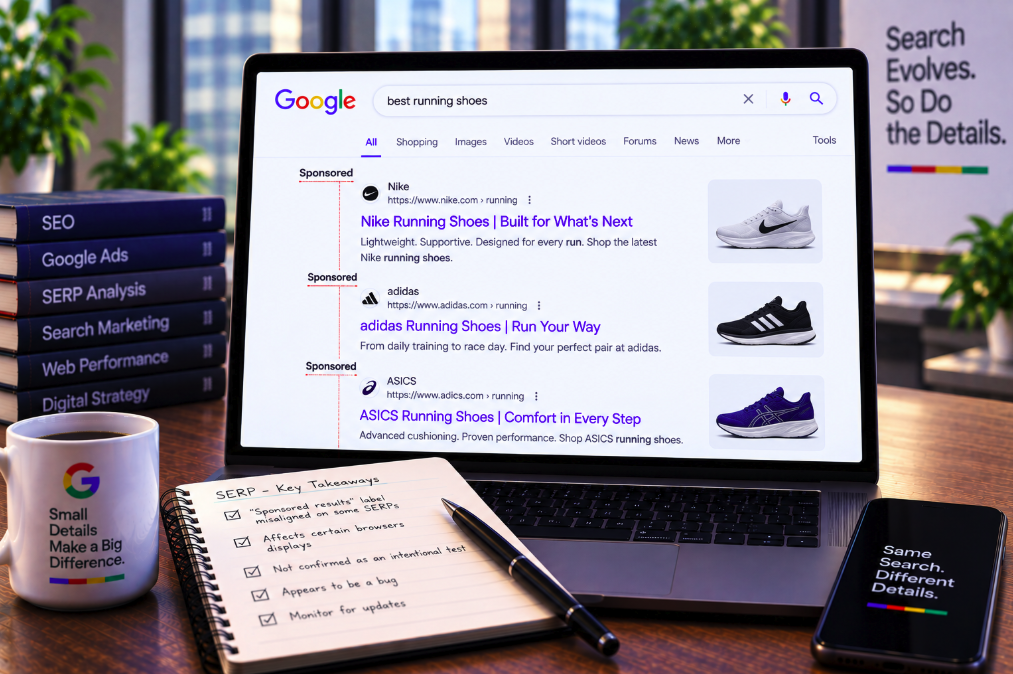
A small visual inconsistency in Google's Search results is drawing attention because it affects one of the most important pieces of disclosure on the page: the heading that tells users which results are advertisements.
Search Engine Roundtable reported on September 11 that Google's “Sponsored results” heading is sometimes positioned slightly out of alignment with the paid listings beneath it. The behavior was spotted by Sachin Patel and appears differently across browsers, including cases where the offset becomes noticeably more pronounced.
There is no confirmation from Google that the alignment change is intentional. Search Engine Roundtable's Barry Schwartz describes it as looking more like a formatting bug, and the available evidence supports cautious wording: this is an observed SERP rendering inconsistency, not a confirmed Google Ads experiment.
That distinction matters because Google regularly tests Search interfaces, but not every unusual layout is a test. Browser-specific rendering, responsive CSS, viewport calculations and ordinary front-end regressions can all produce visual changes that resemble deliberate experiments.
The same query can render the label differently
The screenshots highlighted by Search Engine Roundtable show the problem on searches such as “iPhone.” In one rendering, the Sponsored results heading appears where users would expect it, aligned with the advertising block. In another browser, the heading shifts horizontally.
Schwartz also demonstrated the difference in an animated comparison, making the offset easier to see than in isolated screenshots. A second query reportedly showed an even more obvious displacement.
The fact that the appearance can vary by browser is one reason the behavior looks more like a rendering issue than a deliberately redesigned ad format. A product test can certainly be browser- or cohort-specific, but there is currently no evidence that Google is intentionally testing “misaligned sponsored labels” as a design concept.
Until Google comments, the most defensible description is simply that the heading is sometimes not aligned as expected.
Google redesigned the Sponsored results label in 2025
The current heading is part of a broader Search advertising redesign Google announced in October 2025. In its official announcement, Google said text ads would be grouped under a single, larger “Sponsored results” label rather than relying on smaller disclosures attached independently to each result.
The label was designed to remain visible while users scroll through the paid block. Google also introduced a “Hide sponsored results” control that lets users collapse text ads and move their attention to organic results.
Google said the redesigned treatment was intended to make navigation easier while maintaining prominent disclosure of advertising. The company said its testing showed that users could navigate the top of the page more easily with the grouped format.
That history is important because the heading is not decorative text. It is the structural label for an entire group of paid search results.
Google says ad labels should remain prominent
In announcing the grouped Sponsored results treatment, Google emphasized that the larger label would uphold what it described as industry-leading standards for ad-label prominence.
The company also kept the number of text ads in a grouping capped at four and extended sponsored labeling to other ad units, including Shopping placements. Sponsored-result headers can also appear around AI Overviews depending on the Search layout.
Google's current Ads help documentation continues to distinguish paid placements from organic results and identifies ads using sponsored labeling.
A minor alignment error does not mean the ads are suddenly unlabeled. The screenshots still show the Sponsored results text. The issue is about presentation and visual association, not the complete disappearance of the disclosure.
Why a few pixels can matter in an ad disclosure
On an ordinary interface element, a slight horizontal offset might be little more than a cosmetic defect. Advertising disclosure deserves more attention because its job is to establish a clear visual relationship between the label and the paid content it describes.
Users scan search pages quickly. Alignment, spacing, typography and grouping help them understand which interface elements belong together before they consciously read every word.
If a Sponsored results heading drifts away from the block it labels, the relationship can become visually weaker even though the disclosure text remains readable. A severe enough displacement could theoretically make users wonder whether the heading applies to the result above, below or beside it.
The examples reported so far do not establish that users are actually confused, but they show why disclosure UI deserves precise implementation.
This is not evidence of a new ad-labeling policy
Nothing in the observed behavior indicates that Google has changed its policy on distinguishing ads from organic results. There is no announced reduction in disclosure requirements and no official statement introducing a deliberately offset label.
Google's documented design remains the grouped Sponsored results heading introduced in 2025. The current anomaly concerns where that heading is rendered in some circumstances.
It would therefore be misleading to describe the screenshots as proof that Google is making ads harder to identify. That conclusion would require evidence about intentional design, broader rollout and user impact that is not currently available.
The simpler explanation—a front-end alignment bug—remains plausible and is the interpretation offered by Search Engine Roundtable.
It is also not a Google Ads ranking or auction change
Advertisers should separate Search-page presentation from the mechanics that determine which ads are shown. The reported issue does not provide evidence of a change to Ad Rank, bidding, Quality Score, auction eligibility or paid-result ordering.
There is also no indication that the alignment affects how many ads can appear in the sponsored block. Google's 2025 announcement said the grouped design would continue to show no more than four text ads in a grouping.
The anomaly is a user-interface observation. Treating it as an advertising-system update would assign significance that the available evidence does not support.
For PPC teams, this is primarily something to monitor rather than something that requires campaign changes.
Browser differences are a useful clue
Modern Search pages are highly dynamic. Their layout can depend on viewport width, browser rendering, device pixel ratio, fonts, zoom level, experiments and the combination of modules Google chooses to display for a particular query.
A small discrepancy in any of those calculations can move one component without changing the underlying search result. Sticky elements such as the Sponsored results heading can be particularly sensitive because their position may need to update as the user scrolls.
The cross-browser difference reported in the screenshots is therefore meaningful diagnostic evidence, although it is not proof of a particular technical cause.
Without access to Google's front-end code or an official explanation, attributing the bug to a specific CSS rule, browser engine or experiment would be speculation.
The sticky behavior makes the heading more technically complex
The Sponsored results label introduced in 2025 is designed to stay visible as users scroll through a group of text ads. That means it behaves differently from an ordinary static heading printed once above a block.
Sticky interface components must maintain their relationship with surrounding content while the viewport changes. They can also interact with other dynamic modules inserted above or below the ads.
This complexity does not mean the sticky design caused the reported alignment issue, but it illustrates why seemingly simple SERP elements can develop browser-specific rendering problems.
A heading that appears perfectly aligned at initial page load can potentially behave differently after layout recalculation, scrolling or another module loading asynchronously.
Search interfaces now contain more competing modules
The modern Google SERP is increasingly assembled from heterogeneous components rather than a simple vertical list of blue links. A query can include text ads, Shopping units, AI Overviews, organic results, videos, local features and other specialized modules.
Google's own 2025 announcement noted that Sponsored results headers can appear above or below AI Overviews. That creates more combinations in which paid-result labeling must remain visually clear.
Every new component increases the number of layout states the interface must handle across desktop and mobile devices. A formatting regression can therefore appear only for a narrow combination of query, browser and result composition.
This may explain why the issue can be visible to some users while remaining difficult for others to reproduce.
Screenshots alone cannot distinguish a bug from an A/B test
Search marketers frequently discover Google changes through screenshots before the company announces them. That makes community observation valuable, but it also creates a classification problem.
If two users see different layouts, several explanations are possible. Google may be running an intentional experiment. One user may have received a newer code version. Browser differences may have triggered a rendering bug. Cached resources or viewport dimensions may also be involved.
A screenshot proves that a layout appeared; it does not prove why it appeared.
That is why language such as “Google is testing a misaligned Sponsored results label” would be too strong here. No intentional test has been confirmed.
Advertisers do not control the label position
The Sponsored results heading is part of Google's Search interface, not an advertiser-created asset. Campaign managers cannot change its alignment through Google Ads settings, ad copy or extensions.
If the problem is a Search rendering bug, the fix belongs on Google's side. Rewriting an ad or modifying a campaign will not correct the position of the shared sponsored-results header.
This distinction is useful when clients notice unusual Search screenshots and ask their agency to “fix the ad.” The ad itself may be rendering correctly while the surrounding Google interface is not.
PPC teams can document the query, browser, device and screenshot, but there is no evidence that advertisers need to alter campaign configuration in response.
Monitoring should capture browser and viewport context
For teams that track SERP changes systematically, this episode is a reminder that screenshots need environmental metadata. Recording only the query is often insufficient.
A useful observation should include browser, operating system, device type, viewport dimensions, location, login state where relevant and the approximate time of the search. Repeating the same query in another browser can help distinguish a broad layout change from a narrower rendering problem.
Video or GIF capture can also be useful for sticky interface elements because a static screenshot may not show how the component behaves during scrolling.
This type of disciplined observation helps the search community avoid turning one unusual render into an unsupported rollout claim.
The label itself remains part of Google's transparency strategy
Google's grouped Sponsored results design reflects an ongoing effort to balance advertising with a search interface that users can interpret quickly. The 2025 redesign made the disclosure larger and grouped paid results under one persistent heading.
The Hide sponsored results control also gave users an explicit way to collapse the advertising block. Those choices made the boundary between paid and organic content a navigational feature rather than merely a small annotation.
That makes visual consistency particularly important. If the heading is the organizing label for the block, its placement should reinforce the grouping Google intended.
A misalignment bug would be small in engineering terms but directly visible in one of Search's most sensitive interface boundaries.
There is no evidence yet of measurable advertiser impact
No data has been published showing that the alignment anomaly changes click-through rate, conversion rate or user trust. It would be premature to assume that the offset benefits or harms advertisers.
The visual difference may be too small for most users to notice. It may also affect only a limited browser or result configuration and disappear before any meaningful measurement is possible.
Conversely, because sponsored labeling is an important disclosure mechanism, a persistent or larger alignment problem would deserve closer study if it became widespread.
For now, the evidence supports observation rather than performance conclusions.
The safest conclusion is still “probably a bug”
Google Search changes constantly, and many of those changes are intentional experiments. This one currently lacks the signals needed to make that claim.
The Sponsored results heading is appearing out of alignment in some observed SERPs, including different renders of the same query across browsers. Search Engine Roundtable interprets the behavior as likely a formatting bug, and Google has not confirmed otherwise.
The established design remains clear: Google's text ads are grouped under a prominent Sponsored results heading, introduced globally in 2025 to help users distinguish paid results and navigate the page. The misaligned version appears to be a deviation from that documented layout rather than a newly announced disclosure format.
For search marketers, the sensible response is to monitor it, document reproducible cases and avoid inventing a strategy around a few displaced pixels. Sometimes a strange SERP really is just a strange SERP.