
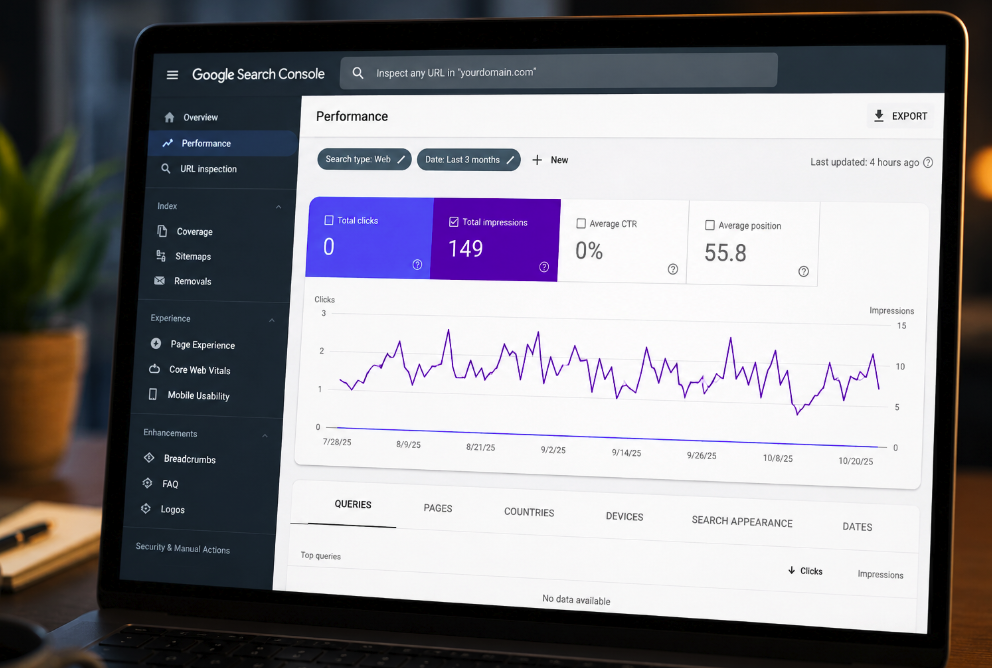
A page being indexed by Google does not mean it will consistently appear in search results. That distinction is creating confusion for site owners who see URLs marked as indexed in Google Search Console, sometimes receive a short burst of impressions after publication, and then watch those impressions fall toward zero. A recent discussion in Reddit's r/SEO community captures the problem neatly: newly published pages received impressions for their first two or three days, then largely stopped appearing, prompting questions about whether the content should be repeatedly changed.
The important point is that indexing and visibility are separate stages of Google Search. An indexed page is eligible to participate in search, but eligibility does not guarantee that Google will serve it for a meaningful number of queries. Google's own documentation on how Search works says that Search Console can report a page as indexed even when users do not see it in search results, citing factors such as relevance to user queries, content quality and robots directives that may affect serving.
Indexing is not a ranking guarantee
It is easy to interpret the green "indexed" status as Google's approval of a page. In practice, it means something narrower. Google has crawled and processed the URL and may store information about it in its index. When an actual search happens, a separate ranking process determines which indexed documents are relevant and useful enough to display, and in what order.
Google explains that its systems search the index for matching pages and evaluate relevance using many signals. That means two pages can both be successfully indexed while having dramatically different levels of visibility. One may match a large number of real searches and rank prominently; another may technically exist in the index but rarely qualify as a competitive result. The second page can therefore produce almost no impressions without being deindexed.
Why impressions can appear briefly and then disappear
The pattern described in the Reddit thread is particularly interesting because the pages reportedly receive impressions immediately after publication. It is tempting to interpret that as a formal "testing period" in which Google deliberately gives every new URL temporary exposure, but there is no need to assume a specific undocumented mechanism. Search results are dynamic, rankings change, Google continues processing pages after discovery, competitors change and the set of queries for which a page is considered relevant can shift.
A new page may initially surface for several queries before settling into less visible positions. It may also target a topic with much less search demand than expected, compete against substantially stronger pages, or fail to satisfy the dominant intent behind the queries it appears to target. In each case, the URL can remain indexed while generating very few impressions.
Average position can also hide important details. A page that appears on the first page for an extremely low-volume query may still generate almost no impressions. Conversely, a page can receive impressions across many queries while ranking too low to attract clicks. Looking only at whether a URL is indexed—or even at one manually checked keyword—can therefore give a misleading picture of its actual search visibility.
Do not rewrite a page simply to make Google notice it
One of the questions raised in the source discussion is whether a page should be changed repeatedly until impressions return. Constant editing without a diagnosis is usually the wrong starting point. A content update makes sense when there is something meaningful to improve: weak coverage, outdated information, poor alignment with search intent, unclear structure, missing evidence, duplication or a better way to answer the reader's question. Changing sentences simply because an impressions chart declined can make it harder to understand what is actually happening.
Instead, Search Console should be used as a diagnostic tool. Google's Search Console guidance recommends examining performance by queries, pages, countries and other dimensions, while the URL Inspection tool can provide page-level indexing information. For an indexed URL with weak visibility, the useful questions are not only "Is Google indexing this?" but also "For which queries does it appear?", "At what positions?", "How much demand exists for those queries?" and "Is another page on the site competing for the same intent?"
What to investigate when an indexed page has almost no impressions
Start with the query data for the specific URL and expand the date range enough to avoid drawing conclusions from a handful of days. If impressions exist but positions are poor, the issue is more likely to involve competitiveness, relevance or authority than indexing. If the page appears only for unexpected queries, its topic and search intent may not be clear enough. If several URLs appear for nearly identical queries, internal competition or overlapping content deserves investigation.
Internal linking is another useful signal to review. An important article buried deep in a site with few contextual internal links may be harder for both users and search systems to understand as a significant resource. Links from relevant, established pages can clarify relationships between topics and help create a coherent site architecture, although internal links alone cannot make an uncompetitive page rank.
Content quality also needs to be assessed comparatively rather than in isolation. A page may look complete to its publisher while competing results offer original data, specialist expertise, better examples, clearer explanations or substantially stronger topical coverage. Google's documentation explicitly lists low content quality and lack of relevance to users' queries among possible reasons an indexed page may not be visible in results. That makes a SERP-level comparison more useful than simply adding another few hundred words.
The better metric is qualified visibility
The broader lesson is that "indexed" should not be treated as the final SEO objective. Indexation is infrastructure: without it, a page generally cannot compete in organic search. The real objective is qualified visibility for searches that matter to the audience and the business. That requires matching genuine demand, satisfying intent, demonstrating value relative to competing documents and giving search engines enough contextual signals to understand the page.
For site owners seeing the same pattern as the Reddit poster, the most productive response is therefore diagnosis rather than constant rewriting. Confirm the URL's indexing and canonical status, study its query-level Search Console data, evaluate actual search demand and positions, compare the page with the results Google currently rewards, and improve the content only when that analysis reveals a concrete weakness. An indexed page with no impressions is not necessarily broken; it is often a signal that the harder part of SEO begins after indexing.