
Ranking on Google’s first page is still one of the strongest advantages a webpage can have. But a new AI-search study shows that the pages occupying the most prominent citation positions inside generative answers are often coming from somewhere else entirely.
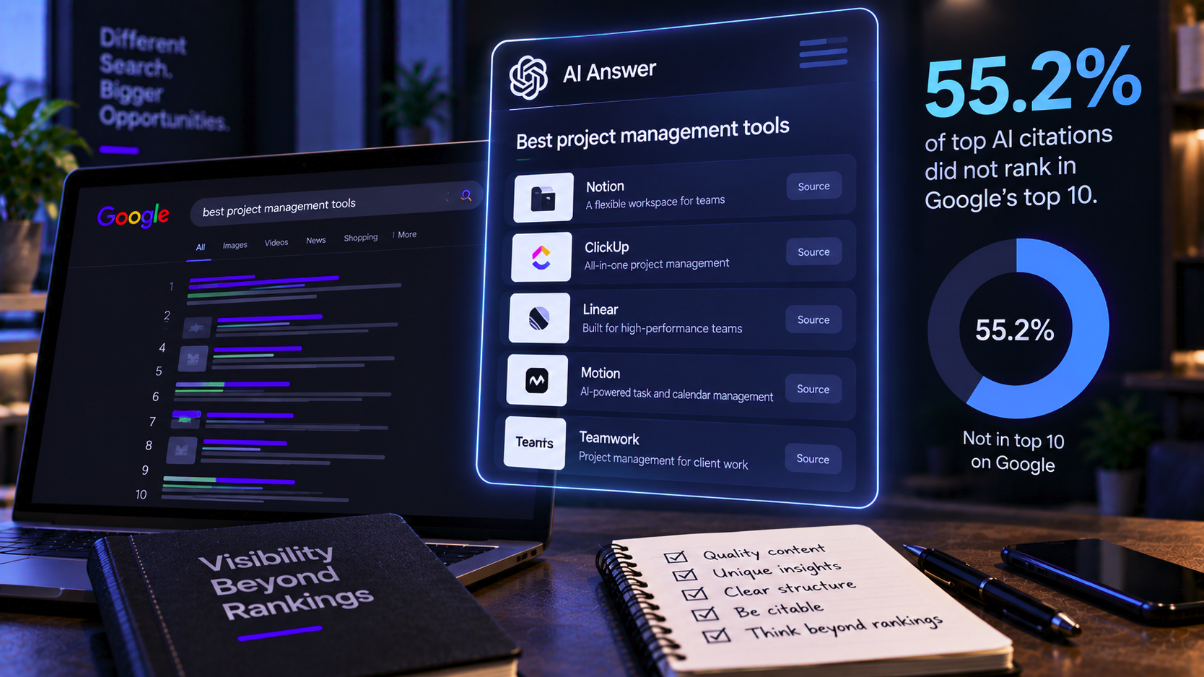
In an analysis published September 3, Rankability found that 55.2% of the pages appearing among the top 10 AI citations did not rank in the traditional search top 10 for the same queries. The research compared 1,645 AI citation observations with 916 traditional search results across 31 topics.
The finding creates an important distinction for SEO teams. Google rankings and AI citations are clearly related: pages ranking at the very top of traditional search were overwhelmingly likely to appear somewhere in AI citation sets. But traditional rank did not determine which sources AI systems elevated most prominently.
That means the emerging AI-search landscape is neither a replacement for SEO nor a simple copy of Google’s first page. It is a second source-selection layer with substantial overlap, but also substantial independence.
More than half of the top AI citations came from outside the traditional top 10
Rankability’s 2026 AI search statistics study examined 310 citations that appeared within the first 10 AI citation positions. Of those, 108 pages had no observed traditional ranking in the measured results and another 63 ranked below position 10.
Together, those groups accounted for 55.2% of the top AI citations.
Only 29.1% of the exact pages appeared in both the AI and traditional result sets for the same query. That is a much smaller overlap than marketers might expect if they assume generative engines simply retrieve the first page of conventional search and summarize it.
The data instead suggests that AI systems can reach beyond the traditional top 10 and surface pages that would receive relatively little visibility in a normal search session.
But high Google rankings still dramatically improve the odds of being cited
The same dataset contains a result that prevents the study from becoming an argument that Google rankings no longer matter.
Rankability found that 98.9% of pages ranking in traditional positions one through three were cited somewhere by the AI systems it studied. Across the full traditional top 10, the inclusion rate remained 90%. Outside the top 10, it fell to 49.3%.
That is a strong relationship. Pages that perform well in traditional search appear much more likely to enter the AI citation pool.
The divergence appears after that initial inclusion step. Only 44.8% of traditional top-10 pages also appeared among the first 10 AI citations.
In other words, Google rank seems to improve the chance of being considered, but it does not guarantee a similarly prominent citation position in an AI answer.
Discovery and source selection are different problems
This distinction helps explain why SEO and generative-engine optimization can overlap without becoming identical disciplines.
A high-ranking page is easy to discover. Search engines have already crawled, indexed and evaluated it, and some AI retrieval systems may rely directly or indirectly on conventional search infrastructure.
But an AI answer has another task after retrieval: selecting which sources are useful for constructing a response. A page that ranks first for a broad keyword may not contain the most extractable evidence for a specific conversational question. A lower-ranking page may provide a better comparison table, an original statistic, a clearer definition or a more direct answer.
The result can be a source set that draws partly from familiar organic winners and partly from pages that traditional search placed much lower—or did not surface in the measured results at all.
AI platforms do not agree with each other either
The fragmentation extends beyond the difference between AI and traditional search. Rankability found that no pair of AI platforms in its study shared more than 24.1% of the pages they cited.
Brave AI and Claude produced the highest observed overlap at 24.1%. Other pairs diverged even more.
This matters because “AI ranking” can sound like a single new leaderboard replacing Google. The data suggests something much messier. A page can be highly visible in one answer engine and absent from another because the systems use different retrieval mechanisms, source pools and answer-generation behavior.
That fragmentation makes a universal AI position difficult to define. There is no obvious equivalent of saying a page “ranks number three in AI” without specifying the platform, prompt, geography, model and time of measurement.
ChatGPT appeared especially independent of measured organic rankings
Rankability’s broader research also compared how individual AI platforms used pages without an observed organic ranking.
In an earlier dataset of 2,824 AI citations, sources without a measured organic ranking represented only 12.2% of Perplexity citations but 77% of ChatGPT citations. Other platforms fell between those extremes.
Perplexity’s results most closely resembled Google in that snapshot, while ChatGPT did not closely match any measured search index.
The researchers caution against turning those percentages into permanent platform rules. AI products change models, retrieval providers and ranking systems rapidly, and a single measurement period cannot establish their future architecture.
Still, the contrast reinforces the larger point: optimizing for one search index cannot be assumed to reproduce the same visibility across every generative engine.
The study found a second path to prominent AI citations: repeated usefulness
Pages that were cited across many different searches were much more likely to appear among the top AI citations.
Rankability found that pages cited across eight or more queries had a 43.3% top-10 AI citation rate. Pages cited for only one query had a 15.5% rate.
The frequently reused pages also appeared across an average of 3.33 AI platforms.
This suggests that AI visibility may reward pages with broad utility inside a topic rather than pages engineered for one exact keyword. A resource that repeatedly answers related questions can become useful across multiple retrieval contexts.
That does not mean every page should become an enormous guide. It means topic coverage and information density can matter in ways that are not captured by a single keyword position.
Thorough topic coverage nearly doubled the top-citation rate
The content analysis supports that interpretation. Pages with thorough topic coverage reached a 27.6% top-10 AI citation rate, compared with 14.5% for pages with weaker coverage.
The difference is important because it moves the discussion beyond technical AI tricks. A page may become more citable simply because it contains the information an answer engine needs to support a response.
For publishers, that means examining whether an article answers the natural follow-up questions around its subject, provides concrete evidence and explains relationships clearly enough for individual claims to stand on their own.
A narrowly optimized page can rank for a keyword while still leaving information gaps that send an AI system elsewhere for supporting sources.
Page-level backlinks were not a prerequisite for citation
Another finding challenges a common assumption imported from traditional SEO. Rankability reports that 72.8% of AI-cited pages in the study had no page-level referring domains.
That does not mean backlinks are irrelevant. Domain authority, discovery and the broader reputation of a publisher can still be connected to link signals, and the study does not isolate causality.
But the result shows that an individual URL did not need an obvious page-level backlink profile to enter the AI citation set.
This creates opportunities for newer pages containing original or highly specific information. They may not yet have accumulated the link history required to compete at the top of a difficult traditional SERP, but they can still provide useful evidence to a retrieval system.
AI search may expand the value of second-page content
Traditional search has historically imposed an enormous visibility penalty on pages outside the first page. A result at position 14 can technically be relevant and indexed but receive only a fraction of the attention given to the first few listings.
Generative search can change that distribution because users do not manually scan the source list before the answer is assembled. The retrieval system can choose a lower-ranking page on the user’s behalf.
That creates a new form of upside for publishers. Content that is strong enough to be indexed and understood but not strong enough to win a competitive top-10 organic position may still contribute to an AI answer.
The 55.2% figure is evidence that this is already happening in Rankability’s sample.
This does not make traditional SEO optional
It would be easy to turn the study into a dramatic claim that Google rankings no longer matter. The data says the opposite.
Traditional positions one through three had a 98.9% AI citation inclusion rate. The full top 10 had a 90% inclusion rate. Those are extraordinarily strong numbers.
Technical crawlability, indexing, internal linking, content quality, authority and other familiar SEO fundamentals continue to create the conditions under which pages can be discovered and trusted.
The new requirement is to stop treating a first-page ranking as the final measurement of visibility.
A page can rank well and receive little prominent AI exposure. Another can sit outside the top 10 and become one of the answer engine’s preferred sources. Both outcomes now need to be measured separately.
SEO teams need two scoreboards
The operational consequence is straightforward. Search teams should continue monitoring rankings, impressions, clicks and organic conversions, but they also need visibility into AI citations across the prompts that matter to their business.
Those measurements answer different questions.
Traditional rank shows whether a page wins placement in a search engine’s ordered results. AI citation monitoring shows whether generative systems select that page as evidence while constructing answers.
The two can reinforce each other, but Rankability’s data shows that neither can reliably stand in for the other.
The opportunity is larger than the first page
The most useful conclusion from the 55.2% statistic is not that brands should stop trying to rank. It is that the addressable visibility surface has expanded.
For decades, SEO strategy was dominated by a brutal threshold: get into the top 10, ideally the top three, or expect dramatically less exposure. AI retrieval can reach beyond that threshold and elevate sources users might never have found by scrolling through ordinary results.
That creates a second route to discovery for useful pages, original research and specialized publishers that do not control the first page.
Google rankings still matter enormously. Rankability’s own numbers make that clear. But the fact that 55.2% of top AI citations came from outside the traditional top 10 shows why rankings can no longer describe the entire search visibility landscape.
The first page is still premium real estate. It is simply no longer the boundary of what can become a source.