
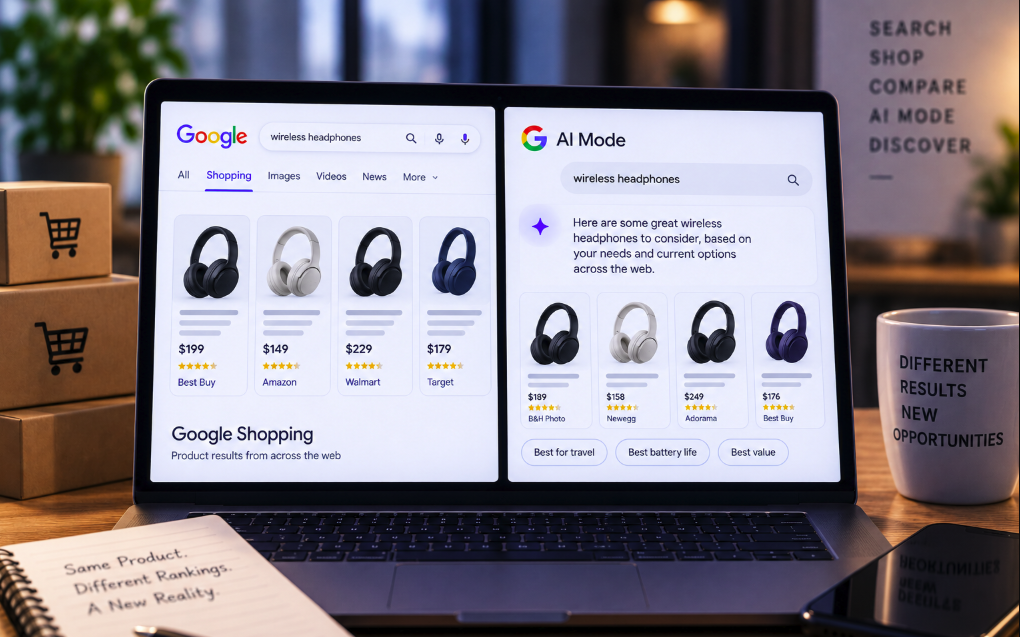
A strong position in Google’s familiar shopping results may tell retailers surprisingly little about whether the same product will appear in AI Mode. New research tracking more than two million product listings found an exceptionally small overlap between products surfaced in Google’s Popular products carousel and those selected by AI Mode for the same shopping queries. For ecommerce teams accustomed to treating Google Shopping visibility as one connected ecosystem, the findings suggest that AI-driven product discovery is developing its own selection dynamics.
Search Engine Journal reported on data from Productrise showing that only 1.28% of products appearing in the traditional carousel also appeared in AI Mode for the same query on the same day. Among the relatively small set of products that did appear in both environments, the first-listed seller was different 49.6% of the time. Google has not verified the study’s claims and has emphasized that both AI Mode and traditional shopping results are powered by the same Shopping Graph.
Two million listings reveal two very different product sets
The Productrise study tracked more than two million product listings across more than 100,000 conventional search results and AI Mode responses between August 9 and August 31, 2026. Researchers ran the same product-focused queries through both experiences on the same calendar day in the United States and United Kingdom, then matched products using Google’s product identifiers where available.
The comparison was deliberately specific. On the traditional search side, Productrise analyzed listings from the Popular products carousel rather than every shopping module on the page. On the AI Mode side, it examined the product cards displayed in generated answers. The query sample was primarily based on products monitored by the company rather than a random sample of all Google searches, an important limitation when interpreting the results.
Even with those caveats, the difference in selection is striking. When both surfaces returned products, the traditional carousel displayed an average of 27.8 products while AI Mode displayed just 3.9. Productrise calculated a daily overlap rate of 1.28%, meaning that ranking in the carousel was a very weak predictor of appearing among AI Mode’s much smaller product set in this dataset.
The same Shopping Graph does not mean the same rankings
The result initially seems counterintuitive because Google says both experiences draw from the same underlying commerce infrastructure. In a response quoted by Search Engine Journal, Google said it had not verified the accuracy of the study but noted that shopping results across Google Search, including AI Mode and the search results page, are powered by the same Shopping Graph. Google also pointed out that shoppers can open a product listing to compare prices across retailers.
That clarification helps define the issue. A shared data source does not require identical selection or ranking logic. The Shopping Graph can provide information about products, sellers, prices and other commercial attributes while different Google interfaces decide which subset of that information to present. Traditional product results are designed around browsing and comparison at scale; AI Mode has far less screen inventory and is built around a generated response that interprets the shopper’s request before presenting a narrower set of recommendations.
For merchants, that distinction is critical. Optimization practices that improve visibility in conventional shopping modules may remain valuable, but they cannot be assumed to transfer directly into AI Mode. If an ecommerce team monitors only carousel positions, it may believe a product has excellent Google visibility while missing the fact that the same item is rarely being surfaced in conversational shopping experiences.
Seller selection changes almost half the time
The product overlap figure is only one part of the study. Even when AI Mode and the carousel selected the same product, they frequently disagreed about which merchant to show first. Productrise found a different lead seller in 49.6% of matched cases. That means product-level visibility and merchant-level visibility are separate competitive problems: getting the item selected does not guarantee that a retailer’s offer becomes the one a shopper sees first.
Prices also diverged. The first-listed price differed on 38.1% of matched products, and when the two prices were different, AI Mode displayed the higher price 68.4% of the time. Across all matched products, Productrise calculated that the AI Mode price was 21.6% higher on average, although the company notes that outliers—including comparisons involving used versus new items—affected the average. When AI Mode was the more expensive side, the median difference was 22.2%.
Those findings do not prove that AI Mode intentionally prefers more expensive merchants. The study observes what Google displayed; it does not reveal the ranking system’s weighting or why a particular seller was chosen. Search Engine Journal similarly notes that the data cannot show whether shoppers ultimately purchased at the first displayed price because clicks and transactions were not part of the dataset.
Price may be only one signal in a conversational decision
The seller and price discrepancies point toward a broader question about what AI shopping optimization actually means. Traditional comparison shopping naturally gives price enormous visual importance. AI Mode, by contrast, is designed to interpret a more detailed request. A shopper can ask for a product that fits a particular scenario, feature set, compatibility requirement or personal preference, creating a selection problem in which the cheapest offer may not be the only relevant variable.
Productrise founder Hugo Huijer interprets the data as a sign that lowest price may carry less weight in AI Mode, but the study does not directly test Google’s ranking factors. Other possibilities include product-data completeness, availability, merchant information, variant matching, freshness or differences in how the two interfaces assemble their result sets. Without access to Google’s ranking systems, the data can establish divergence but not its cause.
For retailers, the safest conclusion is therefore not that price no longer matters. It is that competing on price alone may be insufficient for AI visibility. Rich, accurate product feeds become more important when an AI system must understand whether an item satisfies a nuanced request rather than merely determine whether it belongs in a broad product category.
Ecommerce SEO now needs surface-specific tracking
The study strengthens the case for measuring AI Mode independently from traditional shopping rankings. If overlap can be as low as the Productrise dataset suggests, aggregating both experiences into a general idea of “Google visibility” hides meaningful differences. Retailers need to know which products AI Mode selects, which seller it leads with, what price it displays and whether those choices remain stable over time.
This is particularly relevant as Google develops AI-specific commerce reporting. Merchant Center’s AI Performance Insights can show how brands appear in AI Mode and AI Overviews through metrics such as AI impressions and share of voice, but current reporting does not expose every seller-selection and price detail needed to diagnose an individual product recommendation. Manual checks and specialized tracking may therefore remain necessary for merchants that want a product-level view.
Feed quality should also be treated as an AI discovery asset rather than a back-office requirement. Complete titles, descriptions, identifiers, attributes, availability and consistent pricing give Google more reliable information with which to match products to detailed shopping intent. The more conversational the query becomes, the more valuable precise attributes can be: material, dimensions, compatibility, intended use and other specifics may help distinguish one otherwise similar product from another.
AI Mode is not simply Google Shopping with an answer on top
The most important implication of the research is conceptual. It is tempting to imagine AI Mode as a new presentation layer over the same rankings merchants already understand. The observed 1.28% daily product overlap challenges that assumption. In this dataset, AI Mode behaved less like a condensed version of the Popular products carousel and more like a distinct discovery surface drawing from the same underlying commercial universe.
That creates both risk and opportunity. Brands that dominate traditional shopping results cannot assume their advantage will automatically carry into AI conversations. At the same time, merchants that struggle to win the conventional carousel may have another route to visibility if their products and offers align well with the context AI Mode is trying to satisfy.
The study is a snapshot of a rapidly evolving Google experience, not a permanent ranking rule, and its non-random query set means the exact percentages should not be generalized to every retail category. But the direction is difficult to ignore. As AI Mode becomes a more prominent shopping interface, ecommerce SEO will need to track two questions separately: what ranks in Google Shopping, and what Google’s AI actually chooses to recommend.