
PagePilot.ai had a problem that would have sounded contradictory a few years ago: its SEO was working, but AI search barely seemed to notice.
The Shopify landing-page platform entered a three-month optimization project with established Google rankings, a substantial content library and stable organic traffic. Yet according to a new OtterlyAI case study, very little of that existing search visibility was translating into citations inside AI-generated answers.
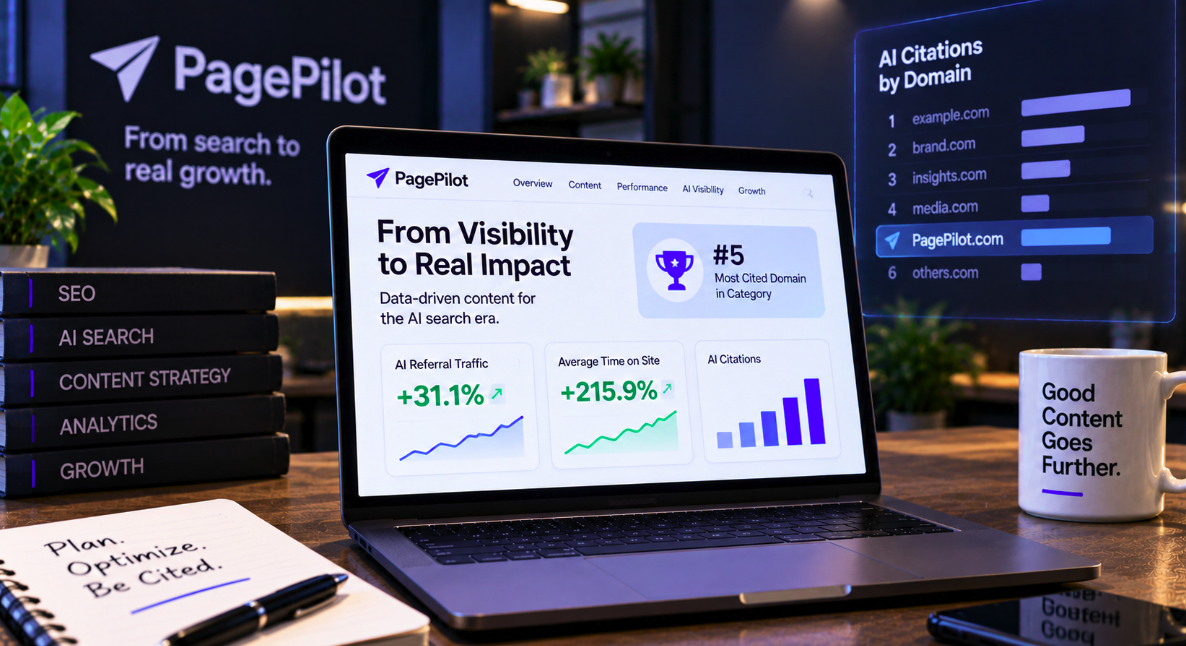
Three months later, PagePilot held a 3% share of tracked category citations and ranked fifth among the most-cited domains in the monitored competitive set. AI chat referral sessions rose 31.1% month over month in June 2026, while visitors arriving from AI referrals spent 215.9% more time on the site on average.
The case study is not proof that traditional SEO has stopped mattering. In fact, PagePilot’s conventional search performance improved during the same period. What it does illustrate is a distinction marketers increasingly need to make: ranking in Google and being selected as a source inside AI answers are related visibility problems, but they are not the same outcome.
PagePilot started with SEO strength, not an SEO disaster
The work was carried out by SORN.AI, an agency that combines content, technical SEO, link building and generative-engine optimization. Its strategists described PagePilot as a site that already had many conventional SEO fundamentals in place.
The site was not invisible to search engines. It had content and rankings, and AI platforms were already sending a small amount of traffic—roughly 0.7% of organic sessions, according to the case study. About 89% of that AI referral traffic came from ChatGPT.
The problem was stagnation. Search Console and Ahrefs performance had plateaued, while the brand was not appearing in AI answers at the level the agency expected from its existing organic footprint.
That starting point makes the case more interesting than a simple technical rescue. SORN.AI was not taking a blocked or unindexed website and making it visible. It was trying to convert existing search authority into a different kind of visibility.
The agency identified three gaps between SEO and AI visibility
According to the case study, SORN.AI initially focused on three issues. AI systems were not resolving PagePilot cleanly as a brand entity, the content lacked FAQ sections, and the company’s headless CMS did not provide structured data.
The agency also considered the existing articles too dense. Large blocks of prose may work for a human reader willing to move through a long page, but SORN.AI believed the information was not being parsed as effectively as it could be for answer-oriented retrieval.
That diagnosis should not be mistaken for a documented rule from OpenAI, Google or Perplexity. The case study reflects the agency’s interpretation of what it observed while working with one client. No AI provider has confirmed that adding an FAQ section or a comparison table automatically increases citation probability.
Still, the underlying principle is straightforward: if a page contains useful information, presenting that information in explicit, well-labeled sections can make the answer easier for both humans and machines to identify.
Existing high-performing pages were optimized before new content was scaled
One of the more practical decisions in the project was sequencing. Rather than immediately publishing a large library of new GEO content, SORN.AI began with pages that already performed well.
The agency treated new comparison and pricing pages as a longer three-to-nine-month investment while rewriting existing assets for faster feedback.
The changes were deliberately answer-oriented. Pages began answering the target question earlier instead of building toward the conclusion. Long passages were broken into clearer sections. Comparison tables were added. Weaknesses were discussed openly rather than presenting PagePilot as universally superior. Prompts being monitored in OtterlyAI were adapted into H2 headings and FAQ questions where they fit the page.
The strategy effectively treated a strong ranking page as raw material rather than a finished asset. A page could already satisfy Google’s traditional ranking system while still being reformatted to make its useful claims easier to extract in conversational search.
Structured data was added because the headless CMS supplied none
PagePilot’s headless setup did not automatically provide the structured data SORN.AI wanted, so the agency implemented custom FAQ markup.
The agency says one of its first leading indicators after adding structured data was increased appearance in Google AI Overviews, followed by more LLM citations.
That sequence is interesting but should be interpreted cautiously. Several interventions were happening during the same engagement, including content rewrites, entity work and off-page activity. The case study does not isolate FAQ schema in a controlled experiment, so it cannot establish that structured data caused the subsequent citation growth.
Structured data can make information more explicit to systems that support the relevant vocabulary. It should therefore be accurate and consistent with visible page content. But marketers should resist converting one client sequence into a universal “add FAQ schema, get ChatGPT citations” formula.
Off-page work reinforced the same claims
SORN.AI did not treat the website as the only source AI engines might use. The campaign also pursued community placements and listicles intended to support the same claims made on PagePilot’s own pages.
This reflects a central challenge of AI recommendations. A company can describe itself perfectly on its own website, but an answer engine may prefer independent sources when comparing vendors or recommending products.
Brand-owned pages explain what the company says it does. Third-party discussions, reviews, comparisons and community references can provide corroboration.
The agency therefore used OtterlyAI’s citation data to identify sources already appearing in AI answers and inform off-page work. The objective was not simply to accumulate links in the traditional SEO sense, but to increase PagePilot’s presence in the source environments that answer engines were already using.
After three months, PagePilot reached fifth place in tracked citations
OtterlyAI reports that PagePilot reached a 3% citation share across the prompts being tracked for its category. That placed pagepilot.ai at No. 5 among the most-cited domains in the monitored set and moved the brand into the Leaders quadrant of OtterlyAI’s Brand Visibility Index against four tracked competitors.
The exact percentage is important context. “Fifth most cited” sounds dominant in isolation, while a 3% citation share shows that the underlying answer ecosystem remained fragmented. PagePilot improved its relative position without controlling anything close to a majority of citations.
That is typical of AI-search measurement. A brand’s competitive rank can move significantly even while individual answers continue to draw from a wide range of publishers, communities, software directories and other sources.
AI referral traffic rose 31.1%, but from a small base
In June 2026, AI chat referral sessions increased 31.1% month over month. The case study also says average time on site from those visitors increased 215.9%, nearly tripling.
Those engagement numbers are encouraging, but the baseline matters. Before the campaign, AI platforms accounted for roughly 0.7% of PagePilot’s organic sessions. A large percentage increase from a small channel does not suddenly make AI referrals comparable with Google organic traffic.
The more interesting signal may be visitor quality. If the 215.9% increase in average time on site persists across larger volumes, it could indicate that users arriving after an AI-assisted recommendation have stronger intent or more context before clicking.
One client month is not enough to establish that as a general behavior, but it is a metric worth monitoring alongside raw AI referral counts.
Google performance improved at the same time
The campaign did not trade traditional SEO for AI visibility. Organic traffic increased 27%, average Google position improved from 9.9 to 6.3, and click-through rate rose 2.2 percentage points to 19.4% in the same period described by the case study.
That overlap complicates any attempt to separate “SEO” from “GEO” into two completely independent disciplines.
Many of the changes SORN.AI made—clearer page structure, stronger answers, useful comparison content, entity clarity and better technical implementation—can plausibly benefit ordinary search as well as AI retrieval. Conversely, stronger Google visibility may increase the opportunities for some AI systems to discover a source.
The important distinction is not that the two channels have nothing in common. It is that success in one did not automatically guarantee success in the other at PagePilot’s starting point.
A high Google position is not the same thing as source selection
Traditional search asks a familiar question: where does this URL rank for a query? AI search introduces another one: which sources does the system choose while constructing its answer?
An answer engine can retrieve multiple documents, synthesize claims and cite only a subset. It may use third-party comparisons for a recommendation, an official site for product specifications and a community discussion for user experience. Different engines can choose different source mixes for the same prompt.
A page ranking well in Google therefore has an advantage in discoverability but not an entitlement to an AI citation.
This is why PagePilot’s initial state matters. The site already had enough SEO strength to rank, yet the agency still found gaps in how the brand and content were represented inside conversational answers.
Prompt research changed what the team optimized for
SORN.AI describes prompt research as distinct from conventional keyword research. Keywords reveal what people type into search boxes; prompts can expose the longer conversations and decision questions users bring to AI assistants.
That difference is especially relevant for SaaS products. A buyer might Google “Shopify landing page builder,” but ask ChatGPT, “What tool should I use to create Shopify product pages quickly without a developer, and what are the tradeoffs?”
The second query contains a use case, constraints and an implied comparison. A page optimized only around the head keyword may rank while failing to provide a concise answer to the broader decision.
SORN.AI used OtterlyAI to build a prompt universe from PagePilot’s ideal customer profile, then manually added bottom-of-funnel prompts. Those questions influenced headings and FAQ content on the site.
Entity clarity became a prerequisite, not a cosmetic exercise
The agency also emphasizes entity resolution: helping systems connect a brand name with the correct company, product category and context.
This can matter for newer or ambiguous brands. A name is simply a text string until enough contextual signals connect it with a specific organization and set of attributes. If an answer engine is uncertain about which entity a name represents, recommendation visibility can become inconsistent.
SORN.AI says two of five additional accounts it discussed in the case study required entity fixes before other work. Another account had an AI crawler blocked, a problem discovered before content production began.
Those examples reinforce a useful diagnostic principle: low AI visibility is not always a content problem. Technical access, entity ambiguity, competitive source coverage and answer formatting can all produce different failure modes.
The case study does not prove one GEO tactic caused the gains
There is an important methodological limitation. This was a client engagement, not a randomized experiment.
SORN.AI changed multiple variables over the same three-month period: page copy, headings, FAQs, comparison tables, structured data, entity signals and off-page placements. Traditional SEO performance was also changing. Without a control group or isolated interventions, the study cannot say how much of the citation growth came from any individual tactic.
OtterlyAI itself publishes a research methodology that stresses the need to distinguish observed results from claims that can be generalized universally. That caution is particularly appropriate for agency case studies, where the goal is usually to improve the client rather than hold every other variable constant for scientific measurement.
The strongest conclusion is therefore observational: PagePilot had solid search performance but weak tracked AI visibility; after a coordinated three-month program, both AI citations and several business/search metrics improved.
AI visibility needs its own measurement layer
If PagePilot had monitored only Google rankings, the initial AI gap might have remained invisible. That is the operational lesson behind the case study.
Teams now need to know not only where pages rank but whether their brands appear in AI answers, which domains receive the citations, which URLs are repeatedly selected and how those patterns differ across engines.
OtterlyAI’s own citation-tracking product is built around that premise, comparing citation winners and losers at domain and URL level. The vendor obviously has a commercial interest in expanding this measurement category, but the underlying analytics problem exists independently of any particular tool.
Google Search Console cannot tell a marketer whether Perplexity cited a competitor’s comparison page or whether ChatGPT repeatedly used Reddit instead of the brand’s own documentation. Conventional SEO dashboards were not designed for that question.
Strong rankings should be treated as an asset, not the finish line
PagePilot’s experience does not support abandoning SEO for a new acronym. Its organic traffic rose during the campaign, and many of the improvements made for AI readability were compatible with ordinary search quality.
Instead, the case suggests that established rankings are a strong starting asset. Pages already earning visibility have authority, history and audience demand. They can be audited for whether their answers are explicit enough, whether key comparisons are easy to extract, whether the brand is clearly defined and whether external sources corroborate important claims.
That approach is less wasteful than assuming every company needs hundreds of new “AI-optimized” articles.
Google visibility and AI citations are becoming two separate scoreboards
For years, a high Google ranking was one of the clearest proxies for online discoverability. It remains enormously important, but conversational search has created another scoreboard beside it.
PagePilot entered SORN.AI’s engagement with respectable rankings and almost no corresponding citation presence in AI answers. Three months later, it ranked fifth among tracked cited domains in its category, AI referral sessions were up 31.1%, and average time on site from those referrals had risen 215.9%.
Those figures come from a single vendor case study and should not be turned into a universal GEO formula. They do, however, illustrate the practical problem clearly.
A page can rank. A brand can have organic traffic. Google can understand the site well enough to place it on page one. And an AI answer can still choose somebody else as its source.
That is why the next generation of search strategy will need to measure both outcomes: whether people can find you in traditional search, and whether the systems answering their questions consider you worth citing.