
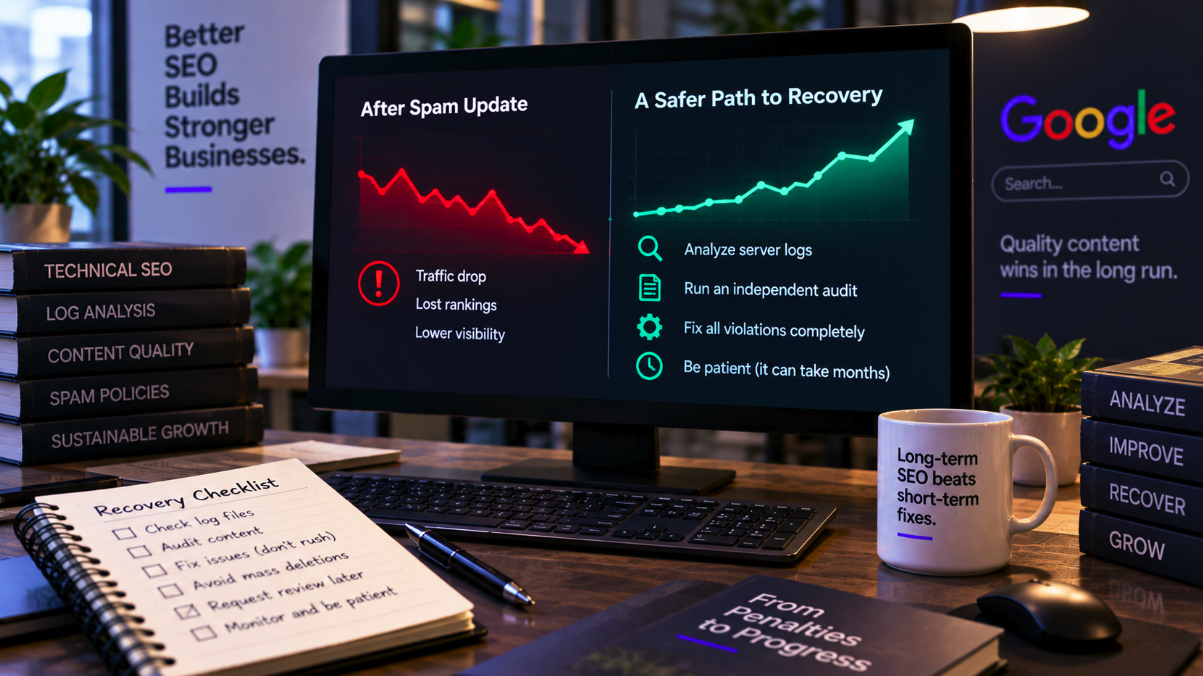
A severe Google ranking loss creates exactly the conditions in which bad recovery decisions become tempting. Revenue drops, executives want an explanation, SEO teams feel pressure to show immediate action, and deleting large amounts of content can look more decisive than spending days establishing what actually went wrong.
That instinct can make the problem harder to solve. In an analysis published September 9, former Google Search Quality team member and penalty specialist Kaspar Szymanski argues that websites affected by Google’s August 2026 spam update or a manual spam action should resist rushed remediation. His recommended sequence is diagnostic rather than reactive: crawl the site, examine server logs, commission an independent audit, identify the complete compliance problem and only then implement changes.
For sites facing a manual action, he is particularly cautious about reconsideration requests. Submitting one before the underlying violations have been fully addressed can result in rejection and make an already expensive recovery process more difficult.
This is not a new Google recovery directive. It is Szymanski’s professional analysis based on penalty work and his previous experience inside Google. But it aligns with a basic principle in Google’s own documentation: sites need to address policy problems before asking Google to reconsider an action.
First determine whether the problem is an update or a manual action
One of the first recovery mistakes is treating every dramatic ranking decline as the same event. An algorithmic visibility loss that coincides with a spam update is not identical to a manual action issued after human review.
Google’s current spam policies say policy-violating practices can be detected through automated systems and, when appropriate, human review. Human review can result in a manual action, and affected site owners are notified through Search Console.
A manual action therefore gives the publisher a specific policy signal to investigate. An update-related decline may require a broader diagnosis because Search Console does not necessarily provide a message identifying one discrete violation behind an automated ranking change.
Szymanski’s article discusses both situations, but recovery procedures should not blur them together.
Correlation with the August spam update is a starting point, not a diagnosis
When rankings collapse during a confirmed Google update, timing is valuable evidence. It does not reveal the exact cause by itself.
Szymanski argues that content quality appears to be an important issue for sites affected by the August 2026 spam update, and he points to insufficient human oversight as a likely problem where large publishing operations have allowed quality to deteriorate over time.
That should be framed as expert analysis rather than an official Google statement about the update’s internal targeting. Google has not published a rule saying the August update specifically penalizes AI-generated content, nor does Szymanski make that simplistic claim.
Google’s spam policies focus on manipulative behavior and policy violations rather than declaring content unacceptable merely because AI participated in its production. Automated, spun and low-value content problems also predate modern generative AI.
The recovery question is therefore not “Was AI used?” but “What does the site actually publish, how is it produced, and does it comply with Google’s policies?”
Mass deletion is attractive because it looks like action
After a traffic collapse, large-scale deletion can feel like the fastest route to demonstrating improvement. If thin or questionable pages appear to be the problem, removing thousands of URLs seems more decisive than conducting a forensic review.
Szymanski warns against that response when it happens before diagnosis.
A site can contain weak pages alongside useful pages, technical inconsistencies, paid-content issues, historical sections with different editorial standards and templates that generate unintended crawlable URLs. Deleting content wholesale can destroy legitimate assets without proving which signal caused the visibility loss.
It can also complicate later analysis. Once pages, links and internal relationships have been removed, the team has changed the evidence it is trying to investigate.
The safer sequence is to understand the failure first, then make targeted changes that address it completely.
Server logs can show what SEO dashboards cannot
Szymanski recommends crawling the affected site and analyzing server log files as an early investigative step. Logs provide a direct record of requests reaching the server and can reveal how crawlers interacted with different sections before and after a major ranking event.
That information can expose patterns that a normal rank tracker or site crawler cannot reconstruct. A section may have experienced unusual Googlebot activity. Large numbers of parameterized or low-value URLs may be consuming crawl attention. Important areas may be returning unexpected response codes or behaving differently for crawlers.
Google’s own documentation confirms that Googlebot activity can be examined through crawl information and server requests. The Googlebot documentation also explains how site owners can verify genuine Googlebot traffic rather than trusting a spoofable user-agent string.
Logs do not reveal Google’s ranking algorithm, but they can help reconstruct what Google was able to access and when.
An independent audit can reduce institutional blind spots
One of Szymanski’s more provocative recommendations is to have the investigation performed by an independent third party rather than relying exclusively on the team responsible for the website.
His reasoning is conflict of interest. The developers, editors, SEO specialists or commercial teams who built the current system may be poorly positioned to identify assumptions that have become normalized internally.
A content operation might consider a publishing practice standard because it has used it for years. A technical team may know why an unusual architecture exists and therefore overlook the fact that it creates undesirable crawl behavior. A commercial team may be reluctant to challenge a profitable advertiser arrangement even if it creates policy risk.
Independence does not guarantee a correct diagnosis, but it can force the site to defend practices that otherwise go unquestioned.
Recovery may require fixing the business model, not just the pages
Szymanski stresses that some spam-policy problems cannot be repaired through cosmetic SEO changes.
A site can operate successfully for years with a model that later conflicts with Google’s policies or becomes more exposed as enforcement changes. His example is the mixing of editorial and paid content, where commercial relationships can create structural issues that are not solved by rewriting titles or removing a few links.
This is an important distinction between optimization and compliance.
If the underlying incentive keeps generating the same type of problematic content, deleting yesterday’s URLs only creates space for tomorrow’s versions. Sustainable recovery requires changing the process that produced the violation.
A reconsideration request is not the first recovery step
For manual actions, urgency often pushes publishers toward the reconsideration form as quickly as possible. Szymanski argues that this reverses the correct order.
The request should come after remediation, not before it.
Google’s official spam documentation says sites notified about relevant actions have an opportunity to address the issue and submit a reconsideration request. The purpose is not to ask Google what should be fixed before the work begins; it is to have Google reassess the site after the publisher believes the policy problem has been resolved.
Szymanski warns that premature submissions can be rejected and says repeated failures can make later attempts more difficult and costly. That latter point reflects his professional experience rather than a published Google rule imposing an escalating penalty for rejected requests.
The operational lesson is still sensible: do not spend the reconsideration process demonstrating that the investigation was incomplete.
Fixing only the highlighted symptom may not be enough
Szymanski argues that modern manual-action recovery requires a broader compliance review than simply removing the most obvious example associated with the Search Console notification.
If one directory exposes a policy problem, the same publishing pattern may exist elsewhere. If a paid-content arrangement caused an issue on one section, related contracts or templates may reproduce it on another. If scaled low-quality production is involved, deleting a small sample leaves the production system unchanged.
The audit therefore needs to ask whether the website is compliant as a whole, not merely whether the URL that attracted attention has disappeared.
This approach also reduces the risk of cycling through repeated partial fixes and reconsideration attempts.
Recovery can take months even after the right changes
Another source of damaging behavior is the expectation that a correct fix should produce an immediate ranking rebound.
Szymanski says recovery can take months. For algorithmic problems, Google first needs to recrawl changed pages and process the new signals. Crawl frequency differs across websites and sections, so even a technically correct remediation is not instantly reflected everywhere.
Manual actions introduce their own review process, and Szymanski notes that Google does not guarantee a universal turnaround time for reconsideration.
This lag creates a dangerous feedback loop. A team makes substantial changes, sees no recovery after a week, assumes the changes failed and starts another round of aggressive edits. By the time Google has processed the first remediation, the site has already changed again.
Patience is not a recovery tactic by itself, but it is necessary to evaluate whether a completed remediation is being recognized.
Do not confuse recrawling with restored rankings
Even after Googlebot revisits a corrected page, rankings are not guaranteed to return to their previous position.
During the period when one site loses visibility, competitors can take its place. Search results continue evolving, and the recovered site re-enters a competitive environment that may no longer look the way it did before the decline.
Szymanski emphasizes this business reality because recovery forecasts often assume a reversible switch: remove violation, regain old traffic.
Google does not promise that outcome. Remediation can remove an obstacle to ranking, but it does not freeze competitors, demand or ranking systems at the moment before the loss.
Google’s EEA changes add an important 2026 nuance
Manual actions also need to be discussed carefully in Europe because Google changed how certain spam-policy enforcement affects users in the European Economic Area.
Google’s August 2026 update to its site reputation abuse policy says manual actions under that policy have different effects depending on where the search user is located. Outside the EEA, an affected section can be directly impacted by a manual action. Within the EEA, Google says the section may instead be categorized separately from the main domain and ranked on its own merits.
Site owners can still receive Search Console notifications and use reconsideration processes, but the ranking impact is not identical in every market.
This does not invalidate Szymanski’s recovery framework. It means publishers should identify the exact policy, affected section and geographic context rather than using “Google penalty” as if it described one universal mechanism.
Prevention is cheaper because recovery is forensic work
Szymanski’s broader argument is that defensive SEO is economically easier than penalty recovery.
Regular audits can identify policy risks while rankings and revenue are still intact. Editorial governance can detect declining quality before thousands of pages accumulate. Commercial agreements can be reviewed for search-policy implications before they become embedded in the business model.
Once visibility collapses, the same work must be performed under financial pressure and with less certainty.
The site also has to separate normal ranking volatility from the suspected violation, preserve evidence, coordinate technical and editorial remediation, wait for recrawling and potentially navigate reconsideration. Prevention removes most of that emergency overhead.
Traffic diversification is part of spam-risk management
The Search Engine Land article ultimately moves beyond technical recovery into business resilience.
Szymanski argues that relying on Google Search for half or more of sales creates significant exposure. If one algorithmic or manual event can threaten cash flow, the problem is not only SEO compliance; it is channel concentration.
He recommends diversification through alternatives such as Bing, direct brand demand and, for larger publishers, potentially multiple genuinely distinct brands.
Diversification does not make spam policies less important, and creating new properties should never be used to circumvent enforcement. Google explicitly prohibits attempts to bypass spam policies through new subdomains, directories or sites.
The business objective is different: build legitimate acquisition channels so a search disruption does not become an existential event.
The fastest-looking recovery path can be the slowest
The central insight in Szymanski’s analysis is counterintuitive only because ranking losses create urgency.
Deleting thousands of pages overnight looks fast. Sending a reconsideration request immediately looks fast. Rewriting large sections before understanding the problem looks fast.
But every rushed action can remove evidence, introduce new variables or leave the actual violation untouched.
A disciplined recovery is slower at the beginning because it invests time in diagnosis. It separates algorithmic losses from manual actions, inspects crawl and log data, challenges internal assumptions, audits policy compliance and fixes the underlying system rather than merely the visible symptom.
Only after that work does a reconsideration request make sense where one is applicable.
There is no guarantee that rankings will return, and there is no universal recovery timetable. That uncertainty is precisely why the first response to a Google spam problem should not be maximum speed. When the diagnosis is still uncertain, moving faster can simply mean getting further into the wrong fix.