
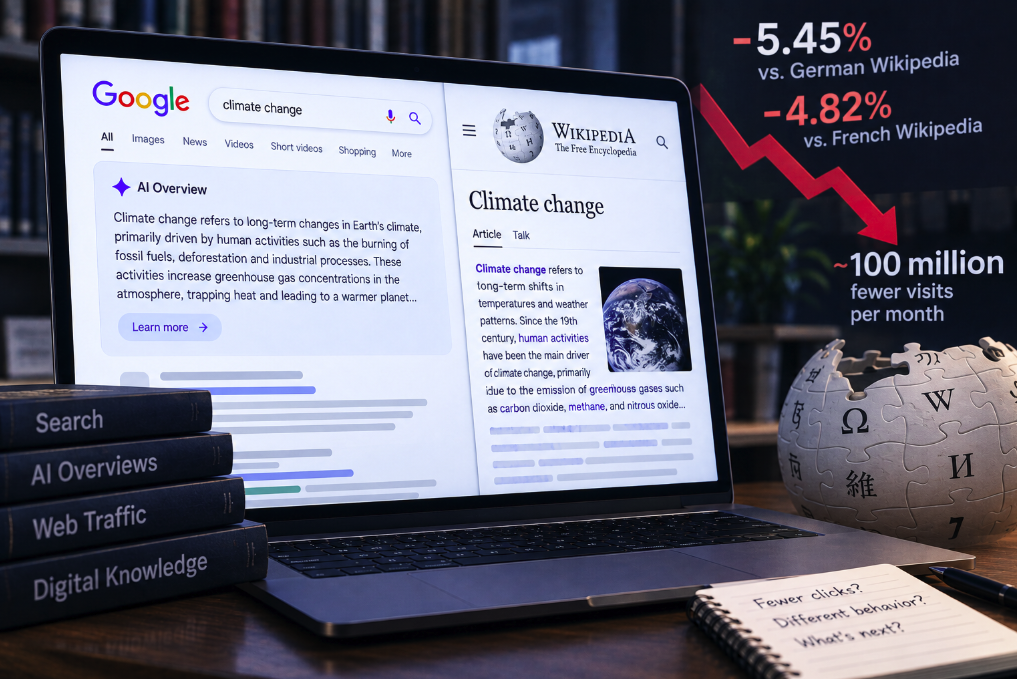
Google's AI Overviews may be diverting roughly 100 million search-originated visits from English Wikipedia every month, according to a revised University of Washington study that attempts to isolate what happened when AI-generated answers became the default Google Search experience in the United States.
The latest version of Impact of AI Search Summaries on Website Traffic: Evidence from Google AI Overviews and Wikipedia, by Mehrzad Khosravi and Hema Yoganarasimhan, estimates that default AI Overview availability reduced external-search referrals to English Wikipedia by 5.45% relative to comparable German-language articles and by 4.82% relative to French-language articles.
Brazilian technology publication UOL Tilt reported on September 4 that the researchers translate the effect into approximately 100.27 million fewer monthly visits, or about 1.2 billion visits over a year if the monthly estimate is sustained.
The number is large enough to sharpen the debate over AI search and publisher traffic, but it needs careful interpretation. The paper is preliminary and has not yet been peer-reviewed. Google disputes its methodology. And the estimate is not the same as saying that every time an AI Overview appears, Wikipedia loses 5% of its clicks.
The revised study finds a smaller effect than its first version
The current figures are particularly important because the paper has changed substantially since its initial release. An earlier version reported an approximately 15% decline using a different multilingual comparison. The revised August version instead compares English Wikipedia with German and French editions and estimates effects of 5.45% and 4.82% respectively.
Those newer estimates should supersede the earlier headline when discussing the study today. Research preprints can change as authors revise data, controls and methodology, and the difference between roughly 15% and roughly 5% is a reminder that preliminary results should not be frozen into permanent industry statistics.
The revised estimate is smaller, but it is not economically trivial. Wikipedia operates at such enormous scale that a percentage change in the mid-single digits can translate into around 100 million visits per month.
The question is whether the research design successfully isolates AI Overviews as the reason for that relative change.
The experiment uses Google's geographic rollout as a natural break
Google made AI Overviews broadly available in the United States in May 2024, while the feature was not yet default in the European control markets during the study's relevant period.
The researchers exploit that staggered rollout using a difference-in-differences design. In simplified terms, they compare how search referrals to English Wikipedia articles changed after U.S. exposure with how referrals changed for versions of the same underlying subjects in German and French.
This is stronger than simply plotting English Wikipedia traffic before and after May 2024. A raw before-and-after chart could be affected by seasonality, changing interest in topics, broader search trends or changes in Wikipedia itself. Using matched language editions attempts to provide a counterfactual for what English traffic might have looked like without the treatment.
The underlying idea is that if comparable articles move similarly before AI Overviews become default and then English search referrals diverge afterward, the rollout may explain part of that divergence.
The estimates are 5.45% against German and 4.82% against French
The revised paper reports remarkably similar results using its two European controls. English Wikipedia's external-search referrals fell by 5.45% relative to German Wikipedia and 4.82% relative to French Wikipedia after default AIO availability.
The authors interpret this as evidence that answer-producing search interfaces can substitute for visits to informational publishers. A user who receives a sufficient summary directly on the results page may no longer need to open the source page that would previously have supplied the answer.
Wikipedia is an unusually useful test environment for this question because many of the same subjects exist across multiple language editions and Wikimedia publishes extensive traffic data.
It is also an unusually important source for generative search itself. Wikipedia's concise, structured coverage of entities and informational topics makes it a natural source of factual context across the web.
About 100 million visits a month is an extrapolated effect
UOL reports that the researchers convert the estimated percentage decline into 100.27 million fewer monthly search-originated visits to English Wikipedia. Annualized, that is roughly 1.2 billion visits.
This should be described as an estimate, not as a directly observed counter showing 100 million users blocked by AI Overviews. The number represents the study's estimate of traffic that would have occurred under its counterfactual model.
That distinction is essential. Causal inference asks what would have happened in a world where the treatment did not occur, and that world cannot be observed directly. Researchers approximate it using controls and assumptions.
If those assumptions are strong, the estimate becomes more credible. If the control groups differ from the treated group in important ways around the same time, the causal interpretation becomes weaker.
This is not the click loss on searches that actually show an AI Overview
The study measures the effect of moving a search market into a default-AIO environment. It does not identify only queries where Google actually displayed an AI Overview and compare their clicks with otherwise identical queries where no overview appeared.
That matters because AI Overviews trigger on only a subset of searches. Their prevalence also changes as Google modifies when and how generative answers appear.
The resulting 5% estimate is therefore a broad market-level effect averaged across a large mixture of Wikipedia topics and searches, including many situations in which an AI Overview may never have appeared.
It should not be compared mechanically with studies reporting click-through changes conditional on a specific SERP containing an AI Overview. Those studies are measuring a different quantity.
Google says the methodology is “deeply misleading”
Google disputes the study. In a statement reported by UOL, the company called the conclusions “deeply misleading” and focused on a significant limitation in the traffic data.
The research is intended to estimate the effect of Google's AI Overviews, but Wikimedia's external-search referral measure combines traffic from search engines rather than isolating referrals from Google alone.
That creates a mismatch between the treatment and the outcome. The treatment is a Google product change, while the measured search-referral traffic also contains visits from other engines.
Co-author Hema Yoganarasimhan acknowledged that the dataset includes other search engines but argued that they represent a relatively small portion of search traffic and that the research design captures the structural break occurring with the AI Overview rollout.
The Google objection is real, but it does not automatically erase the result
Google's methodological criticism should not be dismissed. Ideally, a study estimating the causal impact of a Google interface change would observe Google referrals separately from Bing, DuckDuckGo and other engines.
At the same time, contamination from other search engines does not automatically imply that the estimated direction is false. If non-Google search referrals are relatively small and do not undergo a simultaneous treatment-specific shift that differs systematically across the language groups, they may dilute the measured effect rather than manufacture it.
The question is empirical, which is why peer review and replication matter. Researchers need to examine whether the parallel-trends assumptions hold, whether other contemporaneous changes could explain the divergence and how sensitive the estimates are to alternative samples and specifications.
The appropriate conclusion today is therefore neither “Google has definitively taken 100 million Wikipedia visits” nor “the result is invalid because the data include Bing.” It is that the revised study provides suggestive causal evidence with identifiable limitations.
English Wikipedia is not the same thing as U.S. Wikipedia
Another limitation is geographic dilution. English Wikipedia serves users around the world, while the treatment initially being studied is the U.S. rollout of AI Overviews.
UOL notes that the paper estimates roughly 40% of English Wikipedia traffic comes from the United States. Visitors in the United Kingdom, Canada, Australia and other countries also use the English edition.
This complicates the comparison because the treated language edition contains a substantial amount of traffic that was not necessarily exposed to the same Google product environment at the same time.
Again, that does not make the analysis useless. It means the treatment is imperfectly mapped onto the aggregate outcome, and readers should resist interpreting the reported percentage as a clean per-U.S.-user effect.
Wikipedia is a particularly revealing publisher
Wikipedia differs from most commercial publishers in one crucial respect: it does not depend on display advertising to monetize every additional pageview.
A loss of search traffic therefore does not translate directly into the kind of immediate advertising revenue loss a news, reference or how-to publisher might experience.
The researchers nevertheless argue that audience has value beyond advertising. Visits create visibility, recognition and opportunities for users to participate in the ecosystem that produces and maintains the underlying knowledge.
The concern is circular. Search engines and AI systems benefit from a healthy supply of high-quality source material. If answer interfaces reduce the audience and economic or social incentives supporting that source material, the upstream knowledge ecosystem can weaken over time.
The paper's publisher revenue estimate is hypothetical
The study also explores what a similar traffic decline could mean for an ad-supported publisher with Wikipedia-like traffic. UOL reports an estimated annual revenue effect ranging from approximately $10.82 million to $37.08 million under the paper's assumptions.
That figure is not lost Wikipedia revenue. Wikipedia does not operate the advertising model used in the calculation.
It is an illustrative exercise showing how the same quantity of lost pageviews could translate into money for a publisher monetizing visits through advertising.
This distinction matters because the most dramatic numbers in AI-search debates often combine measured traffic changes with hypothetical monetization assumptions. The two should be reported separately.
AI Overviews change the economic role of the search results page
Traditional search is often described as an intermediary between a question and a destination. The search engine identifies potentially useful pages, and the publisher completes the information transaction after the click.
AI Overviews can change that sequence. Google can synthesize information from several sources and satisfy more of the informational need before the user leaves the results page.
Google has argued that AI Overviews can also create valuable outbound visits. In its 2024 explanation of the feature, the company said users treat AI Overviews as a jumping-off point and that clicks from those experiences can be higher quality because users arrive with better context.
Those two mechanisms can coexist. AI answers can reduce the total number of clicks while making some of the remaining clicks more engaged. Publisher economics depend on both volume and value.
Wikipedia is exactly the kind of site most exposed to answer substitution
The mechanism proposed by the researchers is particularly plausible for concise informational needs. If a user wants a date, definition, biography summary or quick explanation, an AI-generated answer may satisfy the task without requiring deeper exploration.
That does not mean every Wikipedia query is substitutable. Complex topics, references, historical detail, tables and deeper reading still create reasons to visit the article itself.
The distinction is useful for publishers. AI-search exposure should not be analyzed only at the domain level. Different page types and intents can face radically different substitution risk.
A short factual answer may be highly compressible into a generative summary. Original reporting, proprietary data, interactive tools or deeply specialized analysis may preserve stronger reasons to click.
The study strengthens the case for measuring visibility separately from traffic
Generative search creates a reporting paradox. A publisher's information can become more visible inside a search experience at the same time that fewer users visit the publisher's website.
NetContentSEO has explored this separation in its analysis of why ranking is no longer enough for publishers operating in AI search. A page can be retrieved, understood and used as evidence without receiving the same click behavior associated with traditional rankings.
The Wikipedia study approaches the problem from the opposite direction. Instead of asking which pages are cited, it asks what happens to upstream traffic when the search interface itself becomes capable of producing answers.
Together, those questions suggest that publishers increasingly need two sets of metrics: how often their information participates in AI answers and how much direct audience those answers return.
A 5% traffic effect can matter more than a dramatic per-query CTR chart
Industry discussions often focus on individual SERP studies showing very large click-through differences when an AI Overview is present. Those figures are visually dramatic, but they do not automatically describe the total impact on a site.
A publisher cares about the aggregate effect across its full query portfolio: how often AI Overviews appear, which pages are exposed, how much click behavior changes on those searches and what happens elsewhere.
The University of Washington paper attempts to estimate that broader outcome. Its roughly 5% result is smaller than some query-level CTR studies but, because it applies across a huge traffic base, produces the headline estimate of approximately 100 million monthly visits.
For business planning, the aggregate effect can be more important than the largest percentage observed on an individual SERP type.
The revised result is also a warning about premature certainty
The history of this paper is itself instructive. The early version produced an approximately 15% estimate. The revised design now reports effects closer to 5%.
That is not evidence that the researchers did something improper. Revision is a normal part of research. It is evidence that emerging AI-search statistics should be treated as provisional when the underlying work is still changing.
SEO and publishing reports frequently turn early studies into durable benchmark numbers without checking whether later versions changed the sample, methodology or result.
For AI search in particular, where interfaces, rollout geographies and measurement systems are all moving quickly, version control should become part of responsible reporting.
The next test is whether the finding survives peer review and replication
The paper has been submitted for academic publication but has not yet completed peer review. That leaves several important questions open.
Researchers can test alternative control groups, narrower geographic measures and datasets that isolate Google referrals more directly. They can examine whether effects persist as AI Overviews expand to the former control markets. They can also study heterogeneity by topic to determine which kinds of informational pages lose the most traffic.
Replication using other large publishers would be especially valuable. Wikipedia's scale and multilingual structure make it unusually suitable for causal research, but those same characteristics mean its results should not automatically be generalized to ecommerce, news, SaaS or local-search sites.
A credible industry estimate will ultimately require multiple datasets measuring different publisher models.
The 100 million figure is a warning, not a settled verdict
The revised University of Washington study offers one of the clearest attempts yet to move the AI-overview traffic debate beyond simple correlation. Its difference-in-differences design estimates that default AIO availability reduced English Wikipedia search referrals by 5.45% relative to German Wikipedia and 4.82% relative to French Wikipedia, an effect the authors translate into roughly 100 million visits per month.
Those numbers deserve attention because they suggest that answer-first search can reallocate audience at enormous scale even when the percentage effect looks modest.
They also deserve caution. The outcome mixes search engines, English Wikipedia is not geographically identical to the U.S. treatment group, the study measures a default-AIO environment rather than individual overview impressions, Google disputes the methodology and the paper has not yet been peer-reviewed.
The strongest conclusion is therefore narrower than the headline. There is increasingly serious evidence that generative search can reduce upstream informational traffic. How large that effect is, which publishers bear it and whether the remaining visits become more valuable are questions the industry still needs better data to answer.